Multi-Agent Systems for Business: A Breakthrough in AI Operations

Today, as enterprises must handle increasingly complex processes, rigid pre-programmed scripts are no longer flexible enough to respond. This is exactly when Generative AI steps up to a new level. In this article, I will help you grasp the big picture of Multi-Agent Systems for Business: how this flexible AI network operates in practice, typical applications that help cut operational costs, and a detailed deployment roadmap to apply it to your own enterprise.
Key Takeaways
- Multi-Agent System Concept: Master how specialized AIs coordinate like a virtual organization to solve complex problems, far outperforming single AI tools.
- Overcoming Traditional Business Process Automation (BPA) Barriers: Understand why rigid scripts are limited and how Agentic AI reasons and flexibly handles unexpected variables for the business.
- Multi-industry Applicability: Explore 7 real-world scenarios (HR, Marketing, IT, Supply Chain...) that help you turn AI into virtual personnel, fully automating cross-departmental tasks.
- Strategic Value and ROI: See the logic behind optimizing operational costs, easy network scalability, and how to keep humans as an absolute safety checkpoint (Human-in-the-loop).
- Practical Deployment Roadmap: Own a standard 4-step formula from auditing bottlenecks to establishing security, helping you integrate AI systems into your company with the least risk.
- FAQ: Erase all concerns about internal data leakage, operational risks, and how to control biased AI decisions through highly practical answers.
What is a Multi-Agent System in Enterprise?
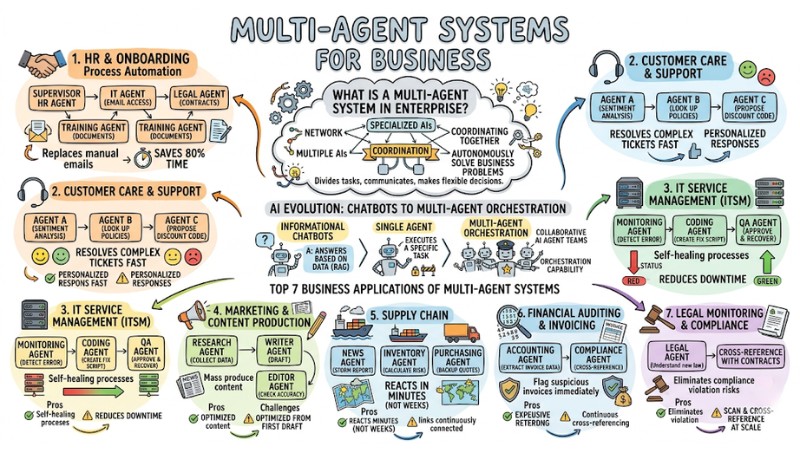
A multi-agent system is a network of multiple specialized AIs coordinating together to autonomously solve complex business problems. Instead of relying on a single AI, this system divides tasks, communicates, and makes flexible decisions on its own.
The Strong Evolution of Enterprise AI: From Chatbots to Multi-Agent Orchestration
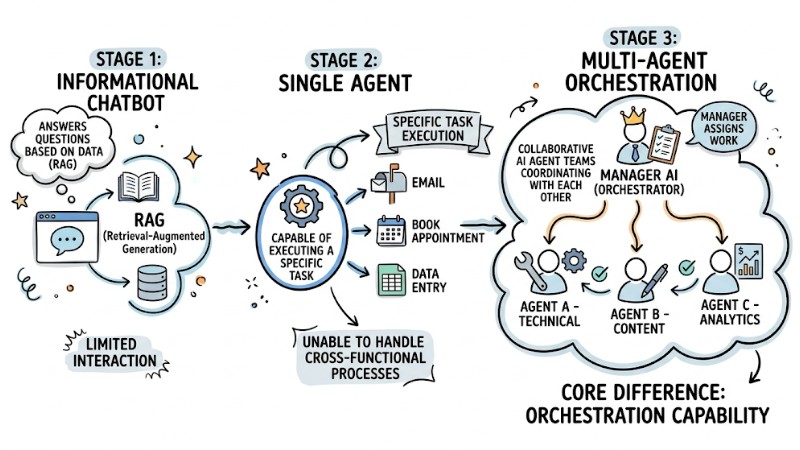
The journey of applying Generative AI (GenAI) in enterprises has passed through these 3 stages:
- Informational Chatbots: AI answers questions based on existing data repositories via RAG (Retrieval-Augmented Generation).
- Single Agent: An AI capable of executing a specific task but unable to handle cross-functional processes.
- Multi-Agent Orchestration: Collaborative AI agent teams coordinating with each other.
The core difference in stage 3 is orchestration capability. In this stage, an AI acting as a manager assigns work to subordinate AIs.
The rapid development of Enterprise AI: From chatbots to multi-agent orchestration
How AI Agent Teams Coordinate Operations
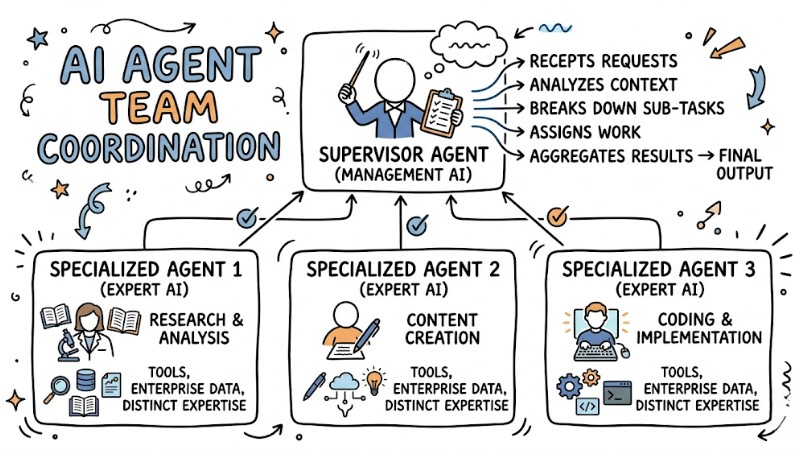
The system operates based on the concept of Organizational Mirroring. Instead of forcing one AI to do everything, you create virtual AI departments:
- Supervisor agent (Management AI): Acts as the conductor. It receives requests, analyzes context, breaks them down into sub-tasks, and assigns work. Finally, it aggregates results to produce the final output.
- Specialized agents (Expert AI): Receive professional tasks. Each agent has its own set of tools, access to enterprise data, and distinct expertise.
My practical implementation experience: Don't try to cram every request into a single AI. Dividing tasks among AI specialists helps minimize hallucinations and increases absolute accuracy.
How AI teams work together
Why is Traditional Business Process Automation No Longer Suitable?
Traditional Business Process Automation (BPA) operates based on fixed “If/Then” rules. If a new variable appears outside the programmed script, the system will error out and stop.
BPA is still very effective for 100% standardized processes. But when enterprises must handle dynamic, complex, and ever-changing issues, you need to switch to more flexible agentic AI workflows.
| Criteria | Traditional Processes (BPA) | Agentic AI Processes |
|---|---|---|
| Reasoning capability | None. Only runs according to pre-programmed scripts. | Self-reasons how to solve problems. |
| Exception handling | Stops operation, requires human intervention. | Automatically finds other directions to complete the goal. |
| Operational method | Linear (Step 1 -> Step 2 -> Step 3). | Iterative and interactive (Evaluate -> Act -> Feedback). |
| Initial deployment cost | Low, easy to deploy quickly. | High, requires setting up complex frameworks. |
Top 7 Business Applications of Multi-Agent Systems
1. Human Resources (HR) and Onboarding Process Automation
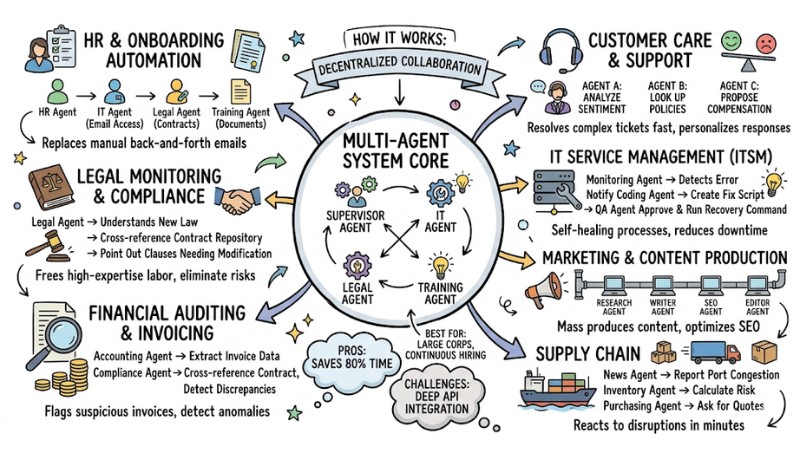
The process of onboarding new personnel often requires cross-departmental collaboration. In this case, Multi-agent replaces manual back-and-forth emails:
- How it works: The Supervisor HR Agent triggers the IT Agent (grants email access), the Legal Agent (creates contracts), and the Training Agent (sends documents).
- Pros: Saves 80% of profile setup time.
- Challenges: Requires deep API integration into internal systems (Active Directory, ERP).
- Best for: Large corporations, companies with continuous hiring rates.
2. Customer Care and Support
Complex complaint handling processes need the flexible routing of decentralized agent systems:
- How it works: Agent A analyzes customer sentiment. Agent B looks up policies. Agent C proposes a compensation discount code level.
- Pros: Resolves complex tickets fast, personalizes responses based on emotion.
- Challenges: Must strictly train compensation boundaries so AI does not exceed the budget.
- Best for: E-commerce, Telecommunications, Financial Services.
3. IT Service Management (ITSM) and Operations
IT service management is moving from "fix it when it breaks" to self-healing processes and predictive maintenance:
- How it works: A Monitoring Agent detects a server error. It notifies a Coding Agent to create a fix script, then a QA Agent approves and runs the recovery command.
- Pros: Reduces service downtime, optimizes engineering resources.
- Challenges: Risk if AI unilaterally changes core network infrastructure configurations.
- Best for: Tech companies, Data Centers, SaaS enterprises.
4. Marketing and Content Production
Content production now operates like a pipeline, maximizing the power of Large Language Models (LLMs).
- How it works: A Research Agent is responsible for collecting and synthesizing data, then a Writer Agent writes the draft, followed by an SEO Agent optimizing keywords, and finally an Editor Agent checking information accuracy.
- Pros: Mass produces content, optimizes for SEO right from the first draft.
- Challenges: AI can write repetitively if the brand-orienting prompt is shallow.
- Best for: Marketing Agencies, Digital Journalism, Inbound Marketing departments.
5. Supply Chain
In Multi-Agent supply chains, the greatest value comes from how links are always connected and interacting continuously, creating new smart reactions that a single system cannot have.
- How it works: A News Agent reports a storm causing port congestion, an Inventory Agent calculates risks and triggers a Purchasing Agent to automatically ask for quotes from backup suppliers.
- Pros: Reacts to supply chain disruptions in minutes instead of weeks.
- Challenges: Requires real-time API access from logistics partners.
- Best for: Manufacturing enterprises, large-scale Retail, Import-Export.
6. Financial Auditing & Invoicing
In environments with massive financial data, fraud can easily escape human eyes. However, AI can leverage enterprise data to continuously cross-reference and detect anomalies.
- How it works: An Accounting Agent extracts invoice data. A Compliance Agent cross-references with the original contract to detect discrepancies.
- Pros: The autonomous decision-making power of AI Agents helps flag suspicious invoices immediately before disbursement.
- Challenges: Requires strict compliance with international financial security standards.
- Best for: Banks, Investment Funds, Corporate Accounting departments.
7. Legal Monitoring & Compliance
Manual contract review can consume hundreds of hours from legal teams. With distributed computing systems, you can break down the legal code and let AI automatically scan and cross-reference at scale.
- How it works: When a new law is passed, a Legal Agent automatically understands the law and cross-references with the existing contract repository to point out clauses needing modification.
- Pros: Frees up high-expertise labor, eliminates compliance violation risks.
- Challenges: Complex legal language requires specific LLM fine-tuning.
- Best for: Law firms, Multinational Corporate Legal departments.
In summary, all 7 of these applications share one core value: Turning AI from a passive tool into a virtual employee actively operating business processes.
7 Business Applications of Multi-Agent Systems
Strategic Benefits of Multi-Agent AI for Enterprise Operations
Easy Scalability and Network Effects
The biggest benefit of a Multi-Agent system is the ability to scale across the entire enterprise. When deployed, you trigger the network effect between AI components.
You can understand the network effect as the value of the entire system increasing exponentially when a new component is added.
Suppose the network has HR, Marketing, and Sales Agents. If you plug in a Translation Agent, immediately all 3 of those departments possess multi-language operational capabilities without needing to re-program from scratch.
Cost Optimization and Increased ROI
Many enterprises are shifting budgets from repetitive work positions to investing in AI infrastructure. These smart automation processes have helped significantly cut and strongly optimize operational costs for the business.
AI systems can run 24/7 without fatigue, thereby improving ROI visibly. For example, processing 1,000 support tickets with human staff can cost about 5,000 USD, while using a Multi-Agent system, the API token cost for the same workload is under 50 USD.
Autonomous Decision-Making with Humans in Control
Even though AI has high autonomy, you cannot delegate 100% of decision-making to machines. This is where the Human-in-the-loop philosophy comes into play.
Especially with disbursement, legal, or infrastructure change decisions, the manager must be the final checkpoint.
Note: Always set the state to “Wait for human input”. AI can do 99% of the investigation and drafting work, but the final 1% – the approval click – must still belong to humans.
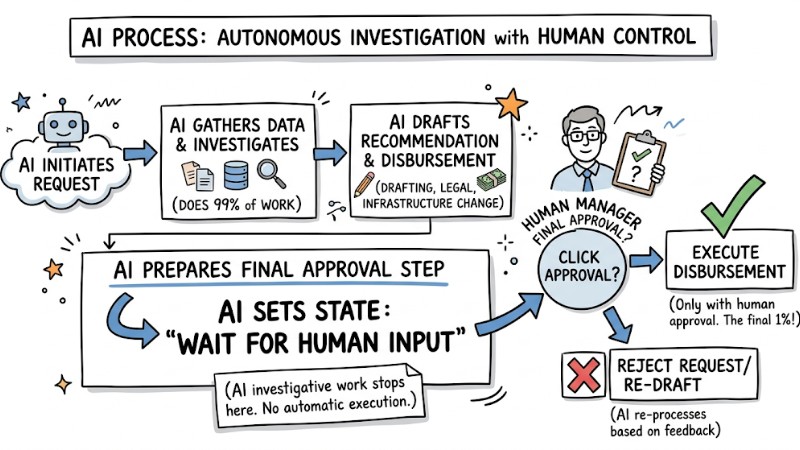
Autonomous Decision-Making with Humans in Control
4 Steps to Deploy a Multi-Agent Framework in Your Enterprise
1. Identify Process Bottlenecks
Don't apply AI blindly. Audit cross-departmental processes that are congested, where standard business process automation (BPA) fails.
You can use the following checklist to evaluate bottlenecks:
- Does the process need coordination from 3 or more departments?
- Does the wait time consume more than 3 days?
- Are employees manually copying/pasting data between software?
2. Choose a Suitable Enterprise Architecture
The architectural foundation accounts for about 80% of the success of any digital transformation strategy. Basically, you have two directions to choose from:
- Open Source: Typically Microsoft AutoGen. Suitable if you have a strong internal dev team and want deep control over the source code.
- Cloud Services: Use Amazon Bedrock / AWS or BMC HelixGPT. For enterprises needing fast deployment and absolute data security.
3. Define Roles and Access Rights for Each Agent
You need to write clear system prompts for each specific agent in the system and strictly limit API access rights.
Below is a basic Prompt configuration for an Agent:
Role: In-house Legal AI Specialist
Goal: Extract indemnity and compensation clauses from PDF contracts.
Tools allowed: PDF_Reader_API, Contract_Database_Read_Only.
Constraint: Strictly no data modification. Return results to the Supervisor Agent only.
4. Establish Responsible AI Standards and Risk Management Processes
In the final step, you need to focus on security and risk governance to ensure sensitive data is not leaked as training material for public AIs.
Practical advice: Don't deploy across the entire company from day one. Start with a small PoC (Proof of Concept) in the IT department, verify efficiency and safety, then step-by-step expand to other departments.
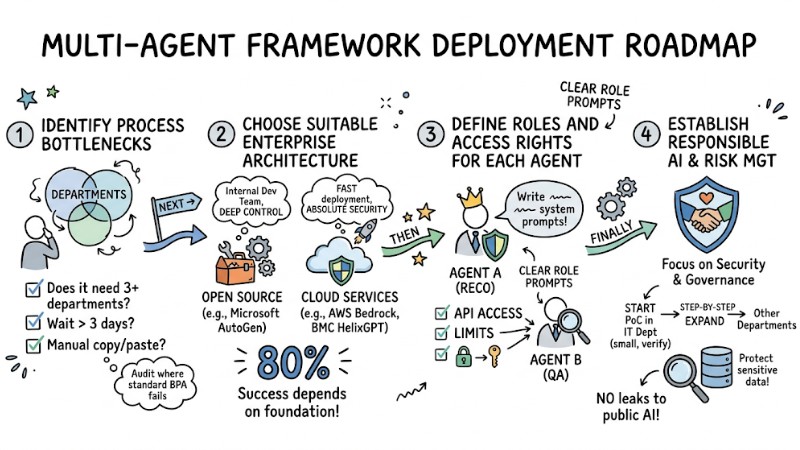
4 steps to implement a Multi-Agent framework in your business
FAQ about Multi-Agent Systems for Business
How is a multi-agent system different from a single agent for business?
A single agent only executes a single task, while a Multi-agent system is a collaborative framework where multiple specialized AIs communicate and divide work to complete complex projects.
Will the system leak enterprise data?
No, if you set it up correctly. Deploy the system on a Private Cloud to ensure internal data is completely isolated and data will not be used to train external AI models.
How to control when AI makes a wrong decision?
The solution is to establish a human-in-the-loop mechanism. When applied, the system is forced to stop and require human approval before triggering a real action (such as transferring money).
What is a multi-agent system in enterprise?
A multi-agent system is a network of specialized AIs, coordinating smoothly to solve complex problems. Each AI agent possesses its own knowledge and goals, working together under the coordination of a "supervisor agent" to achieve superior efficiency compared to single AIs.
What is the difference between a Chatbot, a single AI agent, and a multi-agent system?
- Chatbots provide information based on existing data (RAG).
- A single AI agent can perform one task.
- A multi-agent system is a collection of many specialized agents, coordinating to solve complex problems, similar to how a multi-functional team operates.
How do collaborative AI groups in a multi-agent system work?
A multi-agent system mimics an organizational structure, with a "supervisor agent" (manager) coordinating "specialized agents" (specialists). These specialists have their own knowledge and tools, communicating and collaborating to complete tasks, just like the way humans work in a company.
In which business areas can a multi-agent system be applied?
Multi-agent systems can be applied in HR (recruitment, onboarding), Customer Service (complex support), IT Service Management (self-patching), Marketing (content production), Procurement (supply chain), Financial Auditing, and Legal Monitoring.
What are the strategic benefits of multi-agent AI systems for enterprise operations?
Benefits include easy scalability, cost optimization, and increased ROI through high-performance automation, along with autonomous decision-making capabilities under human supervision (human-in-the-loop).
How to deploy a multi-agent system in a company?
Deployment steps include:
- Identify process bottlenecks.
- Choose a suitable enterprise architecture (e.g., AutoGen, AWS Bedrock).
- Define roles and access rights for each agent.
- Establish responsible AI processes and risk management.
Multi-agent systems are not a far-fetched trend but the future of enterprise operations. Start evaluating your bottlenecks and testing AI agent systems today so you are not left behind. Contact our expert team for a consultation or read more in-depth documentation on AI applications today!
Tags