What is MCP Transport? Understanding the Transmission Mechanisms of the Model Context Protocol

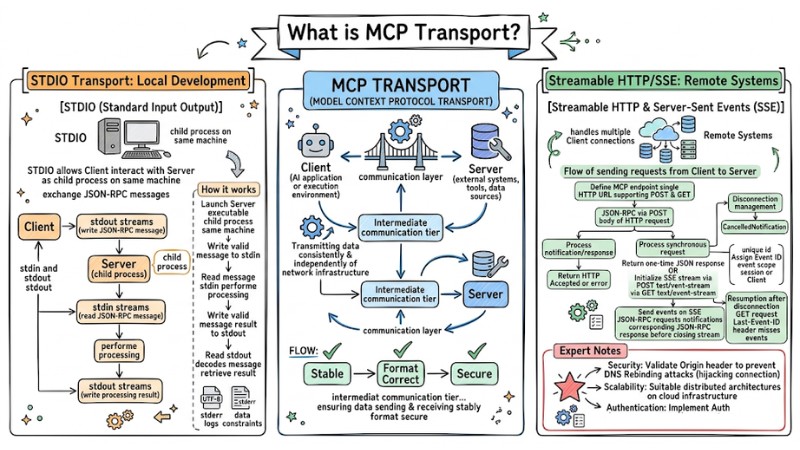
MCP Transport is the communication layer in the Model Context Protocol used to transmit JSON-RPC messages between Client and Server across various types of infrastructure. This article introduces the concept of MCP Transport, describes the two common types of Transport - STDIO and Streamable HTTP or SSE and suggests how to choose the most suitable Transport.
Key Takeaways
- Basic Concept: Clearly understand that MCP Transport is the intermediate layer transmitting data between the AI application (Client) and external data sources (Server), ensuring stable and secure communication.
- STDIO Transport: Explore local operational mechanisms through stdin/stdout streams, offering superior advantages in ultra-low latency, high security and no complex network configuration requirements.
- Streamable HTTP/SSE: Grasp the remote communication solution for distributed systems, where the Server handles multiple Client connections via HTTP POST/GET and streams data continuously via SSE.
- Optimal Choice: Know how to apply STDIO for the development/testing phase on local machines and switch to HTTP/SSE when deploying a shared Server on cloud infrastructure.
- FAQ: Get answers to questions about the necessity of Origin validation in SSE, the reason for mandatory JSON-RPC formatting, and the convenience of changing Transport configurations in the source code.
What is MCP Transport?
MCP Transport (Model Context Protocol Transport) is the communication layer in the Model Context Protocol architecture, responsible for transmitting data between the Client (the AI application or execution environment) and the Server (external systems, tools, or data sources). This component uses the JSON-RPC 2.0 standard to format and exchange messages, helping both sides communicate consistently and independently of the technical details of the network infrastructure.
In other words, MCP Transport acts as the intermediate communication tier, ensuring that the sending and receiving of data are performed stably, in the correct format, and securely throughout the interaction process between the AI model and external data sources.
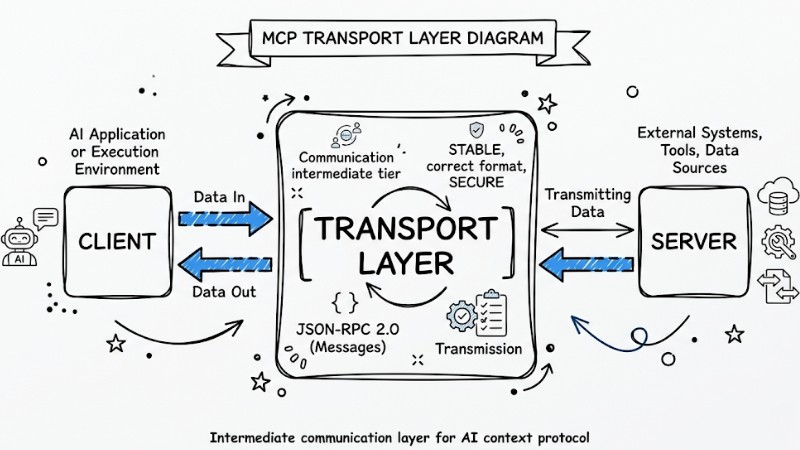
MCP Transport is the communication layer responsible for transferring data between the client and the server
Common Types of MCP Transport
STDIO Transport: Solution for Local Development
STDIO (Standard Input Output) allows the Client to interact with the Server as a child process on the same machine. The Client launches the Server process and exchanges JSON-RPC messages through stdin and stdout streams.
How it works:
- Launch Server: The Client launches the Server executable as a child process on the same machine.
- Send Message: The Client writes a valid JSON-RPC message to the Server's stdin.
- Read and Process: The Server reads the JSON-RPC message from stdin and performs the corresponding processing.
- Return Result: The Server writes a valid JSON-RPC message containing the processing result to stdout.
- Receive Result: The Client reads the data from stdout and decodes the JSON-RPC message to retrieve the result.
- Logging: The Server writes logs in UTF-8 text format to stderr; the Client can collect or ignore this log part.
- Data Constraints: Data written to stdin and stdout must only consist of valid MCP messages, without other content mixed in.
Why use it:
- Performance: Ultra-low latency since it does not go through a network layer.
- Security: Limited to the local environment, not exposed to the internet.
- Convenience: No need for port configuration or complex security certificates.
Configuration example in mcp-config.json:
{
  "mcpServers": {
    "my-local-server": {
      "command": "node",
      "args": ["/path/to/server.js"]
    }
  }
}
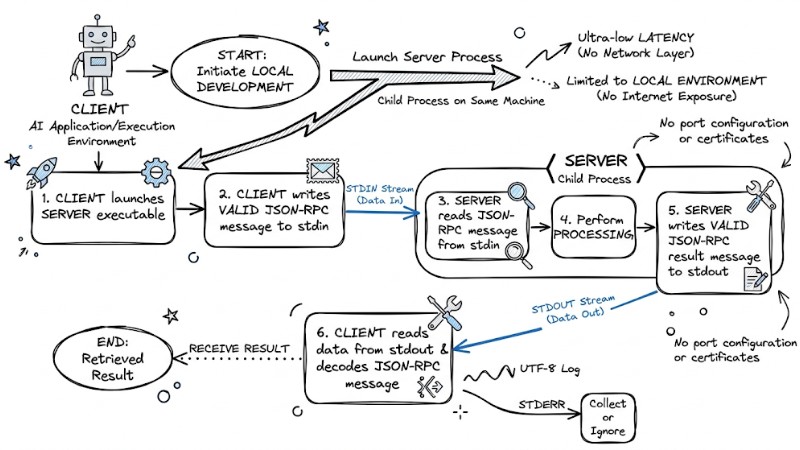
Client process starts the server via stdin/stdout
Streamable HTTP/SSE: Solution for Remote Systems
Streamable HTTP is a Transport method where the Server acts as an independent process and handles multiple Client connections via HTTP POST and HTTP GET. This mechanism can use Server-Sent Events (SSE) to stream multiple messages from the Server to the Client on a single stream.
Flow of sending requests from Client to Server:
- Define MCP endpoint: The Server provides a single HTTP URL supporting both POST and GET methods for MCP communication.
- Send JSON-RPC via POST: The Client sends the JSON-RPC message (request, notification, or response) in the body of an HTTP POST request to the MCP endpoint.
- Process notification/response: For notifications or responses, if accepted, the Server returns HTTP 202 Accepted; otherwise, the Server returns an appropriate HTTP error code.
- Process synchronous request: For a JSON-RPC request, the Server can return a one-time response with JSON content and a Content-Type header of application/json.
- Initialize SSE stream via POST: The Server can replace the one-time JSON response with an SSE stream with Content-Type as text/event-stream to transmit multiple events related to the same request.
- Open SSE stream via GET: The Client sends an HTTP GET request to the MCP endpoint with the Accept header text/event-stream to open the SSE stream for receiving messages from the Server.
- Send events on SSE: The Server sends SSE events containing JSON-RPC requests and notifications, and in cases tied to a specific request, it will send the corresponding JSON-RPC response before closing the stream.
- Manage disconnection: When the SSE stream is interrupted, the Client does not by default consider the request canceled; if cancellation is needed, it sends a CancelledNotification to the Server.
- Assign Event ID: The Server assigns a unique id to each SSE event within the scope of the session or the scope of the Client to support resumption capabilities.
- Resumption after disconnection: After losing the connection, the Client reopens the SSE stream using HTTP GET and sends the Last-Event-ID header containing the id of the last received event so the Server can replay missing events.
Expert Notes:
- Security (Warning): You must validate the
Originheader to prevent DNS Rebinding attacks (hijacking the connection). - Scalability: Suitable for distributed architectures where the Server runs on cloud infrastructure.
- Authentication: Need to implement an Auth mechanism (such as Bearer Token) to ensure only authorized Clients can connect.
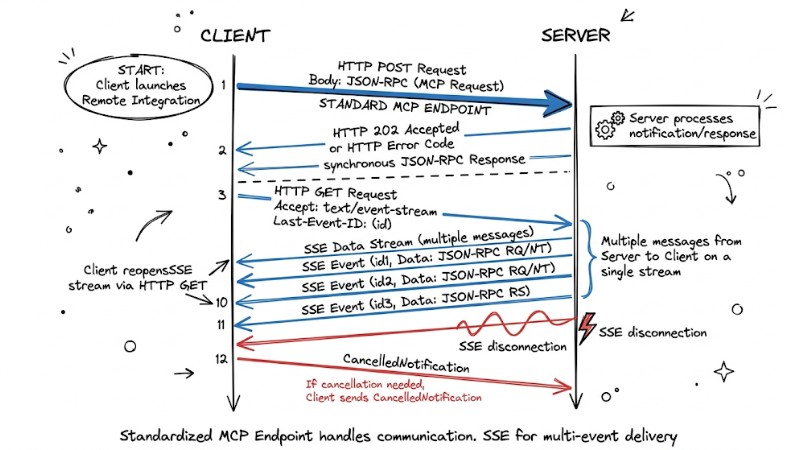
Client sending HTTP POST and receiving data stream from SSE
Quick Comparison of STDIO vs HTTP/SSE:
| Criteria | STDIO | HTTP/SSE |
|---|---|---|
| Environment | Local | Remote |
| Latency | Very Low | Medium |
| Setup | Simple | Requires HTTP Server |
| Scalability | Low (1-1) | High (1-n) |
| Security | Natural (Local) | Requires strict configuration |
How to Choose the Right MCP Transport
To choose the MCP Transport suited to your usage context, you can consider the following criteria:
- Use STDIO when: The environment runs locally on one machine, the Client can directly launch the Server process, low latency is a priority, and there is no need to expose the service to the network.
- Use HTTP Streamable or SSE when: You need to deploy a remote Server, serving multiple Clients over the network, integrating with cloud infrastructure or distributed and microservices architectures.
- Recommended Roadmap: You should start with STDIO for development and testing on a local machine, then switch to HTTP Streamable or SSE when needing to deploy a shared Server in staging or production environments.
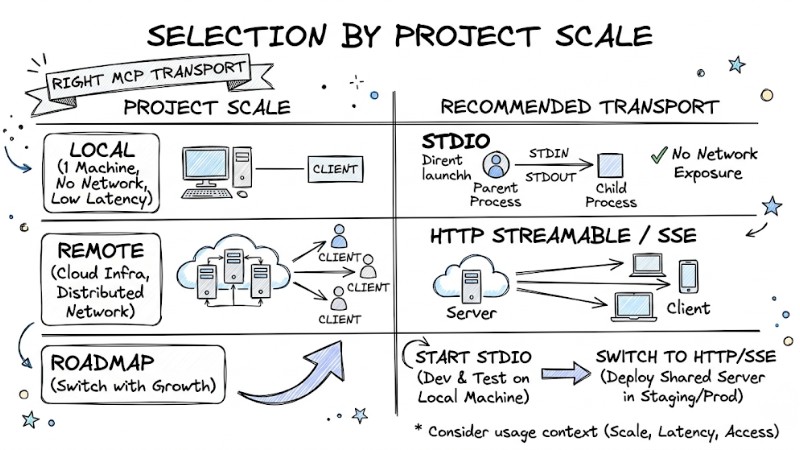
Guide to choosing the right MCP Transport
Answering Frequently Asked Questions
Why is Origin validation necessary in SSE?
Origin validation is necessary in SSE to prevent remote malicious websites from sending requests to an MCP Server running on a local machine via DNS Rebinding techniques.
Can JSON-RPC be replaced by another format?
JSON-RPC cannot be replaced by another format because MCP currently uses JSON-RPC 2.0 as the mandatory message format to ensure compatibility, standardize request-response structures, and support common tooling between Clients and Servers.
Is it necessary to reconfigure code when changing Transport?
When changing the Transport type in the MCP SDK, typically only the initialization configuration or transport parameters need to change; the tool processing logic and JSON-RPC flow can remain the same as they have been abstracted by the SDK.
Read more:
- 7 Practical Coding Agent Use Cases to Optimize Your Workflow
- When to Use an AI Agent? 7 Signs You Need Automation
- How AI Agents work: Autonomy and Functional Mechanisms
MCP Transport provides a unified communication mechanism based on JSON-RPC for both local scenarios and distributed systems, helping Clients and Servers communicate independently of network infrastructure details. By clearly understanding the characteristics of STDIO and Streamable HTTP or SSE, you can choose the Transport suited to your development stage and deployment model to optimize the performance, security, and scalability of your MCP application.