What is Agent Swarm? How Agent Swarm Automates Workflows

Agent Swarm is a way of organizing multiple specialized AI agents to collaborate on a large task through work decomposition, result handoffs, and shared state management. This article introduces the concept, operational mechanics, business use cases, and common frameworks so you can start deploying without needing a deep technical background.
Key Takeaways
- Agent Swarm Concept: Understand that this is an architecture where multiple autonomous agents are assigned specialized roles to collaborate on completing a large task.
- Operational Mechanics: Master the operating principles through role division, smooth task handoff mechanisms, and shared memory spaces.
- Superior Advantages: Identify 4 benefits: Increased speed via parallel processing, enhanced accuracy through specialization, self-healing capabilities when encountering errors, and flexible scalability.
- Practical Applications: Explore how businesses are using Agent Swarm to automate entire Marketing content production lines and build multi-tier customer support and classification systems.
- Framework Evaluation: Compare the strengths, barriers, and target audiences of 5 tools—OpenAI Swarm, CrewAI, Microsoft AutoGen, LangGraph, and the n8n drag-and-drop platform—to choose the solution that fits your technical capability.
- FAQ: Get answers to questions about the level of AI team autonomy, self-correction capabilities, differences from traditional RPA technology, and useful advice for starting safe deployments with small processes.
What is Agent Swarm?
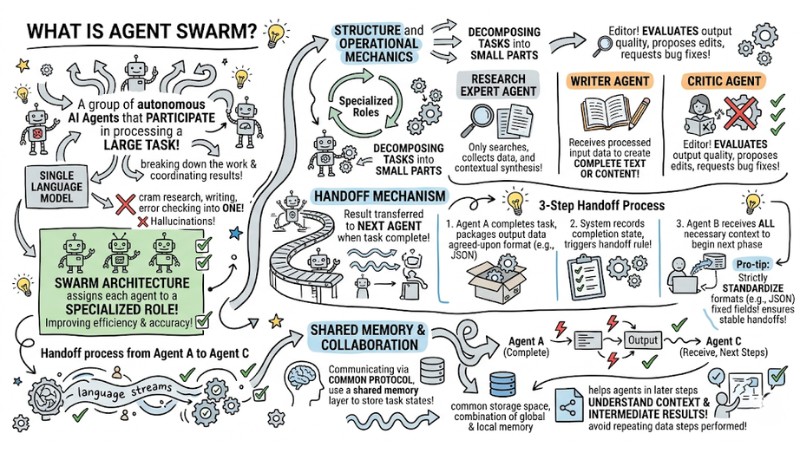
An agent swarm is a group of autonomous AI agents that participate in processing a large task by breaking down the work and coordinating results. Instead of using a single language model to perform every step from research and content writing to error checking - the swarm architecture assigns each agent to a specialized role to improve efficiency and accuracy.
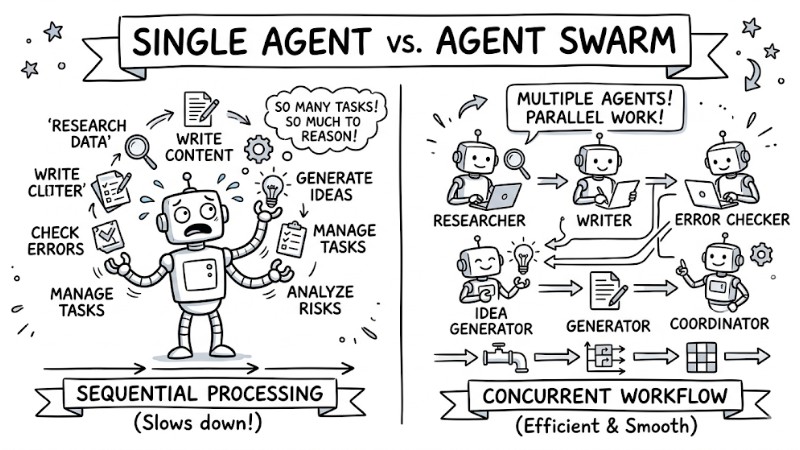
Comparing the working methods of Single Agents and Agent Swarms
Comparison table between Single Agent and Agent Swarm:
| Criteria | Single Agent | Agent Swarm |
|---|---|---|
| Role | One agent handles almost all stages of the workflow | Tasks are split among multiple agents specialized in each part |
| Speed | Sequential processing; dependent on each reasoning cycle of a single model | Can process multiple steps in parallel as agents work concurrently |
| Error Rate | Prone to accumulating errors when one model assumes many different task types in the same flow | Can reduce errors thanks to cross-checking mechanisms between agents at different steps |
| Compute Cost | Low cost for small problems but hard to scale when workload and context increase sharply | Can optimize costs by tiering agents and using models suited for each task type |
Structure and Operational Mechanics of an Agent Swarm
Specialized Roles
The core principle of Agent Swarm is decomposing tasks into small parts, with each part attached to a specific role instead of assigning a massive request to a single agent. Each agent is configured for a clear type of work, for example:
- Research Expert Agent: Only performs searching, data collection, and context synthesis.
- Writer Agent: Only receives processed input data to create complete text or content.
- Critic Agent: Acts as an editor, only evaluating output quality and proposing edits or requesting bug fixes.
Handoff Mechanism
When an agent completes its portion of the work, the result must be transferred structurally to the next agent; this is the handoff mechanism in swarm architecture.
The Handoff process occurs in 3 steps:
- Agent A completes the task and packages the output data into an agreed-upon format.
- The system records the completion state and triggers the corresponding handoff rule.
- Agent B receives all necessary context from the handed-over data to begin the next processing phase.
Pro-tip: To ensure stable handoffs between agents, strictly standardize the input and output formats for each step, typically using JSON with fixed fields.
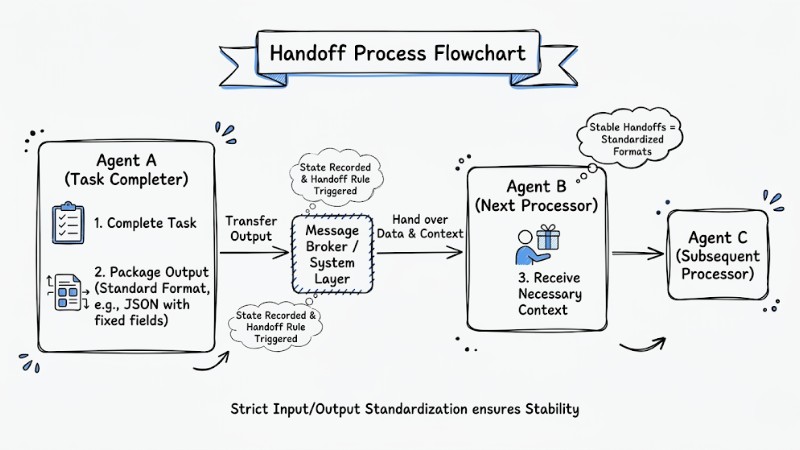
Handoff process from Agent A to Agent C
Shared Memory & Collaboration
Agents in a swarm do not operate in isolation; they communicate via a common protocol and often use a shared memory layer to store task states. Shared memory can be a common storage space or a combination of global and local memory, helping agents in later steps understand the context and intermediate results without repeating data collection steps already performed.
Why is Agent Swarm the Future of AI Process Automation?
Speed Gains with Parallel Execution
Agent Swarm applies distributed computing principles, allowing multiple agents to execute independent parts of the work at the same time instead of waiting in a queue. In a process like report generation, one agent can collect data while another agent builds the content framework in parallel, significantly shortening total completion time compared to sequential processing.
High Accuracy through Specialization
Each agent in a swarm is typically configured for a narrow task scope and short reasoning chains, which reduces the context load required for each inference cycle. When combined with techniques like explicit chain-of-thought design and improved data retrieval quality, this organization helps reduce hallucinations - where information doesn't match the source data.
Self-healing and Fault Tolerance
Modern swarm architectures often integrate state monitoring, logs, and step-by-step results to detect errors early and trigger fix or retry procedures. For instance, if a code-generating agent fails a test, a testing agent can flag the error, return the context, and trigger an automated fix loop until the checks meet the set threshold.
Flexible Scalability
The scalability of an agent swarm comes from its distributed and modular design, where each agent is a component that can be added, removed, or replaced independently. As a result, the system can scale its processing capacity by adding more agents to bottlenecked steps or deploying new roles without redesigning the entire workflow.
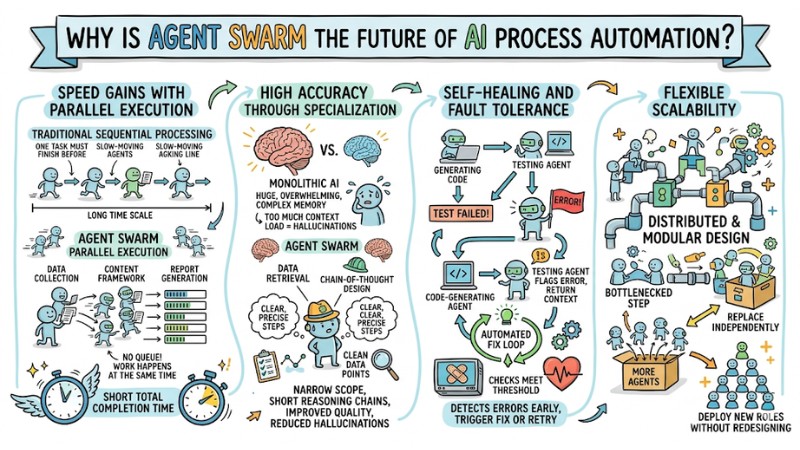
Benefits of using Agent Swarm
Practical Examples: Applying Agent Swarm in Enterprise
Building an Automated Marketing Content Team
Businesses can set up an automated workflow using multiple agents to run a continuous content production chain.
The actual workflow might include:
- Strategy: Agent analyzes keywords and search trends to propose topics.
- Writing: Agent turns the outline into a full article or content.
- Graphics: Agent creates illustrations via image APIs like Midjourney or DALL-E.
- Review: Agent checks for spelling errors, tone of voice, and consistency with guidelines.
- Publish: Agent posts content to the Content Management System (CMS) according to the configured schedule.
To maintain quality control, there should be a separate audit step, which can be performed by a specialized review agent or, for critical content, supplemented with manual human checks.
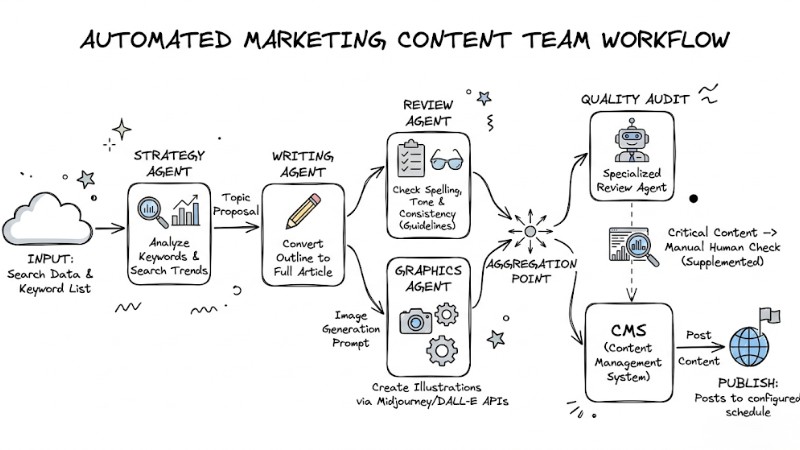
The automation process uses multiple agents to operate the content production chain
Multi-tier Data Analysis and Customer Care System
In customer care, an Agent Swarm can process tickets through multiple layers such as intake, classification, lookup, and response suggestion.
- Receive tickets and automatically classify them by priority level, issue type, and submission channel.
- Query internal databases or policy documents to find the appropriate resolution path.
- Generate response suggestions or propose handling options, such as compensation levels or next steps for the customer.
At the end of the processing chain, a human-in-the-loop step should be maintained for personnel to confirm sensitive cases like refunds or major account changes, ensuring safety and compliance with internal regulations.
Top 5 Popular Frameworks for Building Agent Swarm Systems
Below are some widely used agent orchestration frameworks; each tool supports a different approach to multi-agent systems and fits specific technical levels:
| Framework Name | Strengths | Barriers | Best Fit For |
|---|---|---|---|
| OpenAI Swarm | Lightweight, simple structure, easy to start testing small agent flows | Currently in experimental phase; ecosystem and available features are limited | Developers wanting to quickly test swarm models and basic handoff flows |
| CrewAI | Clear role and goal division for each agent | Requires Python knowledge and working with config files; basic code level or higher | Teams building multi-step workflows focused on content, research, or office tasks |
| Microsoft AutoGen | Supports multi-agent conversations and discussion scenarios, especially for code generation and tool calling | Documentation and initial config involve many concepts; requires time to get familiar | Software engineers in enterprise environments wanting to automate exchanges between multiple agents and humans |
| LangGraph | Detailed state management and flow orchestration via graphs; suitable for complex systems needing tight control | High learning curve; requires understanding nodes, edges, state machines, and workflow modeling | Developers building deep AI applications requiring reliability, observability, and good debugging |
| n8n | User-friendly drag-and-drop interface; supports many built-in integrations to quickly build multi-agent workflows with minimal code | Limited when complex custom logic or detailed source-code-level control is needed | Marketers, product managers, or non-coding teams wanting to connect agents with SaaS services and existing tools |
1. OpenAI Swarm
OpenAI Swarm is an experimental library focusing on lightweight design, allowing the definition of agent sets and task handoff flows between them with minimal configuration. The near-stateless architecture makes it easy for developers to control each agent call and how results transition to the next step without building many wrapper layers.
2. CrewAI
CrewAI supports building multi-agent systems based on the "crew" concept, where each agent is assigned a role, goal, and specific tools for each scenario. This approach is well-suited for office workflows like research, content writing, and report synthesis, where clear role division makes process management more convenient.
3. Microsoft AutoGen
AutoGen focuses on conversational scenarios between multiple agents and between agents and humans, allowing agents to exchange, propose, and critique during the problem-solving process. This framework is heavily used for automated code generation, testing, bug fixing, and integrating human-in-the-loop within the same workflow.
4. LangGraph (from LangChain)
LangGraph introduces state machine and graph orchestration models to agent systems, allowing workflows to be described using nodes and conditional edges. This enables developers to build complex flows with branching, retries, checkpoints, and persistent context states throughout a session.
5. n8n
n8n is a low-code workflow automation platform providing a drag-and-drop interface to connect processing steps, where LLM calls or external agent steps can be attached. The platform supports integration with hundreds of applications like Slack, Google Sheets, and CRMs, making it suitable for building automation flows using agents without writing much code.
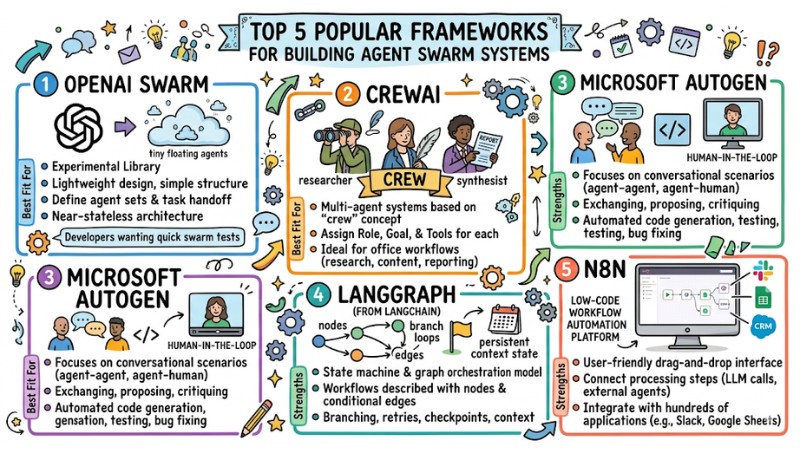
Several popular frameworks for building Agent Swarm systems
Answering Common Questions about Agent Swarm
How much autonomy does an Agent Swarm have?
Agents are autonomous within the scope of small tasks but are still limited by the rules, permissions, and guardrails you design. Important decisions should include a human-in-the-loop step or access control to prevent the system from performing actions outside the permitted scope.
Can an Agent Swarm change its approach when encountering an error?
Many swarm architectures support real-time adaptation mechanisms like retrying with a different strategy, switching to another tool, or using a different data source upon failure. This is typically driven by monitoring logic and specialized error-detection agents rather than agents unilaterally changing system goals.
How is Agent Swarm different from traditional RPA tools?
RPA usually relies on fixed scripts and rules tied to interfaces, which easily break when applications or screens change. Agent swarm is based on language models and semantic reasoning, allowing it to understand goals, read new states, and adjust operations within guardrails without always rewriting code.
Where should one start applying Agent Swarm in an enterprise?
Start with a small, low-risk process like email summarization, content drafting, or simple report synthesis with 2–3 agents. You can use n8n or CrewAI to build the first workflow, verify efficiency and monitoring methods, and then expand to more agents and critical processes.
Read more:
- 7 Practical Coding Agent Use Cases to Optimize Your Workflow
- When to Use an AI Agent? 7 Signs You Need Automation
- How AI Agents work: Autonomy and Functional Mechanisms
Agent Swarm helps upgrade AI processes from a single-agent model to a collaborative multi-agent architecture, thereby improving speed, accuracy, fault tolerance, and scalability. Once you understand the principles of role division, handoffs, shared memory, and choose the right framework, you can put AI agent teams into controlled real-world operation suited to business needs.