What is Human-in-the-Loop? The Role of Humans in the AI Era

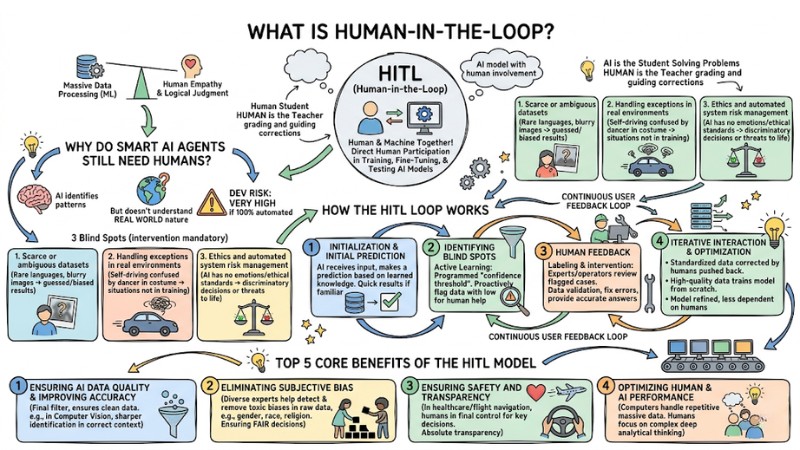
Artificial Intelligence (AI) is changing the world, but they are not perfectly flawless and still frequently make mistakes. To address this issue, the Human-in-the-Loop (HITL) model emerged as a core solution. This article helps you understand how humans and AI collaborate, thereby controlling risks and optimizing technological power for businesses.
Key Takeaways
- The Essence of the HITL Model: Understand that Human-in-the-Loop is a human-machine interaction process in which humans act as "teachers" helping AI train, fine-tune, and control errors.
- AI Blind Spots: Master the reasons why AI, despite its intelligence, still needs humans: lack of real-world understanding, confusion faced with exceptions, and a lack of ethical standards.
- Loop Mechanism: Grasp the 4 operational steps from initial prediction, identifying "blind spots" (active learning), expert intervention to the model re-training process for optimization.
- Value Brought Forward: Leverage HITL to enhance data quality, eliminate bias, ensure absolute safety in critical industries, and optimize collaborative performance between machines and humans.
- Practical Applications: Know how to apply HITL in fields ranging from healthcare, self-driving cars, content moderation to manufacturing quality control to solve complex problems.
- Management Challenges: Identify barriers regarding cost, personnel, and latency to build a deployment strategy suitable for business scale and requirements.
- FAQ: Understand the difference between HITL and full automation and how to distinguish techniques like Active Learning within the operational workflow.
What is Human-in-the-Loop?
Human-in-the-Loop (abbreviated as HITL) is a human-machine interaction process in which humans participate directly in training, fine-tuning, and testing artificial intelligence models. You can briefly understand this as an "AI model with human involvement."
The purpose of HITL is to combine the massive data processing capabilities of Machine Learning with human empathy and logical judgment. In essence, this is often a method closely related to Supervised Learning, especially in data labeling, but HITL itself is a broader human-machine interaction process.
Imagine AI is a student solving math problems, and you are the teacher. When the student makes a mistake or encounters a problem never seen before, the teacher grades it, points out the error, and guides them on the correct solution. Next time the student (AI) encounters a similar problem, they will solve it correctly on their own.
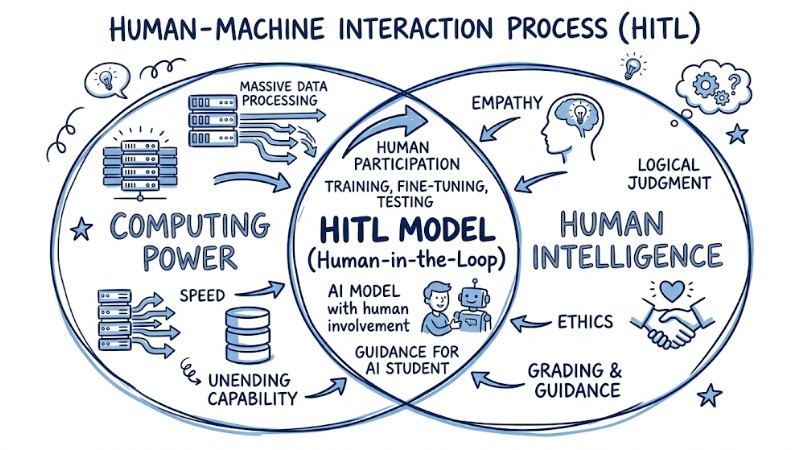
Human-in-the-Loop (HITL) is a human-machine interaction process
Why is Artificial Intelligence (AI) smart but still needs humans?
AI algorithms are very good at identifying patterns from data, but they completely do not understand the nature of the real world. If you trust and delegate 100% of decisions to automated systems, the risk of deviation is extremely high.
Below are 3 blind spots where human intervention is mandatory:
- Scarce or ambiguous datasets: When AI faces rare languages, blurry images, or incomplete input information, machines will guess and return biased results.
- Handling exceptions in real environments: AI cannot handle situations that never appeared during training. For example, a self-driving system will be confused when encountering a person in a costume dancing in the middle of the street.
- Ethics and automated system risk management: AI has no emotions or ethical standards, so humans must supervise to prevent AI from making discriminatory decisions or threatening human life.
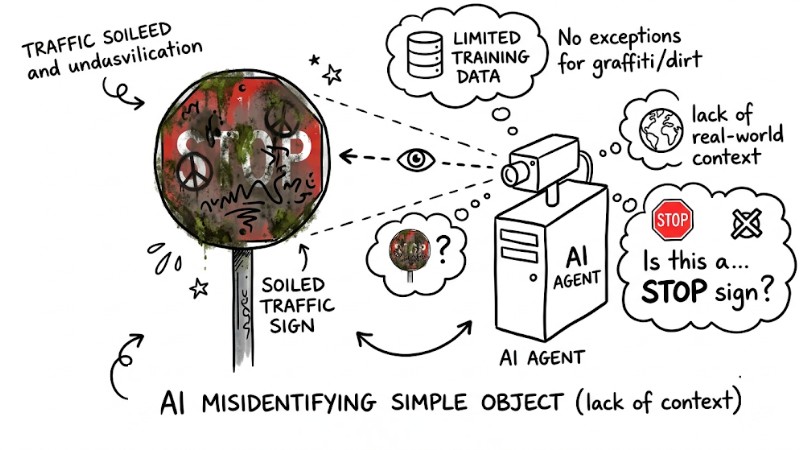
Artificial intelligence is intelligent, but it still needs human intervention
How the Human-in-the-Loop Loop Works
The user feedback loop happens continuously to improve model quality. This process includes 4 core repeating interaction steps as follows:
Step 1: Initialization and initial prediction
The AI model receives input data and performs a prediction based on learned knowledge. If the data is familiar and clear, the AI will return results immediately.
Step 2: Identifying blind spots (Active Learning)
This is when AI applies the Active Learning technique. The system is programmed with a "confidence threshold." When the AI encounters difficult data resulting in confidence lower than this threshold, it will proactively flag and request human assistance instead of deciding on its own.
Step 3: Human feedback (Labeling and intervention)
Experts or operators will review the cases that the AI has flagged. They conduct data validation, fix errors, or perform accurate data labeling. This human feedback process is exactly the provision of standardized answers for the system.
Step 4: Iterative interaction and optimization
Standardized data just corrected by humans will be pushed back into the system. AI uses this high-quality dataset to train the model from scratch. Through many loops, the AI model becomes more refined and reduces dependence on humans.
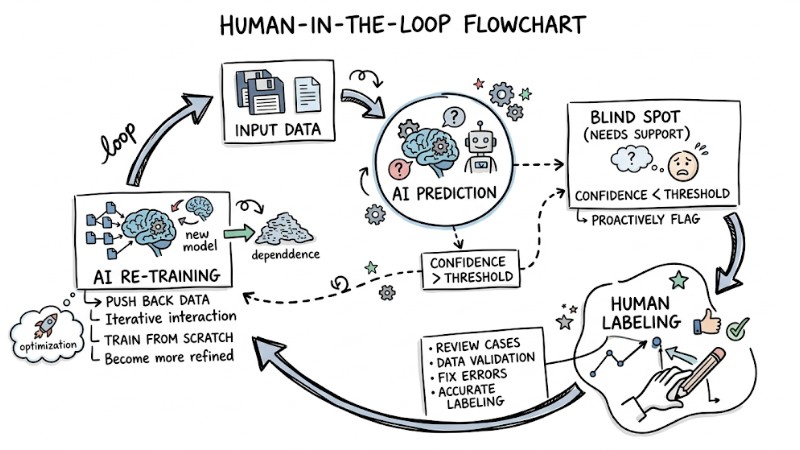
How the Human-in-the-Loop works
Top 5 Core Benefits of the HITL Model
The application of the HITL process brings superior values, thoroughly solving the current limitations of AI technology. Specifically as follows:
Ensuring AI data quality and improving accuracy
Machines learning on their own from low-quality data will produce low-quality results. Therefore, humans act as the final filter, ensuring data fed into the model is always clean and precise. In the field of Computer Vision, this helps AI identify objects more sharply and in correct real-world contexts.
Eliminating subjective bias
Raw data collected on the Internet is often full of biases regarding gender, race, or religion. The intervention of experts from diverse backgrounds helps the system detect and remove these toxic biases, ensuring AI makes fair decisions.
Ensuring safety and transparency
In fields like healthcare or flight navigation, AI mistakes can cost lives. In these situations, the HITL mechanism places humans in the final control position, responsible for key decisions, thereby ensuring absolute transparency and safety.
Optimizing human and AI performance
This model creates a perfect division of labor between the two sides. Computers will handle the repetitive processing of massive volumes of data. Meanwhile, humans are freed up time to focus on complex situations requiring deep analytical thinking.
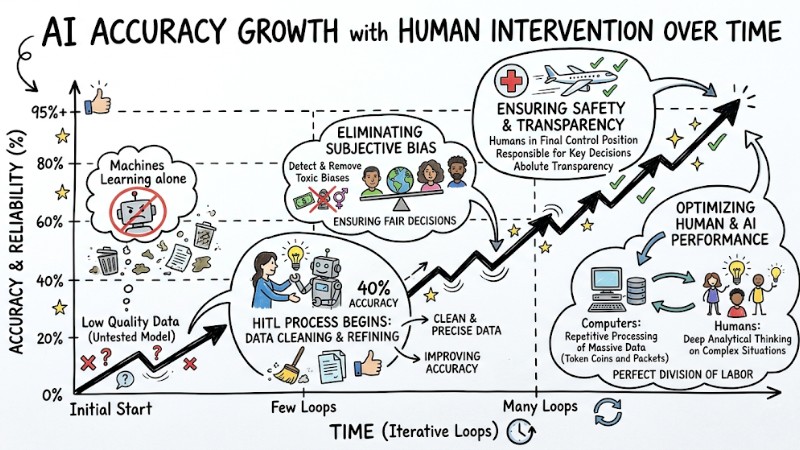
The rate of increase in AI model accuracy with human intervention over time
Top 5 Practical Applications of Human-in-the-Loop
| Field | AI's Role | Human's Role |
|---|---|---|
| Social Media | Filter basic spam data. | Select images (e.g., reCAPTCHA) for authentication. |
| Healthcare | Analyze and outline tumors on X-rays. | Doctors confirm diagnosis and build treatment plans. |
| Self-driving | Navigate and identify obstacles. | Handle emergency situations or extreme weather. |
| Moderation | Automatically flag sensitive words/images. | Re-evaluate the context of flagged content. |
| Manufacturing | Detect cracks/faults on high-speed lines. | Engineers confirm if it's a real fault or just lighting. |
1. Life: reCAPTCHA and Social Media
- Description: Users select images such as traffic lights or crosswalks to prove they are not robots. This process helps provide computer vision training data for AI.
- Pros/Cons: Leverages massive free data sources but sometimes data is noisy due to users selecting randomly.
- Best for: Systems requiring security authentication and crowdsourced data collection.
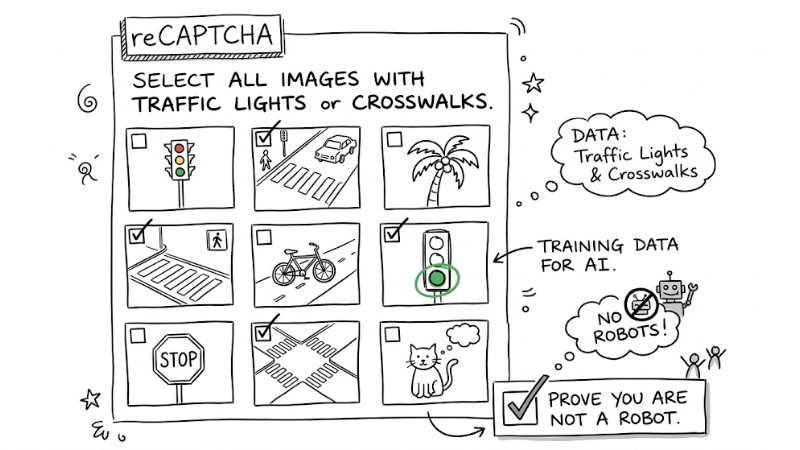
reCAPTCHA requires users to select either a traffic light or a crosswalk image
2. Healthcare and Medicine
- Description: The AI system analyzes thousands of medical images (MRI, X-ray) to find abnormalities, then the doctor confirms the final result.
- Pros/Cons: Significantly increases diagnostic speed but requires a high-expertise team and large investment costs.
- Best for: Large hospitals, specialized clinics, medical research institutes.
3. Self-driving Cars (Autonomous Systems)
- Description: Artificial intelligence controls the car under standard conditions. Drivers or remote engineers will take over intervention rights immediately when encountering strange situations.
- Pros/Cons: Maximizes safety for passengers, but Internet network latency can be dangerous if controlled remotely.
- Best for: Tech corporations developing autonomous vehicles, automated delivery drone systems.
4. Automated Content Moderation
- Description: AI scans millions of posts to delete violent content. Automated content moderation staff will manually review posts located at the difficult-to-define boundary of violation.
- Pros/Cons: Processes massive volumes of content quickly, but can cause negative psychological impacts on moderators.
- Best for: Social media platforms, large community forums.
5. Manufacturing Quality Control
- Description: AI cameras inspect product defects on high-speed conveyor belts. Workers will directly re-check products rejected by AI to avoid waste.
- Pros/Cons: Skyrockets factory productivity, but businesses still must maintain a Quality Control (QC) team.
- Best for: Electronic component manufacturing plants, automobile assembly, consumer goods.
Challenges When Applying the HITL Process
Although highly effective, managing the lifecycle of a hybrid human-machine system still faces certain barriers.
Cost and manpower consumption
To operate HITL, businesses must invest in software platforms and data expert teams. The cost of hiring high-quality data annotation experts is very expensive. You need to carefully calculate the Return on Investment (ROI) before scaling up.
Latency in system lifecycle management
Fully automated systems can return results in just milliseconds. Conversely, HITL takes more time because it needs humans to read, think, and make decisions. This delay makes the process difficult to meet tasks requiring real-time processing.
FAQ for Human-in-the-Loop
How is the HITL system different from full automation?
Full automation is the programming of a system so that it operates 100% independently without intervention. Conversely, HITL requires humans to continuously participate in the workflow to check, correct, and re-teach the system.
What is the difference between Active Learning and Human-in-the-Loop?
Human-in-the-Loop is the overall operational process including interaction between humans and machines. Active Learning is just a data filtering technique inside the HITL process, helping AI self-select the most difficult questions to ask humans for resolution.
What is Human-in-the-loop (HITL)?
Human-in-the-loop (HITL) is an iterative feedback process in which humans interact with systems generated by algorithms to improve the accuracy and processing capability of AI.
Why does smart AI still need humans?
Smart AI still needs humans because it only identifies patterns without understanding real-world nature, handles exceptions poorly, can carry bias from training data, and requires ethical and safety supervision.
How does the mechanism of the Human-in-the-Loop loop take place?
The HITL loop includes: AI processing data and predicting, identifying blind spots, humans labeling or fixing errors. Then, standardized data is used to re-train the AI, helping the model continuously improve.
What are the core benefits of the Human-in-the-Loop model?
Core benefits include enhancing data quality and AI accuracy, eliminating subjective bias, ensuring safety and transparency, and optimizing collective working performance between humans and machines.
How does Human-in-the-Loop help improve AI accuracy?
HITL improves accuracy by having humans provide accurately labeled data, validating model output, and fixing errors. This helps AI learn from these feedbacks to make more reliable predictions.
What are some practical applications of Human-in-the-Loop?
Common applications include reCAPTCHA and social media, medical imaging diagnosis, self-driving car systems, automated content moderation, and manufacturing quality control.
What are the challenges when applying the HITL process?
The main challenges include high costs for experts and platforms, and the potential to slow down the real-time processing speed of a fully automated system.
Who performs the tasks in the HITL loop?
Tasks in the HITL loop can be performed by experts, data annotators, or end-users through crowdsourcing platforms.
Read more:
- Self-hosted AI Agent: Build Your Own Maximum-Security AI Assistant
- What is Multi-tenancy? Multi-tenant Architecture in SaaS
- Building Multi-tenant AI Agents: A Roadmap for SaaS Businesses
Human-in-the-Loop is the indispensable bridge for the artificial intelligence collaboration process to develop more safely and intelligently. AI was not born to replace humans, but encourages us to transition from direct execution roles to "coaches" leading the technology. Contact professional data labeling service providers immediately to start building an optimal AI model for your business!