GoClaw Security: A Secure AI Gateway Solution for Enterprises

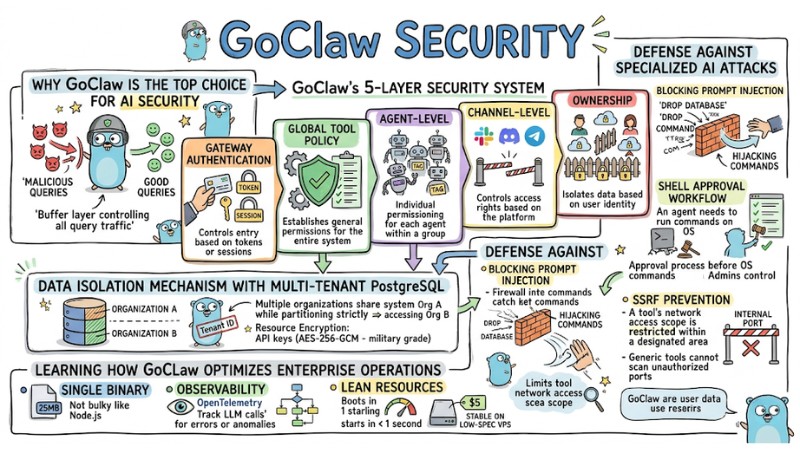
GoClaw is an AI gateway solution (intermediate connection portal) specifically designed for production environments, helping enterprises manage AI Agents safely, in isolation, and effectively. In this article, I will focus on the multi-layered security architecture and multi-tenant operational capabilities of GoClaw.
Key Takeaways
- Why GoClaw is the Top Choice for AI Security: Understand the 5-layer security system that helps control traffic and prevent malicious queries from the Gateway layer down to data ownership.
- Data Isolation Mechanism with Multi-tenant PostgreSQL: Master how GoClaw uses
Tenant IDand AES-256-GCM encryption to ensure absolute data separation between organizations. - Defense Against Specialized AI Attacks: Know how GoClaw proactively prevents Prompt Injection, controls Shell command execution, and guards against SSRF vulnerabilities.
- Encryption and Protection of Sensitive Resources: Learn about advanced security protocols such as WebSocket v3, Browser Pairing authentication, and military-grade encryption.
- Optimizing Enterprise Operations: Explore the lean Single Binary architecture, Observability via OpenTelemetry, and high performance on low-spec VPS.
- FAQ: Resolve inquiries regarding safety, deployment processes, multi-channel scalability, and how to maintain AI system security in practice.
Why GoClaw is the Top Choice for AI Security
GoClaw acts as a "buffer layer" controlling all query traffic between users and Large Language Models (LLMs). GoClaw's 5-layer security system helps block malicious queries before they reach critical system resources.
GoClaw's 5-layer security system is as follows:
- Gateway Authentication: Controls entry based on tokens or sessions.
- Global Tool Policy: Establishes general permissions for the entire system.
- Agent-level: Individual permissioning for each agent within a group.
- Channel-level: Controls access rights based on the platform (Slack, Discord, Telegram...).
- Ownership: Isolates data based on user identity.
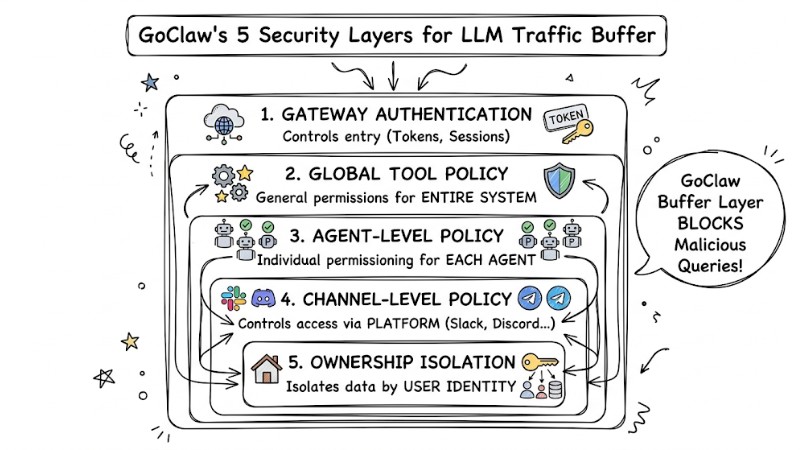
GoClaw's 5-layer security system
Data Isolation Mechanism with Multi-tenant PostgreSQL
GoClaw utilizes a multi-tenant database architecture, allowing multiple organizations to share the system while ensuring data is strictly partitioned.
- Isolation Logic: Every action, context file, and session is tagged with a
Tenant ID. This prevents "Organization A" data from being accessed by "Organization B." - Resource Encryption: API keys are encrypted using the AES-256-GCM algorithm (military-grade symmetric encryption standard), ensuring that even if the database is exposed, sensitive information remains unreadable.
-- Example: Simulated query for data isolation
SELECT * FROM agent_sessions
WHERE tenant_id = 'org_abc_123'
AND user_id = 'user_01';
Defense Against Specialized AI Attacks
AI agents are often targets for attacks such as Prompt Injection or unauthorized resource access (SSRF). Understanding these user concerns, GoClaw integrates built-in protection mechanisms:
- Blocking Prompt Injection: The system filters inputs and analyzes intent to remove commands capable of hijacking control.
- Shell Approval Workflow: When an agent needs to execute commands on the operating system, GoClaw requires an approval process. Administrators can fully control exactly which commands an agent is permitted to run.
- SSRF Prevention: GoClaw limits the network access scope of tools, preventing agents from scanning unauthorized internal ports.
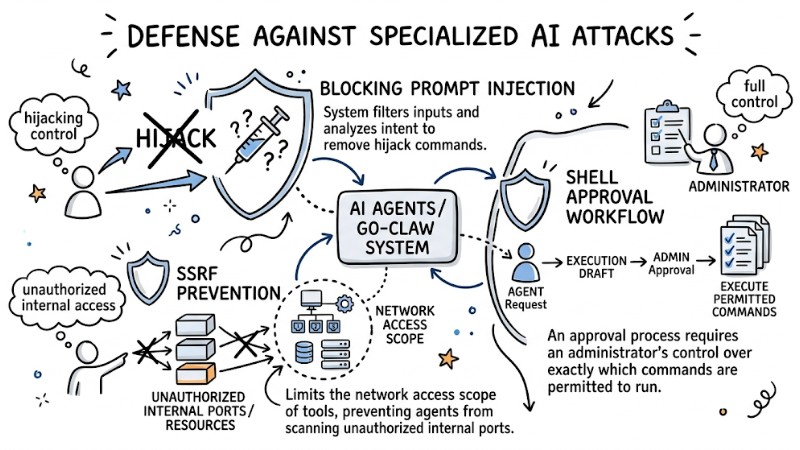
Defense Against Specialized AI Attacks
Encryption and Protection of Sensitive Resources
Transmitting data via WebSocket requires strict safety; therefore, GoClaw uses a multi-step authentication protocol to ensure integrity.
| Feature | Security Method |
|---|---|
| Key Storage | AES-256-GCM |
| Messaging | WebSocket v3 with Secure Handshake |
| Authentication | Token-based or Browser Pairing |
The Browser Pairing process allows operators to authenticate new devices without directly sharing API tokens, minimizing the risk of key exposure.
Learning How GoClaw Optimizes Enterprise Operations
GoClaw is built with minimalism to reduce the attack surface and optimize performance:
- Single Binary: The entire system is encapsulated in a single binary file (~25MB), independent of bulky runtimes like Node.js.
- Observability: Integrated OpenTelemetry allows administrators to monitor the full tracing of LLM calls, making it easy to detect errors or abnormal activities.
- Lean Resources: Boots in under 1 second and operates stably on low-spec VPS (starting from just $5).
FAQ about GoClaw Security
What is GoClaw and why is it important for AI security?
GoClaw is a multi-agent AI gateway built with Go, focusing on security. It acts as a secure buffer layer, protecting LLMs from attacks like prompt injection and SSRF while managing access rights.
How does GoClaw protect data with Multi-tenant PostgreSQL architecture?
GoClaw uses multi-tenant PostgreSQL to isolate data for each workspace. Each user has their own space, and context files and API keys are encrypted, ensuring data does not leak between different organizations.
How are GoClaw's security layers implemented?
GoClaw features 5 security layers: Gateway authentication, global tool policy, agent-level permissions, messaging channel security, and resource ownership, creating a robust defense system.
What measures does GoClaw take to prevent Prompt Injection attacks?
GoClaw integrates prompt injection detection and prevention mechanisms directly at the gateway layer. This helps filter out malicious requests before they can affect the LLMs or underlying systems.
How does GoClaw manage Shell execution safely?
GoClaw allows shell execution with an approval process. Users must be granted permission and confirm each shell command, strictly controlling actions that could pose security risks.
Which standard is used for data encryption in GoClaw?
GoClaw uses the AES-256-GCM encryption algorithm to protect API keys and sensitive data. This standard provides both confidentiality and integrity for the data.
Does GoClaw support secure WebSocket communication?
Yes, GoClaw supports secure WebSocket communication with various authentication methods such as tokens, browser pairing, or pairing flow initialization.
What are the benefits of GoClaw being a "Single Binary"?
GoClaw being a single binary file (approx. 25MB) simplifies deployment, reduces startup time (<1 second), and requires low resources, allowing it to run on low-spec servers.
How can one track and monitor GoClaw activities?
GoClaw integrates observability with OpenTelemetry support. This allows for tracking LLM calls, cache metrics, and other system activities.
Does GoClaw slow down AI response speeds?
GoClaw is optimized with Go, featuring a lightweight binary and asynchronous architecture, which helps maintain ultra-low latency during agent orchestration.
Can I deploy GoClaw without using PostgreSQL?
With the Desktop (Lite) version, you can run GoClaw entirely locally without needing Docker or a database.
Does GoClaw's attack detection system automatically block all malicious prompts?
The system combines static and contextual filtering; however, setting strict policies remains the most important factor for achieving maximum security effectiveness.
How many messaging platforms does GoClaw support?
Currently, GoClaw supports 7 main channels: Telegram, Discord, Slack, Zalo (OA & Personal), Feishu/Lark, and WhatsApp.
How do I update security patches for GoClaw?
Since GoClaw is distributed as a single binary, you simply replace the old binary with the new one to update without reinstalling the environment.
Read more:
- GoClaw Architecture: High-Performance AI Agent Gateway for Production
- GoClaw Use Case: A High-Performance, Ultra-Lean AI Agent Framework
- Guide to Integrating OpenClaw MCP for Advanced AI Agent Optimization
In summary, GoClaw Security does not just add a "shield" for AI models but also brings a clear multi-layered, multi-tenant security architecture and a lean operational process suited to the practical requirements of modern enterprises. If you are building or expanding AI infrastructure for your organization, this is the ideal time to implement GoClaw as a central gateway, protecting critical resources while keeping the system lightweight, stable, and easy to control.