GoClaw Use Case: A High-Performance, Ultra-Lean AI Agent Framework

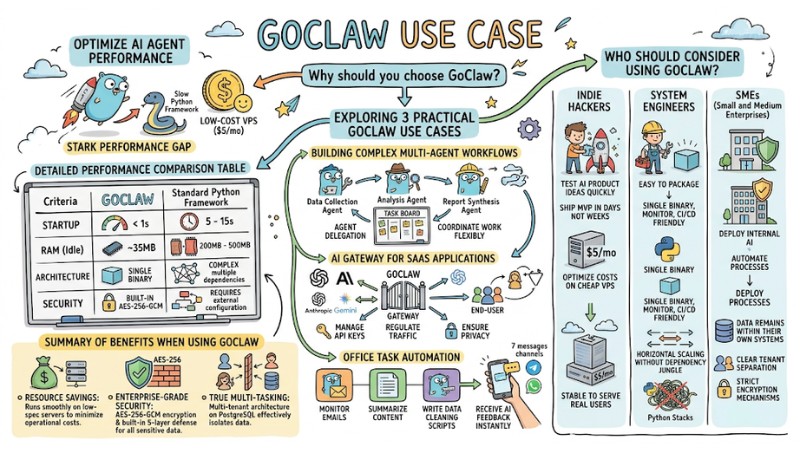
As businesses and individuals seek to leverage the power of AI without overspending on infrastructure, GoClaw has emerged as an ultra-lean AI Agent framework that remains powerful enough to drive complex real-world workflows. Developed by a team of Vietnamese engineers on the Go platform, GoClaw focuses on three core use case groups: building multi-agent workflows, serving as an AI gateway for SaaS, and automating office tasks - all from a single binary that runs smoothly on low-cost VPS. In this article, I will analyze in detail the practical use cases where GoClaw can help you optimize your AI infrastructure and workflows.
Key Takeaways
- GoClaw Definition: Discover the "ultra-lean" AI Agent framework written in Go, optimizing performance with a Single Binary architecture and extremely low RAM footprint.
- Reasons to Choose GoClaw: Understand the benefits regarding VPS operating costs, enterprise-grade security, and superior multi-tasking capabilities compared to the Python stack.
- Practical GoClaw Use Cases: Apply AI Agents to complex multi-agent workflows, use it as an AI Gateway for SaaS, and automate daily office tasks.
- GoClaw Target Audience: The perfect choice for Indie Hackers needing to ship MVPs fast, infrastructure engineers requiring stability/easy CI/CD, and SMEs needing internal data security.
- 5-Minute Getting Started Guide: Simple steps from downloading the binary to configuring the database and YAML files to launch the system immediately.
- FAQ: Get answers to issues regarding LLM compatibility, ease of use for non-Go programmers, and its advantages over OpenClaw.
What is GoClaw?
GoClaw is an open-source AI Agent framework, rewritten in the Go programming language based on the OpenClaw foundation. The biggest differentiator lies in its "Single Binary" architecture (a standalone executable), allowing the system to boot in under 1 second and maintain extremely low RAM consumption (approximately 35MB when idle). It is a lean, optimized alternative for high-performance systems and rapid deployment on resource-constrained infrastructure.
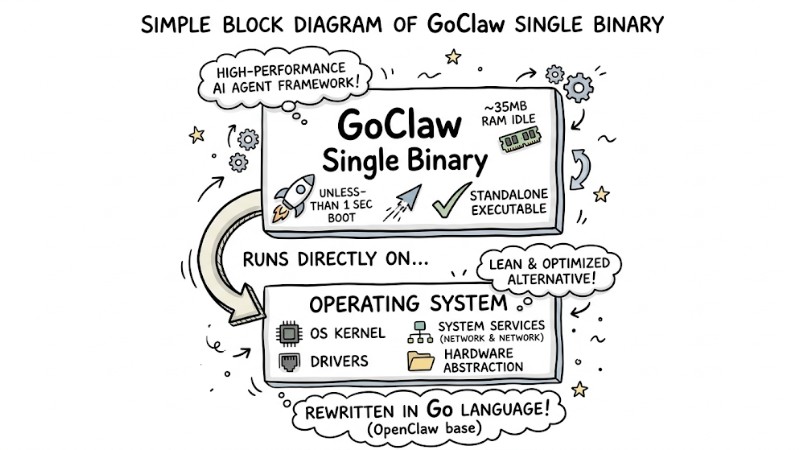
GoClaw is an open-source AI Agent framework, rewritten in the Go language based on the OpenClaw platform
Why should you choose GoClaw to optimize AI Agent performance?
GoClaw fully exploits Go's strengths in memory management and concurrency. When deployed on low-cost VPS plans ($5/month), the performance gap compared to traditional Python frameworks is stark.
Detailed Performance Comparison Table:
| Criteria | GoClaw | Standard Python Framework |
|---|---|---|
| Startup | < 1 second | 5 - 15 seconds |
| RAM (Idle) | ~35MB | 200MB - 500MB |
| Architecture | Single Binary | Complex multiple dependencies |
| Security | Built-in AES-256-GCM | Requires external configuration |
Summary of benefits when using GoClaw:
- Resource Savings: GoClaw's ability to run smoothly on low-spec servers minimizes operational costs.
- Enterprise-grade Security: GoClaw uses AES-256-GCM encryption for all sensitive data and features a built-in 5-layer defense.
- True Multi-tasking: GoClaw's multi-tenant architecture on PostgreSQL effectively isolates data between users.
Exploring 3 Practical GoClaw Use Cases
1. Building Complex Multi-agent Workflows
GoClaw supports an "Agent delegation" mechanism, allowing you to set up specialized agents such as: a data collection agent, an analysis agent, and a report synthesis agent. These agents share a task board and coordinate work flexibly.
2. AI Gateway for SaaS Applications
If you are developing a SaaS that needs to connect to multiple LLMs (OpenAI, Anthropic, Gemini...), GoClaw acts as a centralized gateway. It manages API keys, regulates traffic, and ensures privacy for each end-user.
3. Office Task Automation
Use GoClaw to monitor emails, summarize periodic content, or automate repetitive tasks (like writing data cleaning scripts). Support for 7 messaging channels (such as Telegram, WhatsApp) allows you to receive AI feedback instantly on your phone.
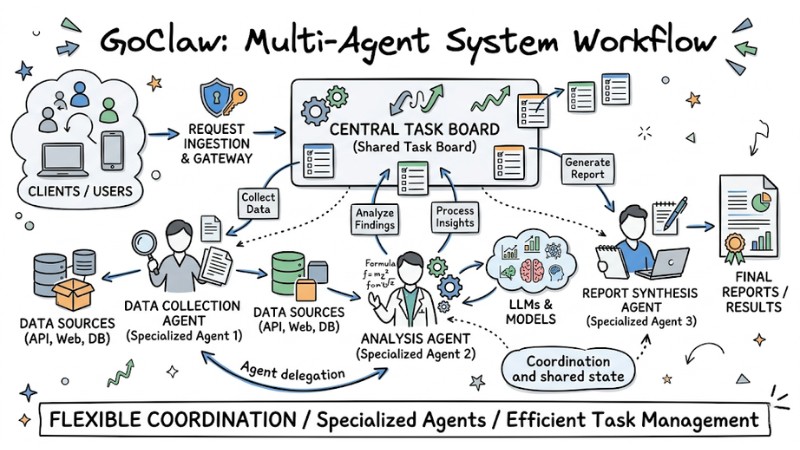
Multi-agent system workflow in GoClaw
Who should consider using GoClaw?
GoClaw is not only suitable for large technical teams but is particularly useful for small groups, individuals building products, and small-to-medium enterprises (SMEs) looking for a lean yet powerful AI platform for long-term operation. Specifically:
- Indie Hackers: Suited for those wanting to test AI product ideas quickly, ship an MVP in days instead of weeks, and optimize costs by running the entire system on a single cheap VPS while remaining stable enough to serve real users.
- System Engineers: Ideal for infrastructure engineers needing an AI agent platform that is easy to package (single binary), monitor, CI/CD friendly, and capable of horizontal scaling without the headache of a dependency jungle found in traditional Python stacks.
- SMEs (Small and Medium Enterprises): Very suitable for businesses wanting to deploy internal AI to automate processes while requiring data to remain within their own systems, with clear tenant separation and strict encryption mechanisms, rather than relying entirely on third-party services.
Quick Guide: Getting Started with GoClaw in 5 Minutes
GoClaw installation is highly simplified; you only need to perform the following steps on your server (Linux/Docker):
- Download and Install: First, download the binary corresponding to your operating system from the project's GitHub page.
- Configure Database: Next, provide a PostgreSQL connection to store agent states and configurations.
- Set Up the
.yamlFile: Declare the LLM providers and communication channels you wish to use. - Launch: Finally, launch GoClaw using the following command:
# Basic execution command
./goclaw --config config.yaml
The system will launch almost instantaneously, ready to receive requests from APIs or messaging channels.
FAQ about GoClaw Use Cases
In which cases can GoClaw be applied?
GoClaw is ideal for building complex multi-agent workflows, acting as a secure AI gateway for SaaS, or simply deploying a powerful AI infrastructure from a single binary on low-spec servers.
What are GoClaw's standout advantages compared to other AI frameworks?
GoClaw excels with sub-1-second startup times and an idle RAM footprint of only about 35MB. Additionally, GoClaw's single binary architecture facilitates easy deployment, while AES-256-GCM security and multi-tenancy with PostgreSQL ensure safety and high scalability.
Why is GoClaw effective for optimizing AI infrastructure costs?
With its lean Golang architecture, GoClaw allows for running powerful AI agents on low-cost VPS, for example, starting from just $5/month. This significantly reduces operational costs compared to more resource-heavy solutions.
How do I start using GoClaw?
You can start with a very simple process: Download the binary, set up PostgreSQL, configure the YAML file according to your needs, and run. The entire process is fast and does not require deep Golang knowledge.
Which messaging channels does GoClaw support?
GoClaw supports a variety of messaging channels, including Telegram and WhatsApp, allowing for easy integration into your existing communication flows.
Is GoClaw suitable for beginners learning about AI agents?
Yes, GoClaw is designed to simplify the deployment and operation of AI agents. You do not need to know Golang to use and configure it, making it accessible to newcomers.
Do I need to know how to program in Go to use GoClaw?
No. GoClaw is designed to be used via .yaml configuration files. You only need the logical mindset for agent workflows.
How is GoClaw different from OpenClaw?
GoClaw is a complete rewrite in Go. It delivers superior speed, extremely low memory usage, and a much simpler deployment process than the original.
Which models can I connect to?
GoClaw supports over 20+ different LLM providers through standardized APIs, making it easy to switch between models without changing code.
Read more:
- Guide to Integrating OpenClaw MCP for Advanced AI Agent Optimization
- OpenClaw Use Case: Effective Work Automation Methods
- What is AI Code Interpreter? Its Importance and How It Works
Overall, GoClaw Use Cases demonstrate that this is not just a "technically interesting" AI Agent framework, but a production-ready platform for building multi-agent workflows, setting up AI gateways for SaaS, and automating operational processes on ultra-minimalist infrastructure. If you are looking for a lightweight, controllable way to deploy AI that doesn't depend on too many external services while ensuring performance and security, GoClaw is an option worth trying right now.
Optimize your AI system today with GoClaw explore more GoClaw Use Cases and start deploying on your server with just a single binary from the official GitHub page or right at the GoClaw website.