GoClaw Architecture: High-Performance AI Agent Gateway for Production


When you start thinking about bringing AI Agents into a production environment, the challenge isn't just "calling the LLM API" but ensuring the system can handle the load, remain stable, and stay easy to operate long-term. GoClaw Architecture is designed to solve exactly that problem: An open-source AI Agent Gateway written in Golang, serving as an intermediate proxy layer to optimize performance, manage context intelligently, and ensure everything runs smoothly with just a single binary. In this article, I’ll take you through the GoClaw Architecture from a production perspective: from the role of an AI Agent gateway, how GoClaw handles routing, context, and security, to the design decisions that enable high performance in real-world environments.
Key Takeaways
- GoClaw Concept: Understand the open-source AI Agent Gateway, an intermediate proxy layer optimizing performance, stability, and professional operability in production environments.
- Reasons to choose Go over Python: Grasp the advantages of the Go language architecture (Goroutines) in handling thousands of concurrent connections without the bottlenecks (GIL) found in Python.
- Core Architectural Pillars: Explore the specialized layered model from the ingestion layer (Channels), control portal (API Gateway), security (Security Layer), coordination core (Agent Engine), language model provider layer (LLM Providers) to data management (Data Layer).
- FAQ: Resolve inquiries regarding GoClaw's role compared to LangChain, the security mechanism (SHA256), and criteria for choosing the right framework between the prototyping and production phases.
What is GoClaw?
GoClaw is an open-source AI Agent Gateway, designed to solve the "bottleneck" problem when moving AI Agent systems from prototype environments to real-world production operations. Completely rewritten in Golang by a team of Vietnamese engineers, GoClaw acts as an intermediate proxy layer that optimizes concurrency, manages context intelligently, and is packaged as a single binary file, making deployment lightweight and stable.
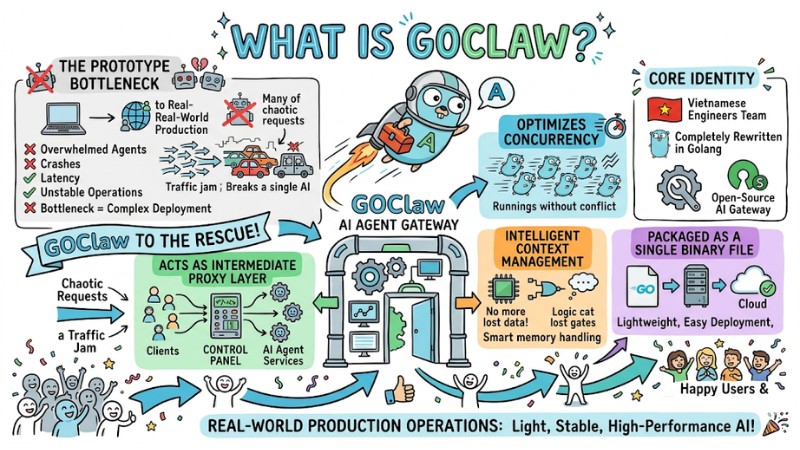
GoClaw is an AI Agent Gateway completely rewritten in Golang
Why choose Go instead of Python for an AI Gateway?
When a system scales beyond a few users, Python-based AI libraries often hit limits due to the GIL (Global Interpreter Lock) mechanism which prevents true parallel execution. In contrast, GoClaw leverages Goroutines - Go's ultra-lightweight thread mechanism (green threads) to process thousands of concurrent WebSocket connections without overloading RAM.
Technical Analysis: For a system with 1000 concurrent users, a Python proxy easily falls into a "bottleneck" state because the asynchronous mechanism (Asyncio) is blocked by heavy computational tasks. Conversely, GoClaw handles this well because each task is isolated in independent Goroutines, making full use of multi-core CPUs without the need for complex event loop management.
GoClaw Architecture: The Core Architectural Pillars of GoClaw
The GoClaw architecture is designed following a Layered Architecture model, focusing on durability, comprehensive observability, and applying a Zero-Trust security philosophy at every level. Specifically:
1. Channels (Multi-channel Communication Layer)
The multi-channel communication layer acts as the entry point for user interactions. The system supports a variety of popular messaging platforms such as Telegram, Discord, Slack, Zalo, WhatsApp, etc., and real-time connections via WebSocket.
2. API Gateway (Access Control Portal)
The API Gateway is the first checkpoint processing incoming data flows. This component is responsible for user authentication (Auth & JWT), Request Routing, traffic control (Rate Limiting), and system tracing (OpenTelemetry Traces).
3. Security Layer (Deep Security Layer)
The system integrates an independent security layer to protect the application core. This layer performs vulnerability detection and prevention (Injection Detection, SSRF Protection, Shell Pattern Guard), AES-256-GCM data encryption, and continuous security patching (CVE Patch).
4. Agent Engine (Intelligent Coordination Core)
This is the main "brain" processing GoClaw's logic. This core manages AI teams (Agent Teams), allocates work, maintains continuous conversation flows, and controls output quality. Notably, the Agent Engine is highly extensible with over 40 integrated tools via the MCP protocol.
5. LLM Providers (Language Model Provider Layer)
This layer provides cognitive power to the Agent Engine. The architecture allows the system to connect flexibly (plug-and-play) with a range of leading AI providers such as OpenAI, Anthropic, Google Gemini, or locally running models like Ollama.
6. Data Layer (Data Management Layer)
The final layer ensures data integrity and information retrieval speed. The system utilizes PostgreSQL combined with RLS (Row-Level Security) for a multi-tenant architecture, leverages Vector Stores to store semantic data for the AI, uses Redis Cache to optimize speed, and Audit Logs to trace every activity.
In summary: GoClaw operates as a seamless pipeline: Information enters from chat platforms, passes through censorship and security portals, is analyzed by the Agent core combined with AI, and finally is stored securely in the database system.
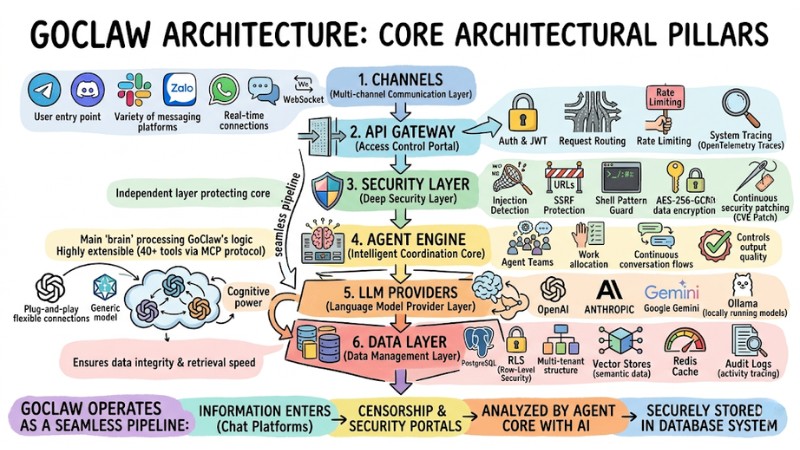
High-performance AI Agent Gateway architecture for Production
FAQ about GoClaw Architecture
Does GoClaw completely replace frameworks like LangChain?
GoClaw is not aimed at "replacing" frameworks like LangChain, but rather plays a different role in the overall AI system architecture. You can view LangChain (or similar frameworks) as the place where you design agent logic, chains, tools, workflows, etc., while GoClaw is the Gateway/Proxy layer standing in front to bring those agents into a production environment safely, stably, and easily.
Why does GoClaw use SHA256 to detect loops?
GoClaw uses SHA256 for loop detection because hashing the entire state into a fixed string is much lighter than directly comparing long text strings at each iteration step. Instead of having to keep and compare the full content of every agent call, the system only needs to store previous SHA256 hash values and check if the current state has appeared before, significantly reducing CPU and memory costs when operating in production environments.
Is GoClaw suitable for beginners?
GoClaw is not the optimal choice for beginners who are only getting acquainted with AI agents at a theoretical or small-scale experimental level. If your goal is to learn concepts, test prompts, chains, tools, etc., then Python and frameworks like LangChain or LlamaIndex remain a more accessible path. Once you have a working prototype and start thinking about "bringing it to production," that is when GoClaw proves its true value as a high-performance gateway.
How to deploy GoClaw?
GoClaw can be conveniently deployed as a single binary, requiring no complex dependency installations. It also supports multi-channel communication (Telegram, Discord) and subagent depth limit configuration to ensure safety.
Should I use GoClaw if I already have an AI framework in Python?
Yes, GoClaw is the ideal solution to bring AI Agents developed in Python to market, helping them operate durably, efficiently, and with high load capacity without changing the core Agent logic.
Read more:
- GoClaw Use Case: A High-Performance, Ultra-Lean AI Agent Framework
- Guide to Installing OpenClaw and Simple Configuration for Beginners
- OpenClaw Review: Evaluating a Self-Hosted Open-Source AI Agent
From an architectural standpoint, GoClaw Architecture demonstrates how to build a proper AI Agent Gateway: clear layering, prioritizing security, observability, and performance right from the design. If you are looking to take an AI Agent from prototype to production while maintaining a lightweight, easy-to-deploy, and easy-to-operate system, this is the right time to try applying GoClaw architecture to your own system.