What is Multi-Agent Workflow? Architecture, Models and Applications

Multi-Agent Workflow is a way to organize multiple AI agents to collaborate within a role-based architecture, using shared rules and states to solve complex problems that exceed the capabilities of a single agent. This article presents everything from concepts and foundational architecture to design models, core components, practical applications, common risks, and how to choose a framework for each need.
Key Takeaways
- Concept: Understand that Multi-Agent Workflow is a distributed system where multiple AI Agents are assigned specialized roles to collaborate toward a common goal, much like a department within an enterprise.
- Architectural Components: Understand the overall structure of a multi-agent system and the roles of layers such as agents, processing flows, state, and guardrail mechanisms.
- Design Models: Get familiar with common ways to arrange agent teams, from peer-to-peer collaboration to centralized supervision or multi-layer hierarchies.
- Practical Application: See how multi-agent workflows can be applied to various scenarios such as software development, customer service, market research, and content production.
- Risk Management: Get an overview of common types of risks in multi-agent systems and technical directions for controlling data quality and execution flows.
- Framework Evaluation: Gain a general perspective on popular multi-agent frameworks and the types of problems each platform is suitable for.
- FAQ: Get answers to concerns regarding the role of humans, how to control agent behavior, and how to operate the system with reasonable costs.
Overview of Multi-Agent Workflow
What is Multi-Agent Workflow?
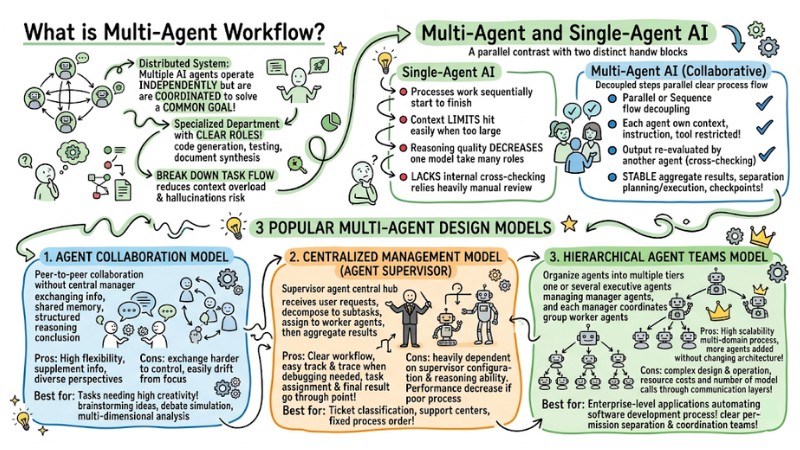
Multi-Agent Workflow is a form of distributed system in which multiple AI agents operate independently but are coordinated to solve a common goal. Instead of using a single model for everything, the architecture is organized into a multi-component cognitive structure similar to a specialized department with clear roles.
In this system, each AI is assigned a specific task scope such as code generation, testing, or document synthesis. Breaking down the task flow helps each agent handle a narrower area of expertise and reduces the risk of generating hallucinations when having to process too much context at once.
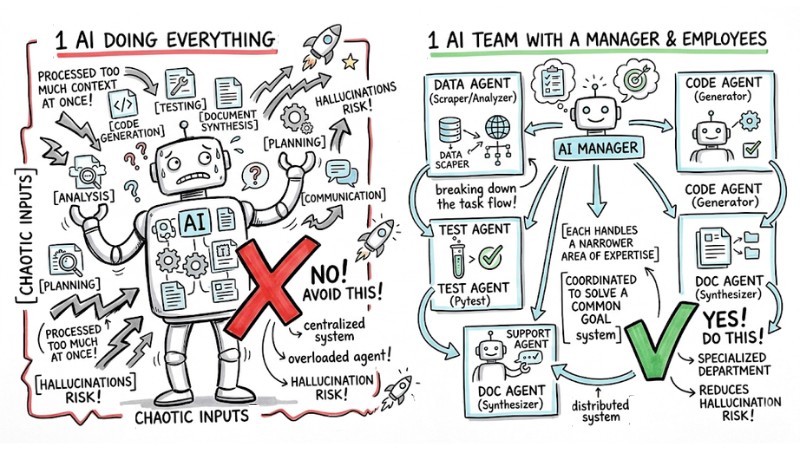
A Multi-Agent Workflow is a system where multiple AI agents are orchestrated to solve a collective goal
The difference between Multi-Agent and Single-Agent AI
To clearly see the power of Agentic orchestration, let's directly compare these two models:
Single-Agent AI:
- Processes most work sequentially from start to finish in one reasoning flow.
- Easily hits context limits when requests or the codebase is too large for the supported context window.
- Reasoning quality can decrease when one model must take on many different roles in the same session.
- Lacks internal cross-checking mechanisms, so it relies heavily on manual review to detect errors.
Multi-Agent AI (Collaborative agent workflows):
- Decouples work into steps that can be performed in parallel or in a sequence with a clear process flow.
- Each agent has its own context, instructions, and tool access restricted by task, helping control the blast radius.
- The output of one agent can be re-evaluated by another agent in a cross-checking role before being integrated into the final result.
- Aggregate results are usually more stable thanks to role-based mechanisms, separation of planning and execution, and multiple checkpoints in the processing flow.
Core components of Multi-Agent architecture
Optimizing the specialization of each agent (Agent Autonomy)
Agent autonomy is one of the foundational characteristics of multi-agent systems, where each agent is given clear goals and tool scopes instead of using an agent with too many capabilities at once.
Practical implementation is often more effective when dividing the toolset into small groups and attaching them to each agent with specialized prompts and about two to three primary tools for that task.
For example, when building an automated task execution system, you can create an agent specializing in code generation with access to the code repository and instructions to create logic functions, then pass the result to another agent with a prompt for testing or security to review the source code.
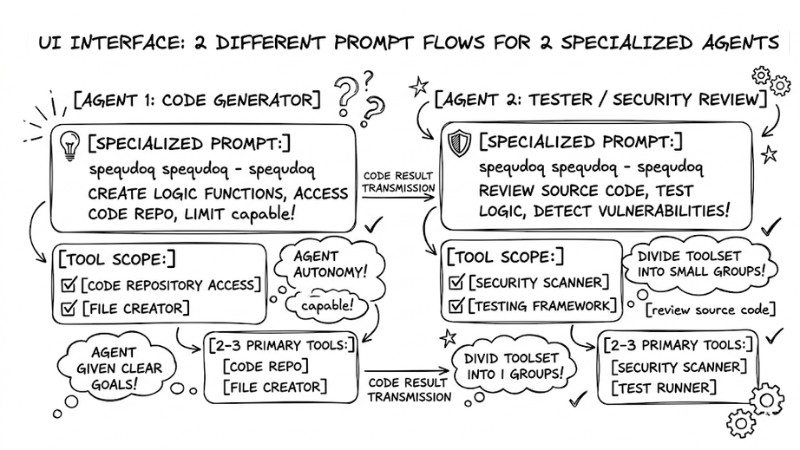
2 different prompt flows for 2 specialized agents
Decomposing and processing complex problems (Decentralized control)
The decentralized control model allows a large problem to be split into many small modules, each attached to an agent with a clear task, making it easy to track the progress and quality of each processing step.
- Ingestion Agent: Responsible for connecting to APIs, gathering raw data from the internet, and performing basic cleaning steps.
- Preprocessing Agent: Receives raw data, categorizes, and converts it into a standard format for downstream agents to use easily.
- Logic Agent: Reads preprocessed data and generates answers or core code functions according to the objective.
- Testing Agent: Runs automated tests on the output of the Logic Agent and requests updates when errors are detected.
This organization helps quickly identify which step in the chain is causing an error when the system fails, instead of having to search for the cause in a long conversation history between the user and a single agent.
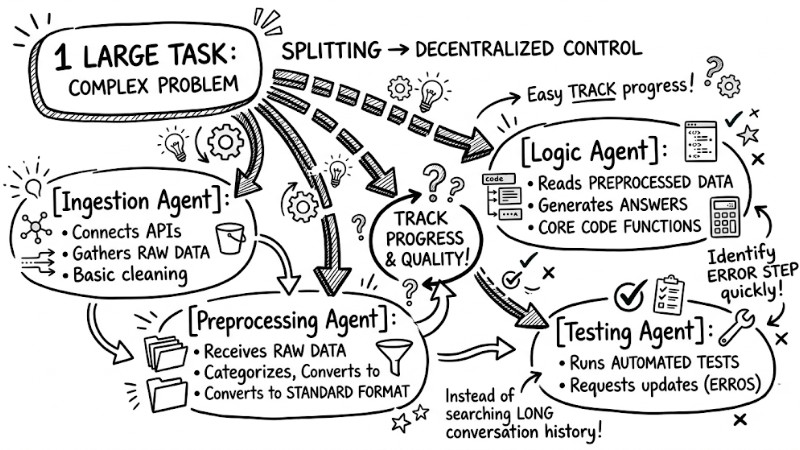
Splitting 1 large task into 4 small tasks assigned to 4 agents
Enhancing stability and controllability (Fault Tolerance in AI systems)
A well-designed workflow orchestration system needs to maintain stable operation even when one or several agents encounter local errors.
- Isolating bottlenecks: When an agent encounters an issue like a lost API connection or execution error, the architecture needs to ensure the error is kept within that node's scope, not spreading to other steps, through node separation, using checkpoints or circuit breakers to break the flow before it affects the entire process.
- Automatic recovery: You can configure automatic retry mechanisms according to defined policies or send error reports to a supervisor agent to decide on switching the flow to an alternative processing path, helping the system continue running without immediate manual intervention.
- Zero downtime upgrades: Architecture separated by agents allows replacing the foundational model of an agent with a newer version or reconfiguring that agent while other agents still operate normally, supporting gradual deployment and fine-tuning without stopping the whole system.
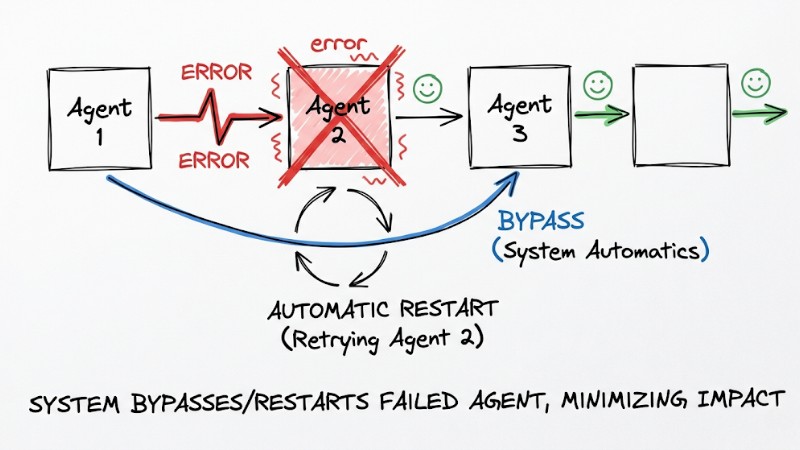
An agent with an error but the system automatically bypasses or restarts only that agent
Communication and data exchange (Message Passing)
Message passing is the mechanism that defines the format and content conventions of the messages that agents use to exchange data with each other. In the interdependent communication model, the output of Agent A is packaged into a standardized message and becomes a mandatory input for Agent B through an intermediate layer like a message broker.
The coordination process between agents takes place based on structured data formats, for example, a JSON payload with sender, receiver, and specific content fields, replacing free text that is difficult for machines to process. This standardization helps reduce deviations when transmitting data between steps and supports tracking, debugging, as well as scaling multi-agent systems.
{
  "sender": "research_agent",
  "receiver": "writer_agent",
  "data_extracted": ["KPI 2023", "Revenue: $1M"],
  "status": "completed"
}
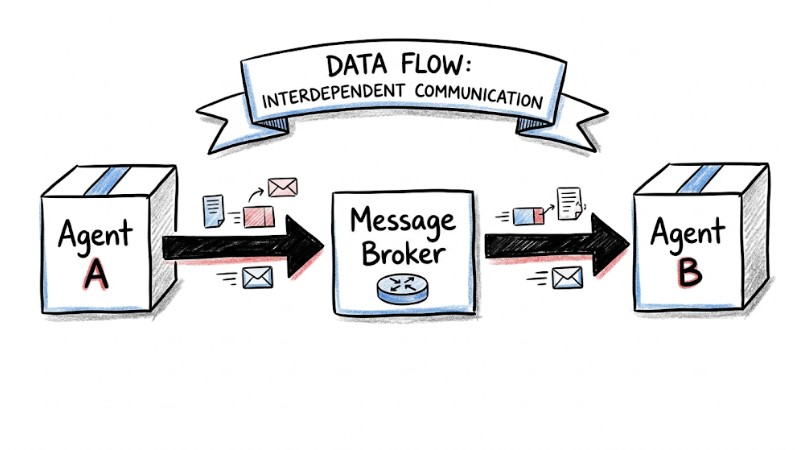
Standardized data transmission process
Shared State Management (State Management)
State management is the mechanism for storing and updating information about the current state of the multi-agent system, including interaction history, intermediate data, and task progress. This storage area acts as a dynamic digital notebook where agents can read and write shared data to maintain continuity when handing over work or collaborating on long-running tasks.
The state rotation process takes place through clear state transitions, usually modeled as a state machine, helping the system determine exactly the next step to perform after each agent action.
Note on loop control: You must strictly establish stop conditions. If two agents with opposing views argue without rules limiting the number of turns, the system will fall into an infinite loop, causing a serious waste of API resources.
Establishing boundaries and permissions (Action Schemas)
To prevent AI from performing operations beyond its permitted scope, it is necessary to establish flow control mechanisms with clear boundaries between each step and each agent. Action schemas act as a set of rules that specifically define what types of actions each agent is allowed to perform on each type of resource.
Example of practical security: A data analysis bot only has the permission to read database files, and is not granted permission to perform operations such as sending mass emails to customers.
Basic Role-Action Matrix:
| Role (Agent) | Action (Permissions) | Tool granted |
|---|---|---|
| Research Agent | Read-only | Search Engine, Web Scraper |
| Writer Agent | Drafting | Text Editor |
| Admin Agent | Approve and Execute | Email API, CMS Publisher |
3 popular Multi-Agent design models
1. Agent Collaboration Model
In this peer-to-peer collaboration model, agents exchange information directly with each other, accessing shared memory together and using structured reasoning patterns to reach a common conclusion without a central management layer.
- Pros: High flexibility, agents can supplement each other's information and make good use of diverse perspectives during processing.
- Cons: The exchange flow is harder to control, easily leading to long interaction chains that drift from the focus if there are no clear coordination rules.
- Best for: Tasks needing a high level of creativity like brainstorming ideas, building scripts, simulating debate, or multi-dimensional analysis of a topic.
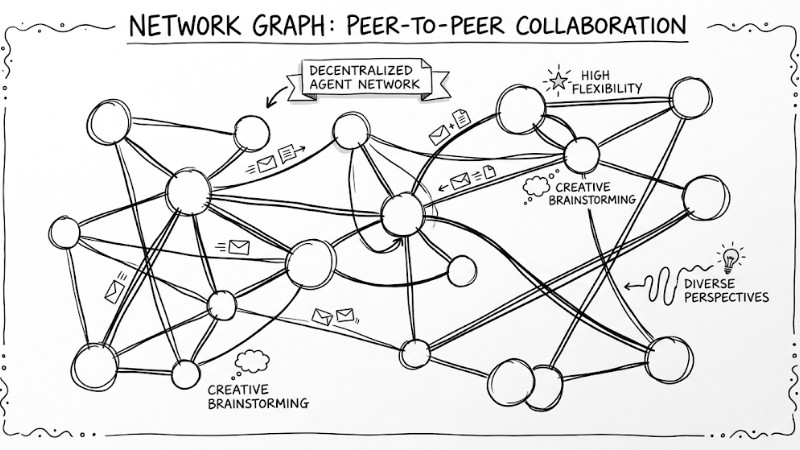
Agent Collaboration Model
2. Centralized Management Model (Agent Supervisor)
This is a popular orchestration model where a supervisor agent acts as a central hub to receive requests from users, decompose them into subtasks, and assign them to worker agents for execution, then aggregate the results.
- Pros: Clear workflow, easy to track and easy to trace when debugging is needed, because all task assignment decisions and final results go through the same coordination point.
- Cons: Heavily dependent on the configuration quality and reasoning ability of the supervisor; if this agent processes poorly or is overloaded, the performance of the whole system will decrease.
- Best for: Ticket classification systems, customer support centers, or multi-step document lookup processes that need to follow a fixed processing order.
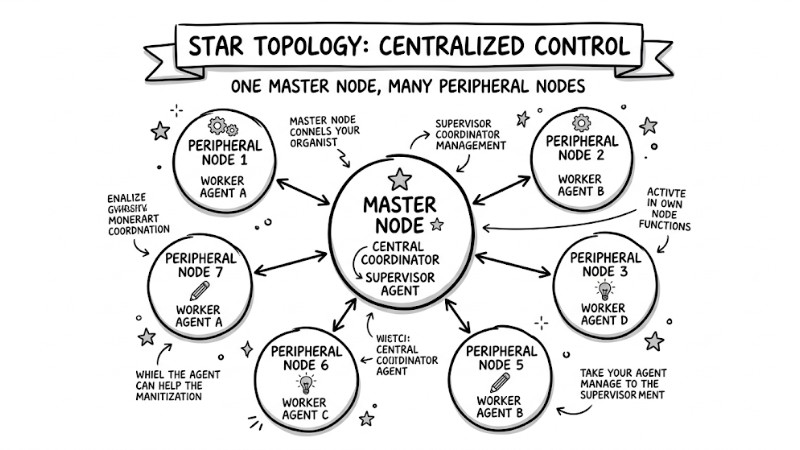
Centralized Management Model
3. Hierarchical Agent Teams Model
This model organizes agents into multiple tiers, usually with one or several executive agents at the top managing manager agents, and each manager coordinating a specialized group of worker agents for each work segment.
- Pros: High scalability, suitable for large and multi-domain processes, because more agents can be added at each tier without changing the entire architecture.
- Cons: More complex design and operation, resource costs and the number of model calls are often large because information must go through many communication layers before completing a request.
- Best for: Enterprise-level applications or systems automating many stages of the software development process, where clear permission separation and coordination of many specialized agent teams are needed.
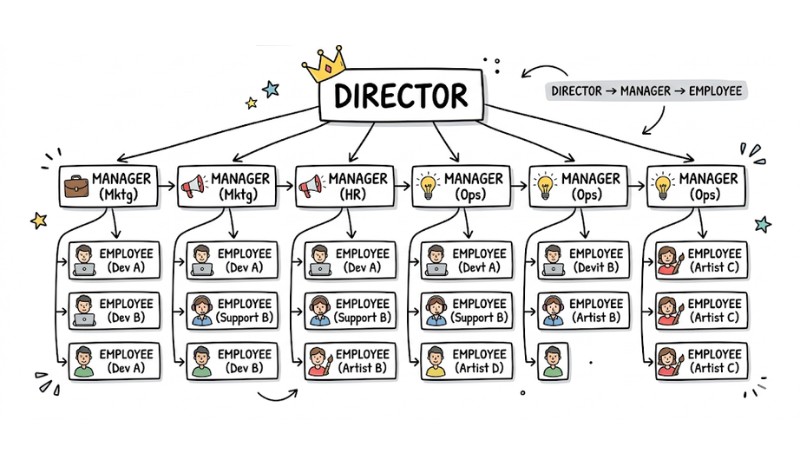
Hierarchical Agent Teams Model
Multi-Agent Workflow applications in practice
Below are some typical application examples of Multi-Agent Workflow in different fields:
- Automated Software Engineering (DevOps/Coding): A group of agents cooperates to handle almost the entire development lifecycle of an application using LLMs, from interpreting requirements, generating code, running unit tests to creating pull requests and proposing patches based on feedback from the repository.
- Intelligent Customer Care: A human-in-the-loop process combining a sentiment analysis agent, a purchase history lookup agent, and a response drafting agent, then passing it to a staff member for approval before sending to the customer to maintain quality control and safety.
- In-depth Market Research: A multi-agent system consisting of an agent gathering news from multiple sources, an agent summarizing and extracting insights, and an agent aggregating data to draw charts and generate reports in standard formats like PDF.
- Digital Content Creation (Marketing): A chain of agents including an SEO agent to cluster and group keywords, a copywriter agent to write content, a design agent to create image prompts, and an editor agent to check for errors before content is published to media channels.
- Financial Investment Analysis: Agents continuously gather financial reports, track real-time market data, assess risk levels, and send alerts when investment portfolios exceed predefined thresholds.
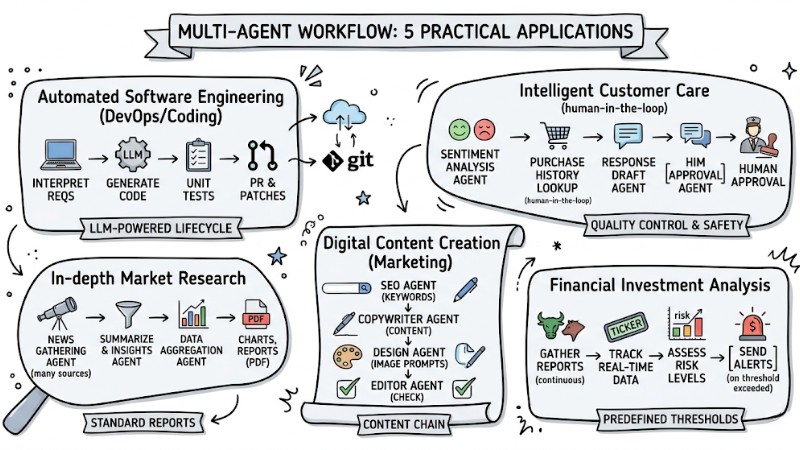
Multi-Agent Workflow applications in practice
Why do multi-agent systems often fail?
1. Communication errors due to inconsistent natural language
When agents exchange with each other using long and non-standardized text segments, the risk of data inconsistency increases because the content and phrasing can be mutated through each step. One agent may interpret a requirement or the result of a previous agent differently, causing the dependent communication chain to break and the system to produce results that no longer stick to the original requirement.
2. Workflow conflicts (Asynchronous task execution)
Asynchronous execution helps increase processing speed but at the same time creates risks of overwriting or consuming data in an invalid state when multiple agents operate on the same piece of information at once.
For example, in an e-commerce system, one agent processes a shipping address update while another agent processes a cancellation request due to a payment error; if there is a lack of a locking mechanism or state check before writing, one agent might try to write changes to an order already marked as canceled by another agent, leading to logic errors or inconsistent state in the system.
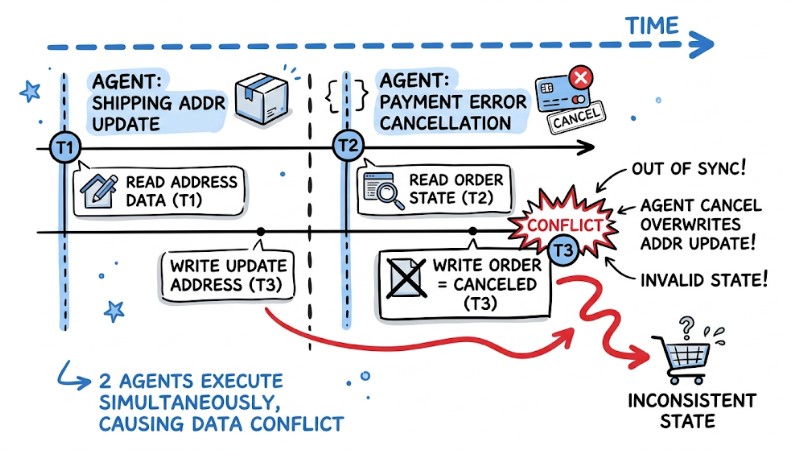
Asynchronous agents can cause conflicts in the workflow.
3. Real-world solution: Data standardization (Schema-based contract enforcement)
To limit communication errors and data conflicts, you can apply schema-based contract enforcement, in which agents only exchange data through fixed structures like JSON validated against a schema.
Implementation methods like the Model Context Protocol use JSON Schema to clearly define input and output for each tool; if an agent returns data missing a mandatory field or in the wrong format, the request will be rejected and return an error, helping detect problems early before incorrect data spreads to other steps.
{
  "name": "update_database",
  "input_schema": {
    "user_id": "integer",
    "action": "string"
  },
  "output_schema": { "status": "boolean" }
}
Top 3 Frameworks for building Multi-Agent today
Comparing Autogen vs CrewAI vs LangGraph will help you choose the right framework to design multi-agent workflows and applications based on LLMs right from the start, instead of building the entire architecture from scratch.
| Framework | LangGraph | AutoGen | CrewAI |
|---|---|---|---|
| Framework type | Multi Agent Orchestrate framework on state graphs, tightly integrated with the langchain ecosystem | Multi Agent framework focused on conversation models between multiple agents and users, developed by microsoft | Multi Agent framework oriented towards “crew” tasks, focused on role division and process-like task coordination |
| Patterns best supported | Supervisor, hierarchical, network, clearly supported via nodes and edges on a graph | Multi-agent conversation, code assistant, collaborative workflow centered around chat between agents | Agent group performing projects via task list, clear role division like researcher, writer, reviewer |
| Strengths | Control of flow, state, and retry is clear, easy to debug, suitable for building complex systems needing high reliability | Easy to start with Multi Agent scenarios based on chat, many ready-made examples for code generation and tool calling | Syntax is quite simple for “project team” scenarios, strong in content writing, research, and business task use cases |
| Notes when using | Need to understand concepts of graph, node, edge and state machine, initial configuration is relatively detailed | Dependent on the python ecosystem and microsoft libraries, need to design clear orchestration logic manually | Developing quickly, need to track versions and documentation to update API changes |
Answering common questions about Multi-Agent Workflow
Does Multi-Agent Workflow completely replace humans?
Current multi-agent systems primarily support the execution of repetitive tasks, data manipulation, and part of process automation, and do not take responsibility for final decisions. Humans still maintain the human in the loop role, designing processing flows, providing professional context, and approving results at predefined checkpoints.
How is state management in LangGraph different from CrewAI?
LangGraph uses a state graph model with TypedDict and reducer, each node receives clear state and returns updates, helping you observe, checkpoint, and restore each step in the processing flow. CrewAI by default implicitly passes results between tasks and uses shared memory for the “crew”, thereby reducing the amount of boilerplate when building linear workflows but providing less detail about the state at each step.
How to prevent agents from running in infinite loops?
You can limit the permissions and scope of each agent through action schemas, combined with schemas for input/output or MCP to force every exchange step to comply with a clear data contract. At the same time, it is necessary to set stop conditions like max_iterations, time limits, or limits on the number of callbacks to the same node so the system automatically terminates the discussion session when the allowed threshold is exceeded.
Is the cost of operating a multi-agent system expensive?
API costs are usually higher than single agent because multiple agents read and write state and context together, especially when using large models for every step. To optimize, you can apply a tiered model, using small and cheap models for routing or preprocessing tasks, only calling powerful models like GPT 4o or Claude 3.5 for steps needing deep reasoning.
Read more:
- What is a Coding Agent? The Best Automated AI Programming Solution
- What is Agent Engineering? The Process of Bringing AI Agents into Production
- What are Autonomous Agents? Mechanisms, Classifications and Applications
Multi-Agent Workflow achieves its highest efficiency when tasks are reasonably decomposed, architecture has clear permissions and state management, communication between agents is standardized by schema, and there is a loop control mechanism. When combining these principles with appropriate design models and the right framework for each context, teams can build deeply automated AI systems while still maintaining the ability to control, monitor, and adjust according to business goals.