MCP vs API: Understanding the Differences in AI Agent Integration

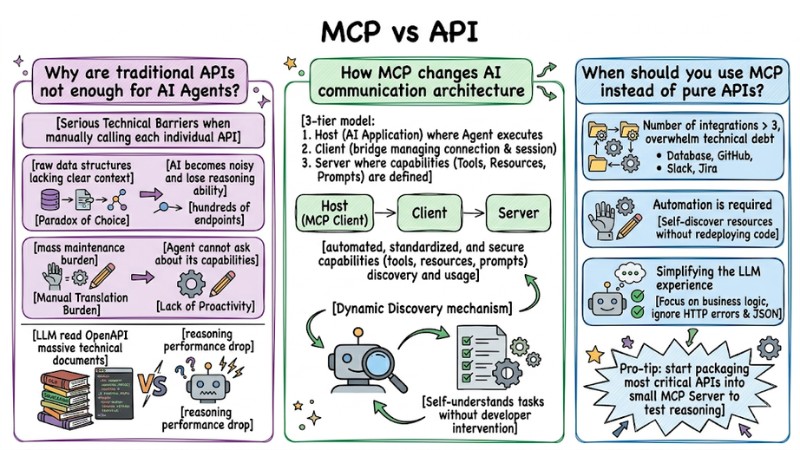
In the AI era, connecting Large Language Models (LLMs) to external data is a life-or-death challenge. If traditional APIs act as the "common language" for software communication, then the Model Context Protocol (MCP) is the "specialized protocol" designed for AI Agents to interact with the data world autonomously and securely. In this article, I will help you deconstruct the differences between MCP vs API, when to use each, and how to leverage MCP to build more effective AI Agents.
Key Takeaways
- Limitations of Traditional APIs: Understand why old APIs cause difficulties for AI Agents (information noise, maintenance burden, and lack of proactivity).
- MCP Architecture: Understand the operational mechanism of MCP that helps AI Agents discover and utilize "capabilities" in an automated, standardized way.
- Comparing API vs MCP: Clearly know the core differences to choose the technology best suited to the complexity of your AI project.
- When to use MCP: Identify the timing for migrating from pure APIs to MCP to optimize scalability and system management.
- Superior Security: Grasp how MCP acts as a "gatekeeper," enhancing security by isolating access rights for AI Agents.
- The Future of AI Agents: Know why MCP is a critical link in helping AI Agents become truly autonomous and smarter in data interaction.
- Answering FAQs: Get quick solutions for concerns regarding deployment, security, and technical comparisons between MCP, API, and Function Calling.
Why are traditional APIs not enough for AI Agents?
An API (Application Programming Interface) is a set of rules and standards that help two software programs communicate in a structured way, usually through endpoints like HTTP/REST, gRPC, or GraphQL.
When applied to AI Agents, it often creates serious technical barriers such as:
- The Paradox of Choice: An enterprise API may possess hundreds of endpoints. This causes the AI to become "noisy" and lose reasoning ability when faced with raw data structures lacking clear context.
- The Manual Translation Burden: You must write numerous wrappers to describe the functions and parameters for each endpoint, leading to a massive maintenance burden.
- Lack of Proactivity: An Agent cannot "ask" an API about its capabilities; everything must be hard-coded in advance.
When an LLM has to read massive technical documents like OpenAPI to understand how to call functions, reasoning performance usually drops significantly compared to using a protocol with pre-packaged capabilities like MCP.
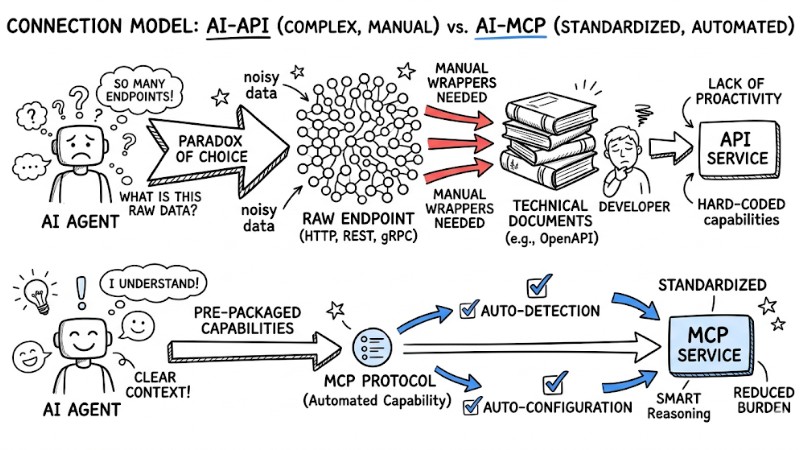
Connection model between AI-API vs AI-MCP
How MCP changes AI communication architecture
MCP (Model Context Protocol) is a protocol specifically designed so AI Agents can discover and use "capabilities" (tools, resources, prompts) in a standardized, automated, and secure way, instead of manually calling each individual API in the traditional manner.
MCP creates an Abstraction layer that ensures the AI Agent doesn't need to know about the underlying infrastructure logic. This architecture operates based on a 3-tier model:
- Host (AI Application): Where the Agent executes, containing the MCP Clients.
- Client: The bridge managing the connection and session with the Server.
- Server: Where the "capabilities" (Tools, Resources, Prompts) that the AI can access are defined.
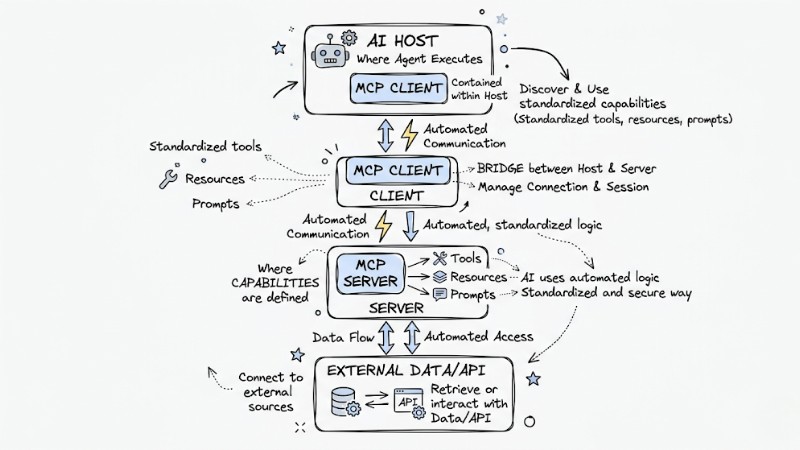
How MCP is changing the architecture of AI communication
The Dynamic Discovery mechanism is the biggest differentiator of MCP compared to APIs. Upon connection, the MCP Server automatically sends a list of available tools with detailed descriptions to the AI. Thanks to this, the Agent "self-understands" what tasks it can perform without the developer intervening in the source code every time there is a new feature.
Quick Comparison Table: API vs MCP
| Feature | Traditional API | MCP |
|---|---|---|
| Target User | Developers (humans). | AI Agent. |
| Mechanism | Read documentation, call endpoints manually. | Automated discovery via protocol. |
| State | Usually Stateless. | Stateful (maintains sessions). |
| Security | Complex token management for each service. | Standardized via intermediate layer. |
| Flexibility | Low; requires code updates for changes. | High; self-adapts to new capabilities. |
When should you use MCP instead of pure APIs?
Based on practical experience, if your project only needs a few individual connections, pure APIs are enough. However, if you are building a complex AI Agent system, consider migrating when:
- Number of integrations > 3: When managing multiple services (Database, GitHub, Slack, Jira), the technical debt from maintaining manual APIs becomes overwhelming.
- Automation is required: Agents need the ability to self-discover resources without redeploying code.
- Simplifying the LLM experience: You want the AI to focus only on business logic instead of handling HTTP errors or complex JSON formatting.
Pro-tip: Start by packaging your most critical APIs into a small MCP Server to test the Agent's reasoning ability before expanding the entire system.
Security and Permission Management in the MCP Ecosystem
One of the greatest advantages of MCP is high-level security for the Agent:
- Access Isolation: The Agent never directly holds API Keys or admin rights. Instead, the MCP Server acts as a "gatekeeper," only granting permission to execute specific actions.
- OAuth 2.0 Implementation: You can integrate authentication flows into the MCP Client to ensure the Agent only operates on the data of authorized users.
- Principle of Least Privilege: Only define necessary "Tools" in the MCP Server, preventing the Agent from accessing sensitive, unrelated endpoints.
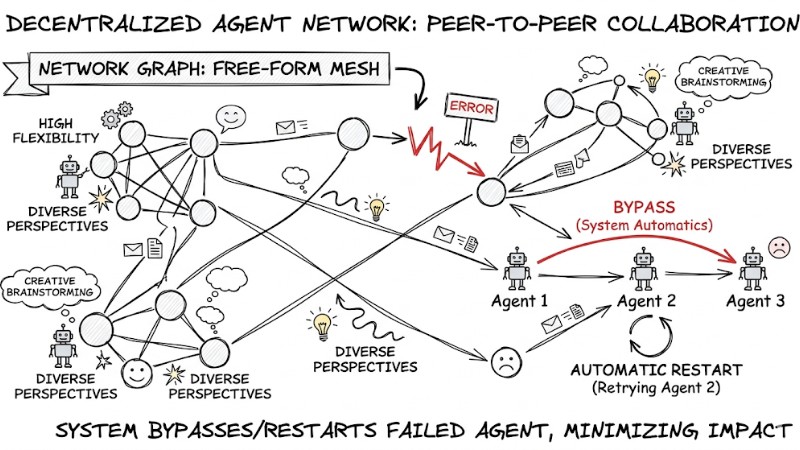
The MCP protection layer plays a role in controlling input/output data
Answering Frequently Asked Questions about MCP vs API
Does MCP replace APIs?
No. MCP does not replace APIs; it sits at a higher layer, acting as a standardized "wrapper" that helps AI Agents understand and use APIs (and other data sources) more intelligently, securely, and automatically.
What is the difference between MCP and Function Calling?
Function Calling is a technique that helps the AI "see" functions, whereas MCP is a complete protocol (Protocol) with features for discovery, state management, and consistent security for those tools.
Can I build an MCP Server for old APIs?
Absolutely. You just need to write an adapter layer to map the old API endpoints into "Tools" within the MCP standard.
How do MCP and API differ in the context of AI Agents?
MCP is a protocol specifically designed for AI Agents to discover and use tools. Meanwhile, an API is a traditional application programming interface, primarily intended for developers and interacting software applications.
Why is a traditional API not enough for an AI Agent?
Traditional APIs can be too complex with many endpoints, making it difficult for an AI Agent to choose the right tool. Interpreting API documentation for the AI also requires significant effort, and systems are less flexible when APIs change.
How does MCP work with an AI Agent?
MCP provides an abstraction layer between the AI Agent and the underlying system. The Agent only interacts with the MCP Server – where "capabilities" (tools, resources, prompts) are clearly described. The MCP Server receives the Agent's request, translates it into appropriate API calls or data queries, and returns a standardized result. This allows the Agent to discover, select, and use tools securely and consistently without knowing the infrastructure details behind them.
Should I use MCP instead of pure APIs for every AI Agent project?
Not necessarily. If you only need to integrate 1-2 simple services, pure APIs may suffice. However, when you need to connect multiple services or build complex AI Agents, MCP brings significant benefits in management and scalability.
Does MCP completely replace APIs?
No, MCP does not replace APIs. It operates on top of existing API foundations. MCP acts as an intermediate layer, helping AI Agents interact with APIs more effectively and securely.
How do I build an MCP Server for existing APIs?
You need to create an MCP Server that exposes "capabilities" packaged from existing APIs. This involves clearly defining the functions, parameters, and expected results for each capability, allowing the AI Agent to query and use them.
What is the main benefit of using MCP for AI Agent security?
MCP enhances security by restricting AI Agents from directly accessing the original API and API Keys. Every interaction is managed through the MCP Server, allowing for granular access control and activity monitoring.
Read more:
- AI Agent Orchestration: 6 Optimal System Design Patterns
- Multi-Agent Architecture: 4 Core Models and Practical Applications
- AI Agent Architecture: A Comprehensive Developer's Guide
MCP is not just a technical change; it is a necessary step for AI Agents to transform from disjointed scripts into true assistants. Start migrating your system to MCP today to optimize connectivity and intelligence for your AI ecosystem.