What is an AI Agent: How it works and its applications

Is your business wasting too much time and resources on repetitive manual tasks? If so, an AI Agent is the comprehensive automation solution for managers, HR, Marketing, Customer Service, or IT personnel. In this article, GoClaw will help you understand the core concepts, operational principles, and how to immediately deploy a "virtual employee" into your real-world workflows to optimize performance without requiring complex programming knowledge.
Key Takeaways
- Core of AI Agents: AI Agents are autonomous artificial intelligence systems that automatically plan and execute complex tasks instead of just passively answering questions.
- Operational Principles: Master the coordination between the "Brain" (LLM) and "Hands/Feet" (Tools/API) to interact directly with the real-world working environment.
- Core Differences: Distinguish the "looping" mindset of AI Agents from the "straight-line" mechanism of traditional AI.
- Technical Architecture: Grasp the 3 core components and the operational loop to design an optimal system.
- Practical Applications: Explore 10 key application areas from Customer Service, Finance, HR to IT and Logistics to identify the right problems to automate.
- Tools and Platforms: Select the right solution by categorizing tools from deep programming to no-code solutions.
- Risk and Ethics Management: Identify challenges regarding data security and "AI hallucinations", while establishing Human-in-the-loop rules to ensure absolute safety.
- Deployment Roadmap: Master the 3-step standardization process before scaling up.
- FAQ: Get definitive answers to issues about replacing personnel, data security, and the differences between AI Agents and traditional RPA.
What is an AI Agent?
Basic Concepts of AI Agents
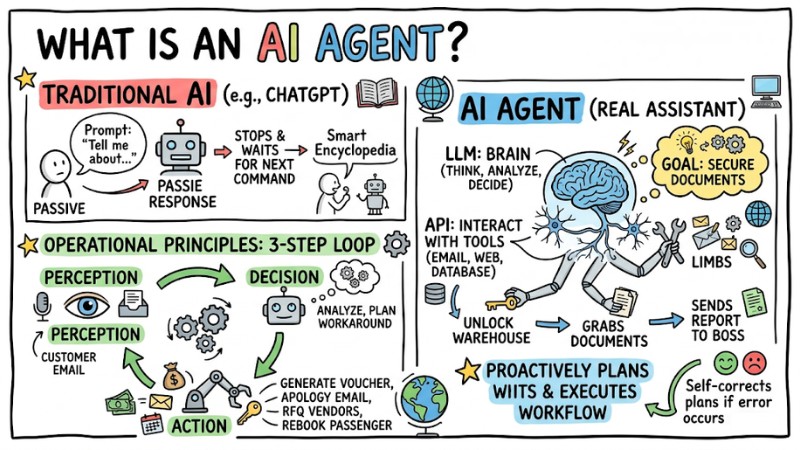
An AI Agent is a software system capable of perceiving its environment, reasoning independently, and automatically executing actions to achieve a specific goal set by humans.
The power of an AI Agent lies in its Autonomy. You just need to assign the final goal; the system will automatically handle the Planning, break down the work, and complete it without you having to monitor every step.
To easily visualize this, think of an AI Agent functioning as a complete entity:
- LLM (Large Language Model): Acts as the "Brain" to think, analyze, and make decisions.
- API (Application Programming Interface): Acts as the "Limbs" to help the AI interact with other software (like sending emails, searching the web, querying databases).
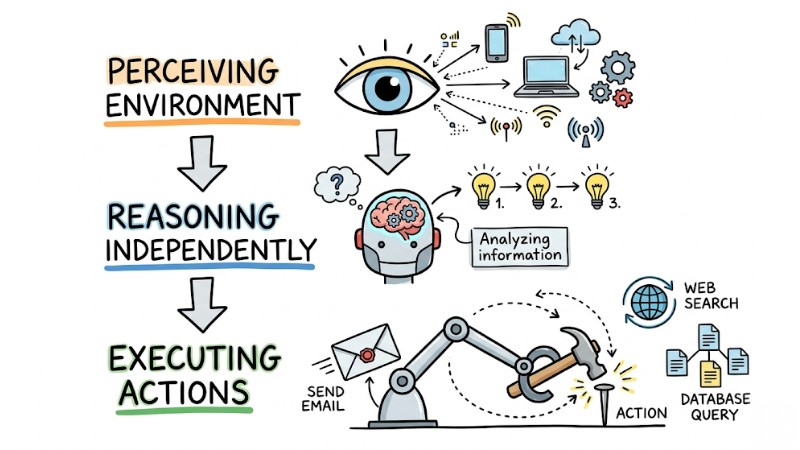
AI Agents are capable of perceiving their environment, reasoning independently and automatically executing actions
The Core Difference Between AI Agents and Traditional AI
Traditional AI (like ChatGPT) operates passively. You input a prompt, the AI responds and stops, and it cannot do anything on its own without your continuous intervention.
Conversely, an AI Agent possesses chain-of-thought reasoning and the ability to self-correct its plans. If it encounters an error midway, the system automatically finds another workaround until the goal is met.
| Criteria | Traditional AI (ChatGPT, Claude) | AI Agent |
|---|---|---|
| Autonomy | Passive, waits for human commands. | Proactively plans and executes the entire workflow. |
| Environment Interaction | Confined to the chat interface. | Interacts directly with the web, databases, and internal software. |
| API Usage | Very limited or non-existent. | Proficiently uses multiple external tools and software. |
| Supervision Level | Requires human intervention at every step. | Operates independently, humans only act as Human-in-the-loop (supervising critical decisions). |
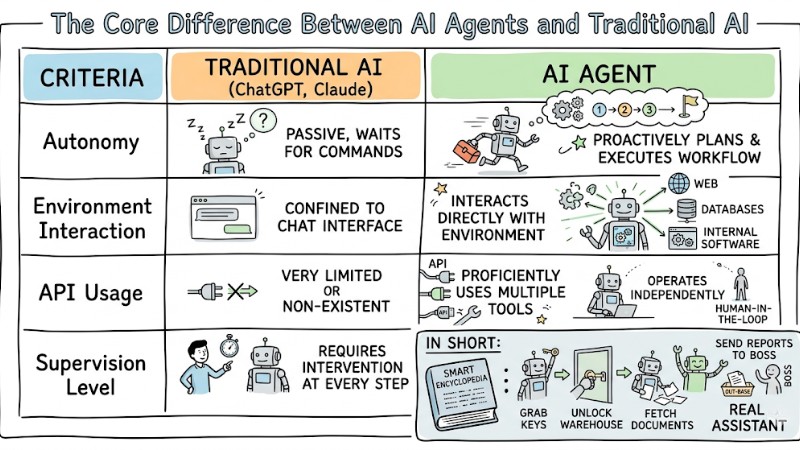
The core difference between AI Agents and Traditional AI
In short:
- Traditional AI is just a "smart encyclopedia".
- An AI Agent is a "real assistant" who knows how to grab the keys, unlock the warehouse, fetch documents, and send reports to the boss.
Architecture and Operational Principles of AI Agents
3 Core Components
A complete AI Agent system consists of 3 main components:
- Large Language Model (LLM): The central brain that processes input data, applies logical reasoning, and issues directives.
- Tools/API: Extensions that expand the AI's capabilities. Thanks to APIs, an AI Agent can read PDFs, access CRMs, calculate on Excel, or send Slack messages.
- Orchestration Layer: The execution bridge that manages the agent's lifecycle, maintains context memory, and smoothly routes the workflow.
Battle-tested advice: Don't deify the LLM. The real power and business value come from how many suitable Tools you provide the Agent. An average AI model paired with high-quality APIs will outperform a massive LLM with no "limbs".
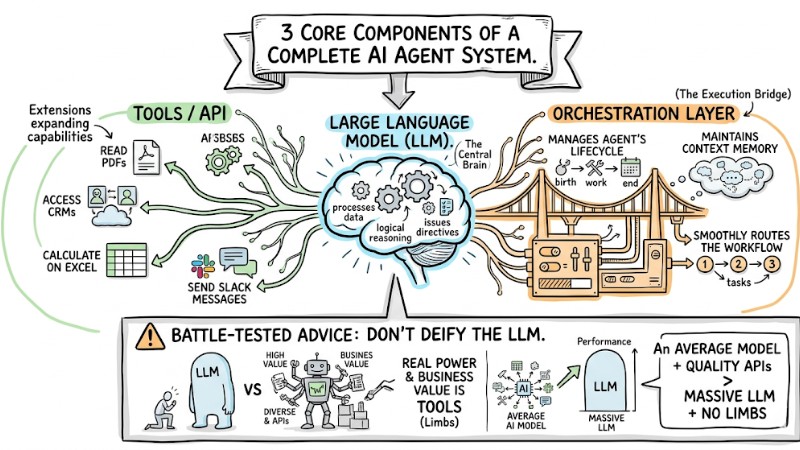
The three core components of an AI Agent.
The 3-Step Execution Mechanism (Perception - Decision - Action)
AI Agents operate in a continuous loop, interacting with their surrounding environment:
- Perception: The system collects input data from users or sensors/software (e.g., receiving a customer complaint email).
- Decision-making: The LLM analyzes the information, evaluates priorities, and plans the execution (e.g., determining the error belongs to shipping and requires compensation).
- Action execution: Calls tools to perform the task (e.g., automatically triggering an API to access the system, generating a 20% discount code, and sending an apology email to the customer).
Case Study: How an AI Agent Automates Customer Complaints
Traditional complaint resolution workflows often take hours to days, but with an AI Agent, this process happens in seconds, specifically:
Customer sends a complaint email -> Agent 1 reads and runs sentiment analysis -> Agent 2 checks order history in the CRM -> Agent 3 decides on compensation -> Agent 4 generates a voucher and drafts a reply -> Sends to the customer.
Expert perspective: To achieve the highest accuracy, I usually set up Multi-agent systems. Instead of having one Agent handle everything, spin up several micro-agents (a Reading Agent, a Searching Agent, a Writing Agent). The collaboration between specialized agents helps reduce hallucination and improves security.
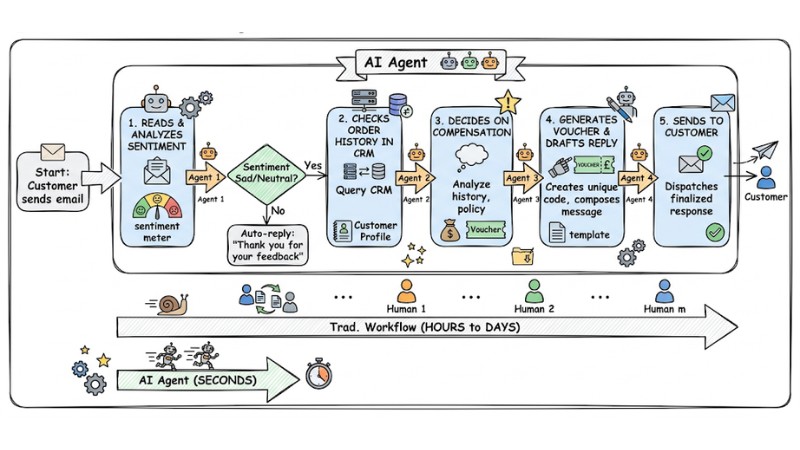
Automated customer complaint processing flow via Multi-agent
Top 10 Enterprise and Real-world Applications of AI Agents
Customer Service and 24/7 Virtual Assistants
AI Agent systems automatically receive, parse context, and resolve customer issues in real-time.
- Pros: Ability to handle thousands of concurrent requests, 24/7 uptime without breaks, and smooth, human-like responses.
- Cons: Lacks deep empathy in highly sensitive or complex edge cases.
- Best for: Customer Support departments, retail, telecommunications.
- Example: The AI automatically checks flight statuses and proactively rebooks passengers upon sensing delay notifications.
Marketing and Ad Campaign Optimization
AI Agents automatically scrape market data, analyze user behavior, and dynamically adjust ad budgets.
- Pros: Blazing fast A/B testing, accurate proactive forecasting of consumer trends.
- Cons: Heavily reliant on the quality of input data.
- Best for: Digital Marketing Agencies, in-house Marketing teams, FMCG enterprises.
- Example: The Agent automatically kills underperforming Facebook ads and reallocates budget to winning campaigns at 2 AM.
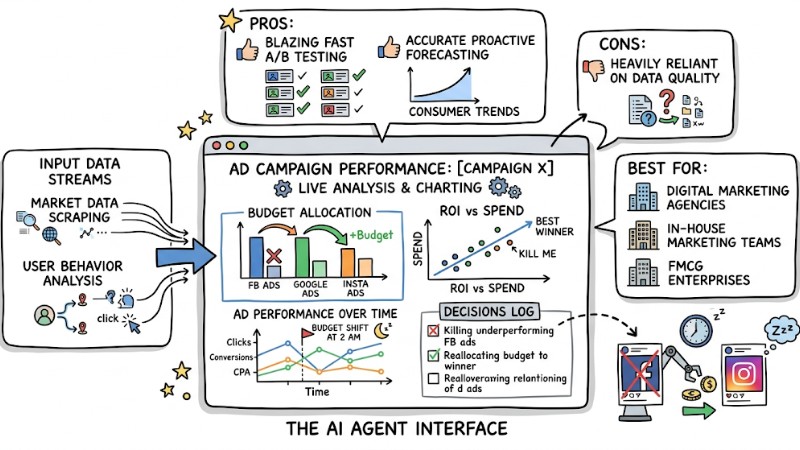
AI Agent applications in Marketing and ad campaign optimization
Financial Management - Accounting and Risk Analysis
Utilizing AI to reconcile books, scan invoices, and detect anomalies in the blink of an eye.
- Pros: Completely eliminates manual data entry errors, capable of scanning millions of transactions for fraud detection.
- Cons: Requires extremely strict system security.
- Best for: Banks, financial institutions, enterprise Accounting departments.
- Example: The AI Agent automatically downloads invoices from emails, extracts the data, and pushes it directly into MISA accounting software.
Human Resources (HR) and Candidate Screening
Automates the entire recruitment pipeline from scanning thousands of CVs and scoring fit, to scheduling interviews.
- Pros: Cuts resume screening time by 80% while remaining objective and free of personal bias.
- Cons: May miss out on top talent if CVs are formatted weirdly, confusing the parser.
- Best for: Headhunters, HR departments, large-scale corporations.
- Example: The Agent automatically parses 500 CVs, shortlists the top 10 candidates, and auto-sends interview invites based on the Director's free calendar slots
Software Development (IT) and Code Review
Applied in software engineering to assist developers in writing code, debugging, and auto-generating technical documentation.
- Pros: Shortens the product development lifecycle, detects deep-seated security vulnerabilities in the source code.
- Cons: Cannot replace the high-level architectural design thinking of a Principal Engineer.
- Best for: Tech companies, development teams (DevOps).
- Example: The AI automatically reviews thousands of lines of code every night, fixes syntax errors, and pushes a report the next morning.
Supply Chain and Logistics
AI Agents hook directly into GPS and warehouse systems to optimize routing and forecast inventory shortages.
- Pros: Lowers logistics costs, enables real-time inventory management.
- Cons: Requires synchronized hardware infrastructure (IoT sensors) and software.
- Best for: Freight companies, manufacturing plants, import/export businesses.
- Example: The Agent forecasts bad weather and automatically reroutes the delivery fleet to safer paths without dispatcher intervention.
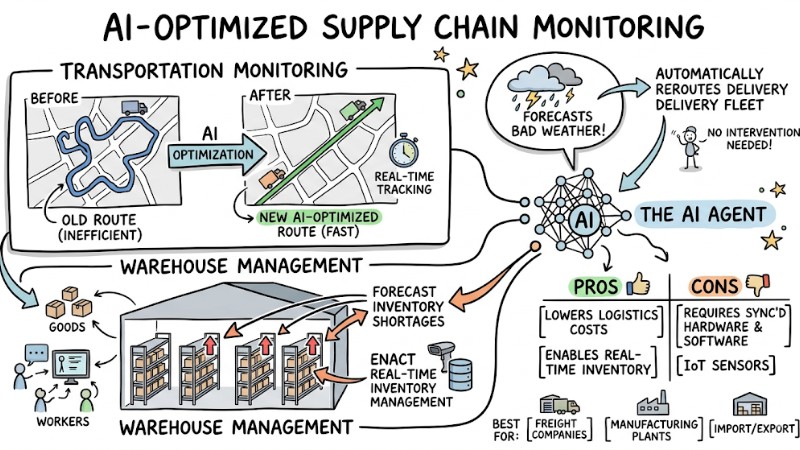
AI Agent applications in Supply Chain and Logistics
E-commerce (Experience Personalization)
Tracks click behavior and page dwell time of individual customers to dynamically render the most relevant products.
- Pros: Spikes Conversion Rates and Average Order Value.
- Cons: Needs tactful implementation to avoid making users feel over-tracked.
- Best for: E-commerce platforms (Shopee, Lazada), online retail websites.
- Example: A customer abandons their cart; the Agent automatically spins up a custom discount code and shoots them a Zalo message to nudge checkout completion.
Procurement Management and Vendor Recommendation
The system automatically tracks global raw material price fluctuations, compares quotes, and drafts contracts.
- Pros: Secures the best pricing, ensures transparency in the bidding process.
- Cons: Still requires humans in the loop for negotiating sensitive terms.
- Best for: Procurement departments, hardware manufacturing enterprises.
- Example: The AI Agent monitors global steel prices; when the price drops to the threshold, the system automatically triggers RFQs to 5 trusted vendors.
Big Data Analysis and R&D
Leverages RAG (Retrieval-Augmented Generation) to synthesize millions of research papers, discovering patterns or forecasting new trends.
- Pros: Knowledge synthesis speed far exceeds human limits, with exact source citations.
- Cons: Consumes massive compute resources.
- Best for: Research institutes, pharmaceutical companies, R&D departments.
- Example: The AI Agent automatically parses 10,000 medical reports to uncover potential side effects of a novel active ingredient.
Business Process Automation (Combining AI and RPA)
Users can integrate AI Agents into Robotic Process Automation (RPA) systems. Here, the AI acts as the brain handling edge cases, while the RPA does the actual mouse-clicking and data entry.
- Pros: Creates hyper-automated workflows with zero human intervention.
- Cons: Complex deployment, high initial CapEx.
- Best for: Multinational corporations, enterprises with heavy paperwork processes.
- Example: The AI parses a budget request email (non-standard format), extracts the context, and then commands the RPA to hit the ERP system and generate an approval ticket.
7 Popular AI Agent Tools and Platforms
Depending on your technical chops and business needs, you can choose tools from the 3 tiers below:
The Hardcore Tier (For Developers):
- AutoGPT: The most famous open-source agent, capable of self-prompting and writing code to execute tasks.
- LangChain / LlamaIndex: Foundational frameworks for engineers to build AI Agent systems from scratch.
The User-Friendly Tier (For Business Users):
- Custom GPTs (OpenAI): Easily spin up a specialized Agent with just a few prompts on ChatGPT.
- Microsoft Copilot Studio: Deeply integrated into the Microsoft 365 ecosystem, helping you build internal virtual assistants without writing code.
The Automation Workflow Tier (No-code Automation):
- Zapier Central: A platform hooking into thousands of apps, turning AI into an automated cross-platform execution agent.
- AgentGPT: Deploy autonomous agents directly in your browser just by entering a name and a goal.
- Make.com: Similar to Zapier but offers a visual workflow interface and more complex branching logic.
Pro Tip: If you are just getting into AIaaS (AI as a Service), I recommend starting with Custom GPTs or Zapier Central to get a feel for how to delegate to Agents before dropping budget on expensive enterprise systems.
Pros and Cons of Deploying AI Agents
Massive Benefits Driving Digital Transformation
Piping AI Agents into operational workflows yields tangible results for your digital transformation roadmap:
- Boost enterprise productivity: Process massive workloads in seconds.
- Slash costs: Save 40% - 60% of your budget on repetitive tasks.
- Eliminate manual errors: Guarantee absolute precision in reconciliation and data entry tasks.
- Optimize strategy: Free up bandwidth so your team can focus on creative work and high-level decision-making.
Challenges, Security Risks, and AI Ethics
However, this technology ships with risks that demand strict governance:
- Data privacy issues: Over-scoping API permissions can cause the AI to inadvertently leak sensitive company data.
- AI Hallucinations: Agents can confidently make skewed decisions, causing severe financial fallout.
The optimal solution right now is enforcing the Human-in-the-loop principle. Any critical operation (like wiring money, firing personnel, or executing contracts) must pause and await final human approval to ensure AI Ethics.
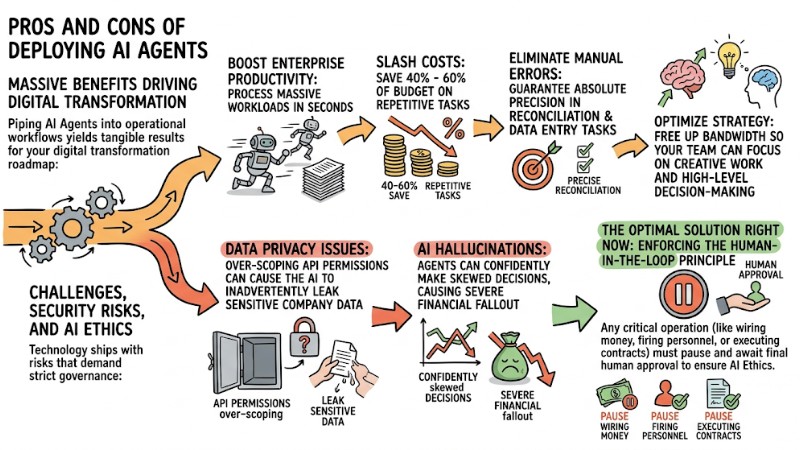
Pros and cons of deploying AI Agents
How Should Enterprises Start Deploying AI Agents?
Don't fall into the FOMO trap and ship AI haphazardly; instead, execute these 3 sequential steps:
- Pinpoint the exact Pain-point: Figure out which workflow is burning the most time and is highly error-prone to set as your target problem. Solving a specific bottleneck always yields the highest ROI.
- Standardize internal data: AI Agents are only smart when fed clean data. So, digitize all your documents and company policies. This is a mandatory foundation for implementing RAG architecture, ensuring the Agent pulls correct internal knowledge instead of hallucinating.
- Run a small-scale Proof of Concept (PoC): Start with a simple agent (e.g., an Agent handling internal HR policy FAQs). Measure performance and tweak accuracy before rolling it out company-wide.
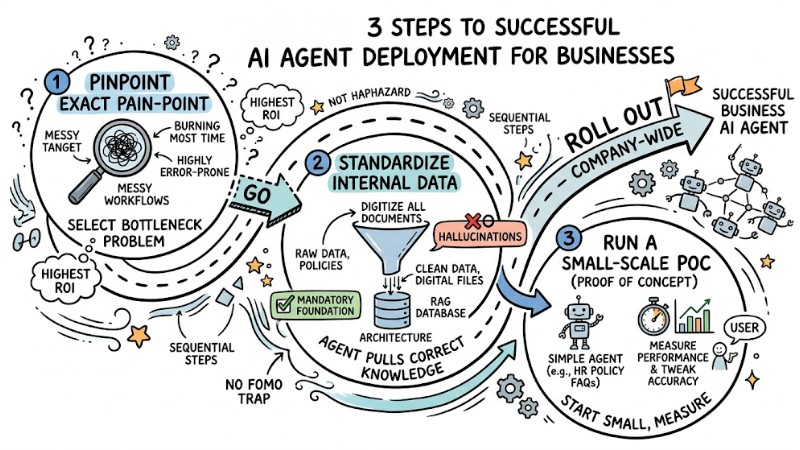
3 steps to successful AI Agent deployment for enterprises
Frequently Asked Questions (FAQ) about AI Agents
Will AI Agents completely replace humans?
No. AI Agents are built to augment Human-Computer Interaction, acting as powerful sidekicks. They perfectly execute high-volume, repetitive tasks, but they cannot replace humans in empathy, agile strategic thinking, and complex negotiations.
Does using AI Agents require complex programming skills?
No. The explosion of No-code/Low-code platforms like Zapier or Microsoft Copilot Studio allows anyone to spin up an AI Agent via drag-and-drop interfaces and natural language prompts (Vietnamese/English).
How do AI Agents differ from RPA (Robotic Process Automation)?
AI Agents are infinitely more flexible than RPA. RPA runs on pre-programmed, static if-then scripts and will break if the UI changes. Conversely, AI Agents can parse context, process unstructured data (like emails or images), and dynamically figure out how to complete the task even if the environment shifts.
Is enterprise data safe when processed by AI Agents?
Yes, if configured correctly. To ensure data security in AI, enterprises need to use the Enterprise tiers of OpenAI or Microsoft. These platforms guarantee they won't train their base models on your internal data. Additionally, you must strictly avoid dumping confidential data into free, consumer-grade AI tools.
Read more:
- How AI Agents work: Autonomy and Functional Mechanisms
- Popular Types of AI Agents: How to choose and Real-World Applications
- When to Use an AI Agent? 7 Signs You Need Automation
AI Agents are no longer just a whitepaper concept or a fleeting tech trend; they are rapidly becoming the core "executors" of the near-future digital workforce. Integrating intelligent agent systems helps enterprises break through in velocity, optimize overhead, and build an overwhelming competitive moat.
Instead of sitting on the sidelines, start today by auditing your inefficient internal workflows. Try spinning up a simple AI Agent on user-friendly platforms to experience firsthand the incredible automation power this tech delivers.
Tags