How AI Agents work: Autonomy and Functional Mechanisms

If you are looking to automate complex workflows instead of just relying on simple Q&A chats, this article is for you. I will directly explain how an AI Agent system self-reasons, plans, and manipulates tools to complete tasks from A to Z. Fully grasping the core operational mechanisms will help you know how to apply this technology to optimize enterprise performance.
Key Takeaways
- Core Nature: AI Agents are artificial intelligence systems capable of autonomous planning and taking action to achieve goals, rather than just answering questions.
- Architecture: Comprises 4 core components: the LLM (brain), Sensors (perception), Memory, and Tools.
- Workflow: AI agents operate through 5 steps: perception, reasoning, tool selection, execution, and self-correction.
- Core Differences: Outperforms traditional AI due to its ability to autonomously use tools and fix errors instead of waiting for continuous commands.
- Applications: Powerfully optimizes software engineering, customer support, financial analysis, and supply chain management.
What is an AI Agent? A Simple Breakdown of Artificial Intelligence Agents
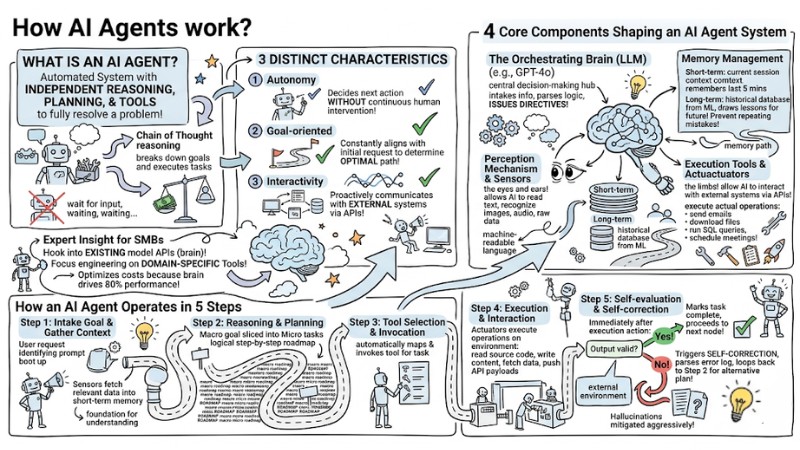
An AI Agent is an automated system capable of independent reasoning, planning, and using tools to fully resolve a problem. Instead of waiting for you to input prompt after prompt like a standard chatbot, an AI Agent leverages Chain of Thought reasoning to break down goals and execute tasks until it produces the final result.
A standard AI Agent system possesses 3 distinct characteristics:
- Autonomy: Decides the next action without requiring continuous human intervention.
- Goal-oriented: Constantly aligns with the initial request to determine the most optimal execution path.
- Interactivity: Proactively communicates with external software, websites, or databases.
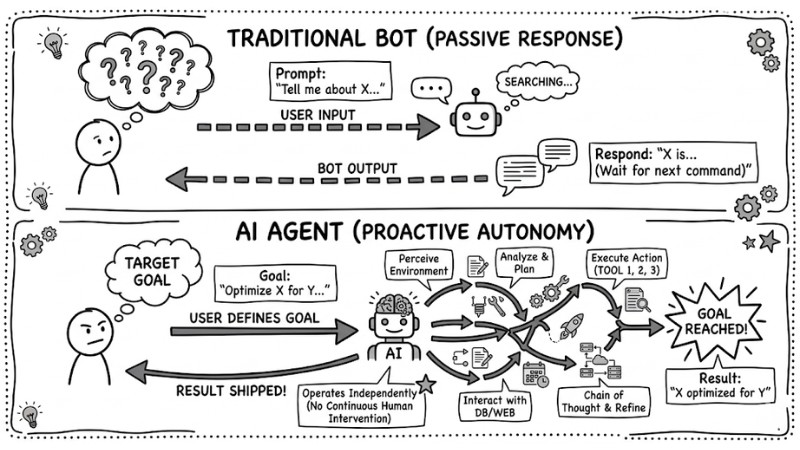
AI Agents possess the capability to reason steps with remarkable flexibility.
4 Core Components Shaping an AI Agent System
For an AI agent to operate independently, it requires a tightly coupled architecture that simulates human body parts.
The Orchestrating Brain (LLM)
Large Language Models (LLMs) like OpenAI's GPT-4o act as the central decision-making hub. The LLM intakes information, parses the logic, and issues directives. The LLM's reasoning power dictates the intelligence level of the entire agent system.
Perception Mechanism & Sensors
These are the eyes and ears of the system. The perception mechanism allows the AI Agent to read input text, recognize images, audio, or raw data from the environment. Sensors then parse these signals into machine-readable language for the "brain" to process.
Memory Management
Memory prevents the AI Agent from repeating mistakes and maintains the workflow context. Memory is divided into two types:
- Short-term memory: Stores the context of the current session, allowing the AI to remember what you requested 5 minutes ago.
- Long-term memory: A historical database accumulated through Machine Learning, enabling the AI to draw lessons for future tasks.
Execution Tools & Actuators
If the LLM is the brain, these are the limbs. Tools allow the AI to interact with external systems via APIs (Application Programming Interfaces). Actuators enable the AI to execute actual operations like sending emails, downloading files, running SQL queries, or scheduling meetings.
Battle-tested advice: From my perspective, SMBs should not build LLMs from scratch. Hook into existing model APIs (like OpenAI, Anthropic) to serve as the "brain" and focus your engineering efforts on building domain-specific Tools. This optimizes costs because the "brain" drives 80% of operational performance.
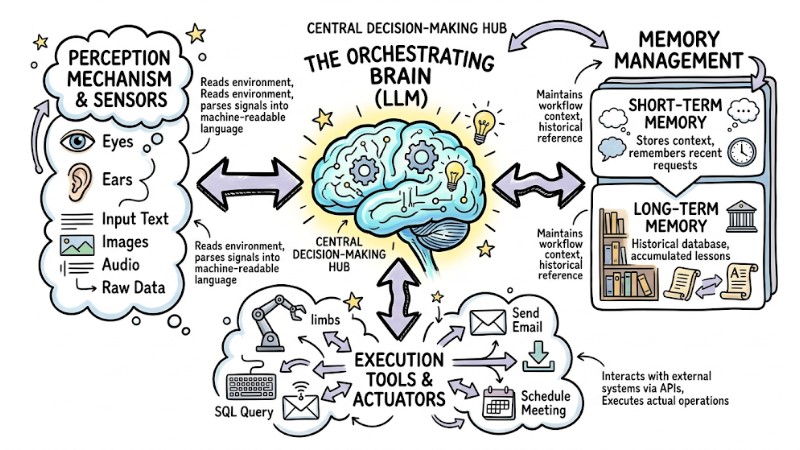
4 Core Components of an AI Agent System
Deep Dive: How an AI Agent Operates in 5 Steps
The baseline operational workflow of an AI Agent follows the Perception-Action Loop. Here is how the execution pipeline runs in detail.
Step 1: Intake Goal & Gather Context
The system boots up by identifying the user's request via a prompt. Sensors fetch relevant data from the current environment to load into short-term memory. This forms the foundation for the system to understand what it needs to execute.
Step 2: Reasoning and Planning
The LLM "brain" parses the Macro goal and slices it into Micro tasks. The system plots a logical step-by-step roadmap, strictly defining the execution sequence of which tasks run first and which follow.
Step 3: Tool Selection and Invocation (Tool Use)
For each micro-task, the AI Agent automatically maps and invokes the corresponding tool. For example, if the task is "fetch stock prices," it triggers the web search tool instead of an image generation tool.
Step 4: Execution and Environment Interaction
This is where the actuators kick in. The AI Agent executes direct operations on the external environment. These actions can include: reading source code, writing content, fetching data, or pushing API payloads to a third-party system.
Step 5: Self-evaluation and Self-correction
Immediately after executing an action, the system validates the output against the initial goal.
- If the output is correct: Marks the task as complete and proceeds to the next node in the plan.
- If the output is incorrect: Triggers self-correction. The AI Agent parses the error log and loops back to Step 2 to generate an alternative plan.
Expert perspective: The secret to a highly performant system lies in how you engineer the Prompt at Step 1. Providing deep context and defining strict boundaries helps the system aggressively mitigate Hallucinations when validating outputs in Step 5.
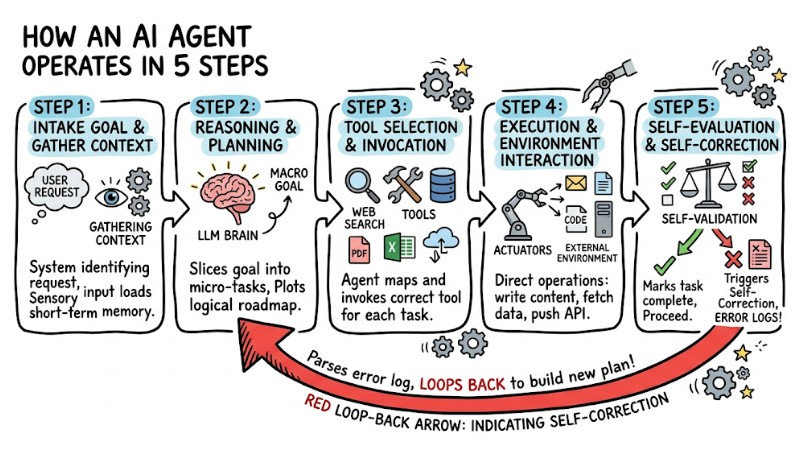
AI Agent Operational Workflow
Practical Example: How an AI Agent Executes a Real-World Task
To help you visualize how an AI Agent functions in an enterprise setting, imagine a "Digital Workforce" assigned the task: "Draft a summary report of the Nvidia CEO's latest statements and email it to the boss."
Instead of just generating text based on stale data like standard AI, the AI Agent automatically runs the following execution chain:
Action 1: Parse request -> Goal: Fetch Jensen Huang news, draft report, send email.
Action 2: Invoke Web Search tool -> Query: "Jensen Huang Nvidia latest news 2024".
Action 3: Scrape the top 5 articles -> Extract key data points.
Action 4: Invoke Word/Docs tool -> Outline and generate a 300-word summary report.
Action 5: Self-evaluation -> Report hits all constraints, zero errors found.
Action 6: Invoke Email tool -> Inject target address "sep@doanhnghiep.com", attach report, and execute send.
Status: TASK COMPLETED.
Through this example, you can see the AI Agent does not wait for you to spoon-feed it prompts. It natively knows how to spin up Google, write in Word, and fire off an Email to close out the ticket.
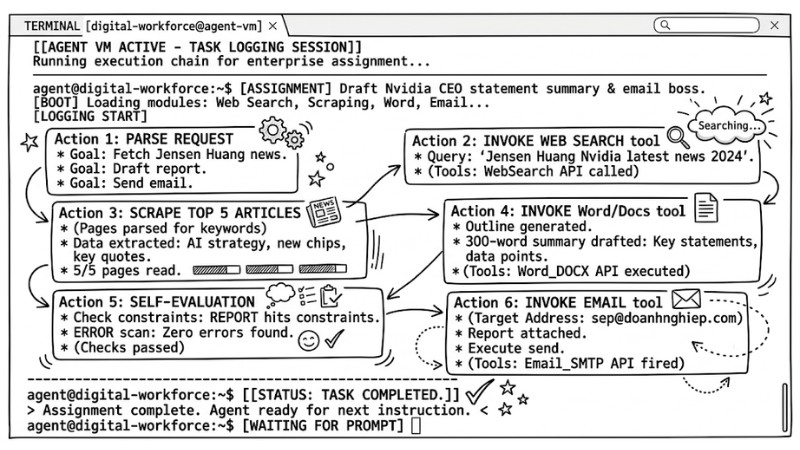
How AI Agents execute Real-World tasks
Core Differences Between AI Agents and Traditional Generative AI
Many still confuse AI Agents with standard Generative AI models like basic ChatGPT. The core differentiator lies in Proactivity and the capacity for autonomous execution.
| Criteria | Traditional Generative AI | AI Agent |
| Intervention Level | Requires continuous human prompting (Prompt chain) for every step. | Only requires a single upfront goal assignment. |
| Problem Solving Approach | Passively responds based on pre-trained data weights. | Proactively slices the problem and autonomously discovers practical solutions. |
| Tool Usage | Typically sandboxed within a text chat interface. | Freely invokes APIs, manipulating external software and websites. |
| Self-Correction Capability | Relies on humans to catch bugs and prompt for rewrites. | Self-validates output; if an error occurs, it automatically retries via an alternative path. |
Top 5 Practical Enterprise Applications of AI Agents
The advent of AI Agents is massively accelerating process automation workflows. Below are the 5 standout application domains driving digital transformation value for enterprises:
Software Engineering Assistance
- Pros: Automates code generation, testing, and real-time code reviews.
- Cons: Occasionally generates code that is unoptimized for large-scale system architectures.
- Best for: Software tech companies, developer teams.
Omnichannel Customer Support
- Pros: Autonomously resolves tickets, queries orders, and triggers direct refunds via API.
- Cons: Lacks empathy in emotionally sensitive edge cases.
- Best for: Retail, e-commerce, hospitality services.
Research Assistants (RAG)
- Pros: Leverages RAG (Retrieval-Augmented Generation) to parse thousands of pages of internal docs and synthesize reports.
- Cons: Requires upfront CapEx to standardize input data pipelines.
- Best for: Legal, healthcare, education, research institutes.
Financial Analysis
- Pros: Monitors market fluctuations, automates risk modeling, and ships revenue reports.
- Cons: High risk if granted direct execution rights for investments.
- Best for: Banks, brokerage firms, accounting departments.
Supply Chain Management
- Pros: Automates inventory tracking, demand forecasting, and vendor procurement workflows.
- Cons: Bottlenecked by the API uptime of logistics partners.
- Best for: Manufacturing enterprises, import/export, FMCG.
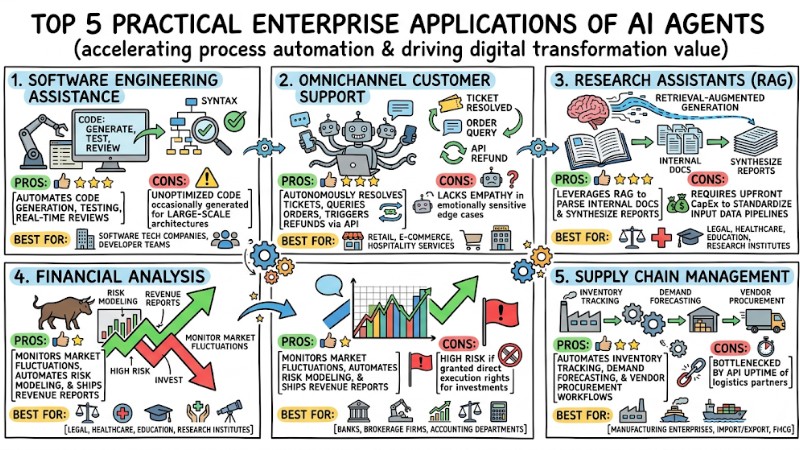
5 real-world AI Agent use cases for Enterprises
Frequently Asked Questions (FAQ) about AI Agents
Can AI Agents operate 100% independently?
You shouldn't let AI operate 100% autonomously at this stage. Especially for financial tasks or sensitive data pipelines, you must enforce a Human-in-the-loop mechanism. The AI Agent will handle 90% of the heavy lifting, while humans act as the final approval gate for critical decisions.
Does deploying AI Agents risk leaking enterprise data?
There is a risk if the system is granted over-scoped Tool access. To ensure AI ethics and security, enterprises must encrypt input data payloads and configure strict API RBAC (Role-Based Access Control). It is highly recommended to use enterprise-grade LLMs that do not train on your proprietary data.
What do SMBs need to prep before adopting AI Agents?
First, you need to standardize your internal databases. Next, map out detailed Workflows for each department. Finally, test Multi-agent Systems on a micro-scale (e.g., within the HR unit) before scaling company-wide.
Read more:
- What is Agentic Workflow? Autonomous AI Solutions for Enterprise
- What is Agent Engineering? The Process of Bringing AI Agents into Production
- Popular Types of AI Agents: How to choose and Real-World Applications
AI Agents are not just a hype cycle; they are the digital workforce shaping the future. By mastering how AI Agents operate, you hold the key to 10x your operational output. Start auditing your internal workflows, connect with reputable digital transformation consultants, and sign up to test-drive AI solutions today to skyrocket your revenue.
Tags