Popular Types of AI Agents: How to choose and Real-World Applications

Artificial intelligence is shifting from merely answering questions to autonomously executing tasks. If you are an SME owner or a tech beginner, clearly understanding the types of AI Agents will help you choose the right tools to optimize operations. This article will break down in detail the 5 popular types of AI agents, from simple rule-based systems to complex self-learning models, making it easy for you to apply them in the real world.
Key Takeaways
- Core operational loop: Every AI Agent operates through a closed 3-step loop: Perceiving the environment, Decision-making, and Independent action.
- Technological evolution: AI agents are aggressively shifting from rigid, script-based execution to flexible reasoning capabilities thanks to large language models.
- Resource optimization: Grasping the exact characteristics of the 5 AI Agent types helps enterprises accurately automate individual phases, avoiding wasted tech investment CapEx.
What is an AI Agent?
An AI Agent (intelligent agent) is an autonomous system capable of perceiving its surrounding environment, making autonomous decisions, and executing actions to achieve a specific goal. To easily visualize this, traditional software is like a passive machine, only operating when you press a button. Meanwhile, an AI Agent acts like a diligent employee. You just need to assign a goal, and it will autonomously find a way to complete it.
A complete AI agent must possess 3 core elements:
- Perception: Collects data from the environment via sensors (cameras, microphones, text inputs).
- Decision-making: The brain processes information, comparing it against a rule set or learned data to select the optimal action.
- Action: Executes the decision via actuators (generating speech, moving a robotic arm, sending automated emails).
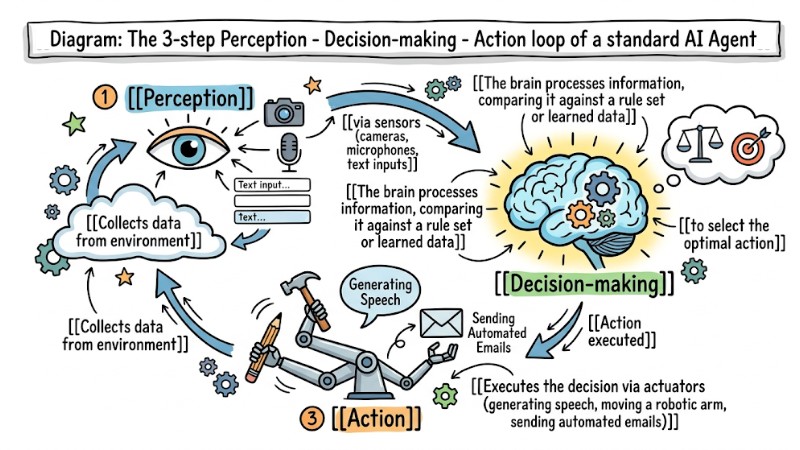
3-step Perception - Decision-making - Action loop of a standard AI Agent
Details of the Popular AI Agent Types Today
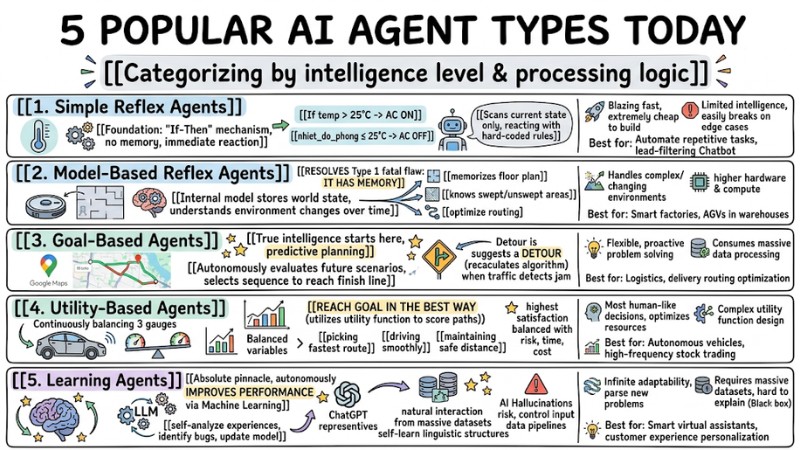
Categorizing AI agents is based on their intelligence level and how they process information. Below are the 5 basic types from lowest to highest.
1. Simple Reflex Agents
This is the most primitive form of AI Agent. Its foundation relies entirely on the "If-Then" mechanism. This agent has no memory and does not care about what happened in the past. It solely scans the current state of the environment and reacts immediately if it matches a hard-coded rule.
The most classic example is a smart thermostat. Its rules are extremely simple:
If nhiet_do_phong > 25°C -> Bat_dieu_hoa()
If nhiet_do_phong <= 25°C -> Tat_dieu_hoa()
Battle-tested review:
- Pros: Blazing fast response speeds, extremely cheap to build and operate.
- Cons: Limited intelligence, highly prone to breaking when encountering edge cases outside its hard-coded ruleset.
- Best for: Small businesses needing to automate repetitive tasks, like a scripted lead-filtering Chatbot.
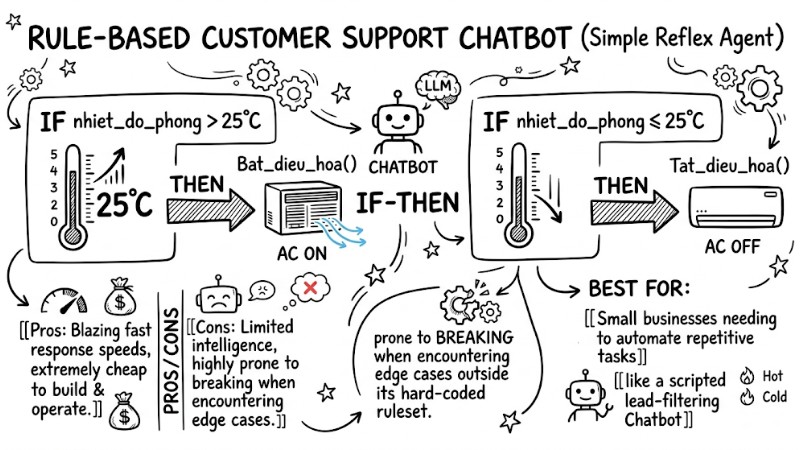
The If-Then processing workflow of a Rule-based customer support Chatbot
2. Model-Based Reflex Agents
This upgraded version resolves the fatal flaw of type 1: It has memory. This agent possesses an internal model helping it store the state of the surrounding world. Thanks to this, it understands how the environment changes over time to make more accurate decisions.
The most visual example is an autonomous robot vacuum. It doesn't just avoid obstacles right in front of it (simple reflex), but also memorizes the floor plan, knowing which areas have been swept and which haven't to optimize its routing.
Battle-tested review:
- Pros: Capable of handling complex, obscured, or continuously changing environments.
- Cons: Demands higher storage hardware and compute capacity.
- Best for: Enterprises operating smart factories or warehouses that require Automated Guided Vehicles (AGVs).
3. Goal-Based Agents
Reaching this level, the AI truly starts having intelligence. Instead of just passively reacting, this agent is equipped with predictive planning capabilities. It strictly knows where the finish line is, autonomously evaluates multiple future scenarios, and selects the action sequence that moves it closest to the goal.
Take Google Maps as an example. Your goal is to get from point A to point B. The app doesn't just plot a path. When it detects a traffic jam ahead, it automatically recalculates the algorithm and suggests a detour to ensure you still reach your destination.
Battle-tested review:
- Pros: Extremely flexible, proactively solves problems even when the environment shifts suddenly.
- Cons: Consumes massive amounts of data processing time before arriving at a final decision.
- Best for: Logistics companies optimizing their supply chain, orchestrating real-time delivery routing.
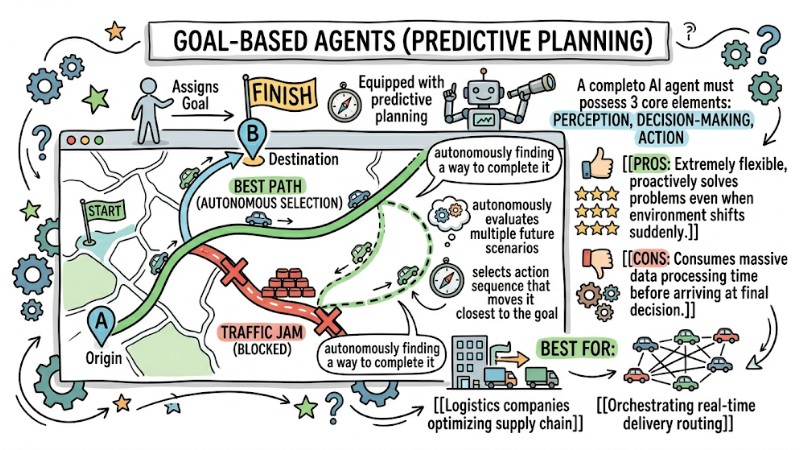
Google Maps screenshot showing green/red routes simulating the selection process of a Goal-based Agent
4. Utility-Based Agents
If a Goal-based Agent only cares about "reaching the finish line," a Utility-based Agent cares about "reaching the finish line in the best possible way." This type of agent utilizes an optimization function (Utility function) to score alternative paths. It weighs and balances risk, time, and costs to deliver the highest satisfaction.
You can clearly see this in autonomous driving systems. The car doesn't just need to arrive; the system must continuously balance 3 variables: picking the fastest route (saving time), driving smoothly (saving fuel), and maintaining a safe distance (avoiding collisions).
| Criteria | Goal-based Agent | Utility-based Agent |
|---|---|---|
| Focus | Complete the goal at all costs. | Complete the goal with the highest quality. |
| Selection method | Picks any path as long as it reaches the destination. | Evaluates, scores, and selects the safest, most cost-effective path. |
Battle-tested review:
- Pros: Generates the most human-like decisions, radically optimizing resources.
- Cons: Extremely complex in designing the utility function, demanding highly skilled data engineers.
- Best for: Big tech corporations, autonomous vehicle projects, high-frequency stock trading systems.
5. Learning Agents
This is the absolute pinnacle of current AI tech. Learning agents possess the ability to autonomously improve their performance via Machine Learning. Instead of waiting for humans to write more code, they self-analyze experiences, identify bugs, and update the model to perform better next time.
Large Language Models (LLMs) like ChatGPT are the most prominent representatives. They self-learn linguistic structures from massive datasets to interact naturally with users.
Expert tip: Despite being smart, agents based on Generative AI still run the risk of catching "AI Hallucinations" (the phenomenon where AI hallucinates false info but presents it highly convincingly). Enterprises must strictly control input data pipelines.
Battle-tested review:
- Pros: Infinite adaptability, capable of parsing problems never encountered in the past.
- Cons: Requires massive datasets for training, difficult to explain the logic behind its decisions (Black box).
- Best for: Any enterprise looking to deploy smart virtual assistants or customer experience personalization systems.
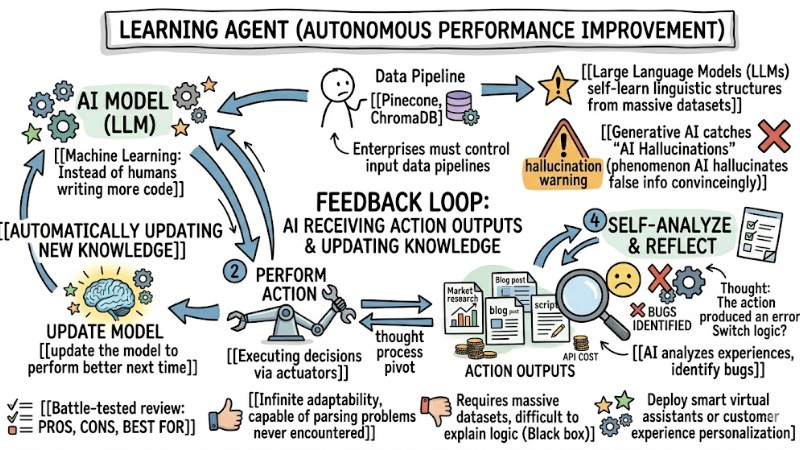
The AI receiving action outputs and automatically updating new knowledge
Quick Comparison Summary of the 5 AI Agent Types
To help you easily systematize your knowledge, I've compiled the characteristics of the AI Agent types into the comparison table below:
| AI Agent Type | Core Operational Mechanism | Complexity Level | Typical Application Example |
|---|---|---|---|
| Simple Reflex | Matches "If-Then" rules, no memory. | Very Low | Thermostats, Static scripted chatbots. |
| Model-based Reflex | Stores past states, tracks the environment. | Low | Robot vacuums, Smart light sensors. |
| Goal-based | Forecasts the future, plans to reach the destination. | Medium | Google Maps, Rubik's cube solver algorithms. |
| Utility-based | Scores alternative solutions, prioritizes optimization. | High | Autonomous vehicles smoothly dodging obstacles. |
| Learning Agent | Self-learns from data, self-corrects without coding. | Very High | ChatGPT, Netflix recommendation engines. |
Multi-Agent Systems and the Future of AI
In real-world enterprise environments, a monolithic AI Agent rarely solves macro-level problems. That is why Multi-agent Systems were born. This is a network where multiple specialized AI agents autonomously communicate, negotiate, and collaborate.
Through AI orchestration, a massive project is sliced down. For example, in a supply chain: Agent A tracks inventory; when it detects a shortage, it pings Agent B to automatically scrape the web for the best vendor pricing, then Agent C handles the checkout pipeline. The entire pipeline executes with zero human intervention.
The future of automation lies in effectively deploying AI Agents. Clearly understanding the pros and cons of each type is the first step to architecting a lean, intelligent, and cost-efficient operational pipeline.
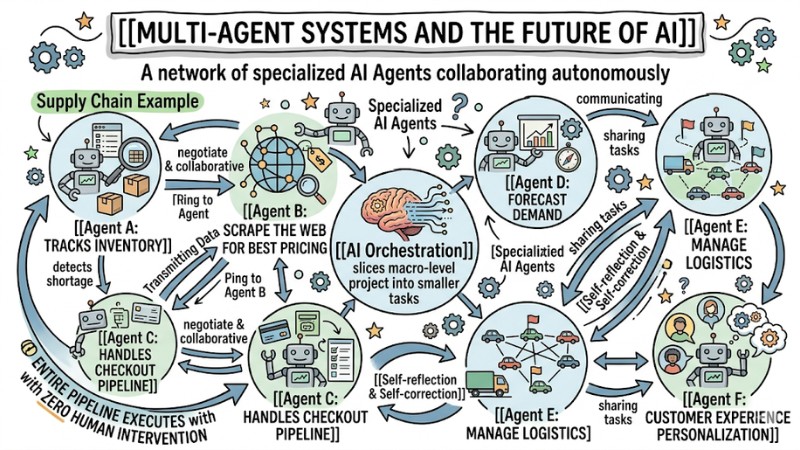
A network of AI Agents connecting, transmitting data and sharing tasks with each other
Frequently asked questions (FAQ) about AI Agent Types
How do AI Agents and Artificial Intelligence (AI) in general differ?
Artificial Intelligence (AI) is an umbrella term, acting as the "brain" that provides reasoning and data parsing capabilities. Meanwhile, an AI Agent is the "executor". It leverages that AI brain to interact with the environment, make autonomous decisions, and directly close out tasks.
Which type of AI Agent is the most popular today?
Learning Agents are currently dominating the market. The explosion of Deep Learning models has allowed this type of agent to infiltrate every sector, from facial recognition and automated translation to smart virtual assistants.
How have LLMs (Large Language Models) elevated the capabilities of AI Agents?
LLMs provide AI Agents with human-like natural language understanding and reasoning. Instead of just crunching raw metrics, an Agent integrated with an LLM can parse emails, auto-summarize docs, and even write its own code to invoke APIs and interface with third-party software.
Which type of AI agent should SMEs start deploying?
You should start with a bottom-up roadmap to optimize CapEx. Bootstrap with Simple Reflex Agents (Scripted chatbots) to handle customer FAQs. Once accustomed to the operational flow, upgrade to Learning Agents (hooking into the ChatGPT API) to spin up deep-dive sales consulting virtual assistants.
How do Simple Reflex Agents operate?
Simple Reflex Agents run on hard-coded "If-Then" rules, reacting directly to the current condition without logging interaction history. A classic example is a thermostat.
What is the difference with Model-Based Reflex Agents?
This type houses an internal model of the world, helping track environment states over time and understanding the impact of previous interactions, unlocking more complex decision-making.
What do Goal-Based Agents prioritize?
This agent defines a strict target goal, then plots a roadmap and makes step-by-step decisions to maneuver closer to the desired output.
What do Utility-Based Agents aim for?
They deploy a utility function to score and select optimal actions, aiming to maximize overall value rather than just fulfilling a singular goal.
What standout capabilities do Learning Agents possess?
This is the agent class capable of self-improving performance over time by learning from new data and experiences, adapting and self-patching without manual intervention.
Read more:
- How AI Agents work: Autonomy and Functional Mechanisms
- When to Use an AI Agent? 7 Signs You Need Automation
- AI Agents for Enterprise: An A-Z Practical Deployment Roadmap
In conclusion, correctly understanding and classifying AI Agent types is not just theoretical knowledge, but the skeleton key for enterprises to architect a step-by-step automation roadmap, from simple rules-based chatbots to intelligent, synchronized multi-agent systems. By matching the right agent type to your specific problem space and scale, you will optimize costs, offload repetitive manual labor, and build a rock-solid foundation to fully exploit the power of LLMs and near-future AI technologies.
Tags