Multi-Agent Architecture: 4 Core Models and Practical Applications

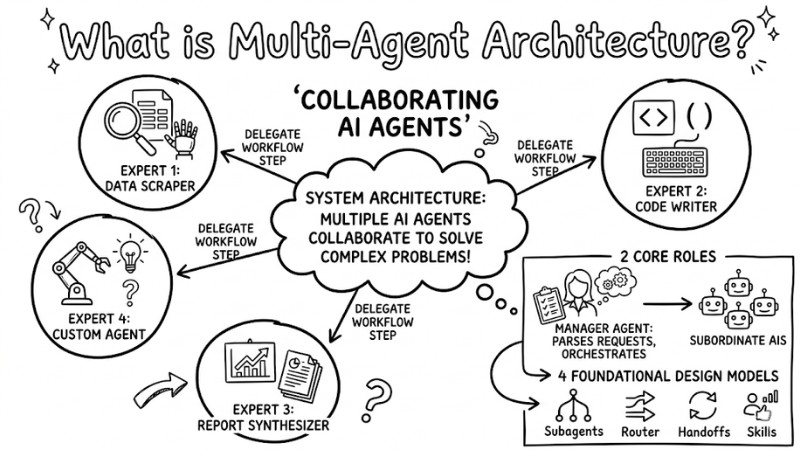
When scaling AI applications, relying on a single agent will rapidly overload the system. In this article, I will help Project Managers, Developers, and Business Owners fully grasp Multi-Agent Architecture. I will break down the 4 core design models, alongside their pros and cons, empowering you to build a robust automated AI network, optimize costs, and completely resolve technical bottlenecks.
Key Takeaways
- The Nature of Multi-Agent Architecture: Understand the system architecture where multiple independent AI agents interact, debate, and collaborate to solve complex problems beyond the capability of a single agent.
- Single-Agent Limitations: Grasp why single-agent architectures easily fall into the "Context window overload" trap and lack self-correction capabilities in lengthy business pipelines.
- 4 Core Models: Master the Subagents, Router, Handoffs, and Skills models to optimize performance for specific problem spaces.
- Operational Dynamics: Understand coordination mechanisms (Collaboration vs. Competition) based on game theory to steer Agents toward a common goal.
- Strategic Applications: Explore 7 scenarios spanning from Logistics and Healthcare to Financial Management, where multi-agent systems deliver breakthrough ROI metrics.
- Risk Management: Master security strategies by setting up Sandboxes and enforcing Human-in-the-loop mechanisms for critical decisions.
What is Multi-Agent Architecture?
Multi-Agent Architecture is a system architecture where multiple independent AI agents collaborate to solve a complex problem. Instead of using a single AI to handle everything, this architecture decomposes the workflow into multiple steps. Each step is delegated to an AI with dedicated expertise.
A basic multi-agent system operates on two core roles:
- Manager Agent: Parses user requests, decomposes tasks, and orchestrates workloads for subordinate AIs.
- Expert Agent: Receives tasks from the Manager and focuses strictly on executing a single operation (like scraping data, writing code, or synthesizing reports) with high precision.
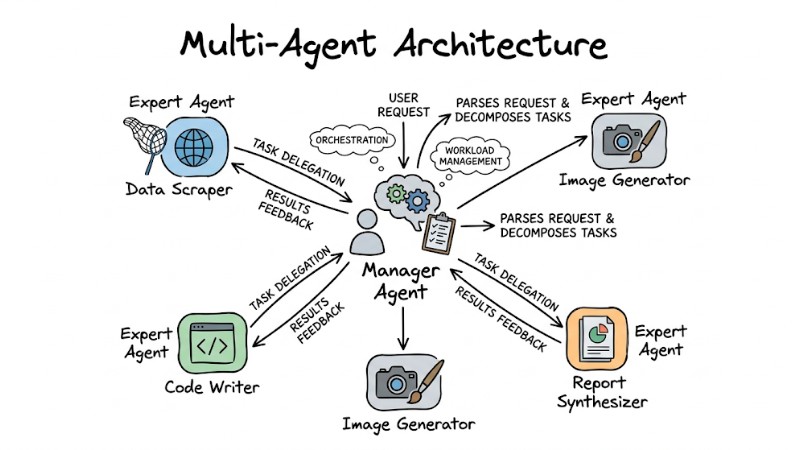
Multi-Agent Architecture, where multiple independent AI agents collaborate to solve a complex problem
Why is Single-Agent Architecture No Longer Sufficient for Large Projects?
A single AI operates perfectly fine in short Q&A tasks. However, when an enterprise needs to automate entire workflows, this architecture exposes fatal flaws.
- Context Window Overload: A single prompt packing the entire business logic will exceed the model's memory limit. The AI will start "forgetting" instructions from the beginning of the context.
- Spiking Hallucination Rates: When forced to independently reason through an excessively long logic chain, the model easily outputs skewed information or fabricates data.
- Lack of Self-Correction Mechanisms: Single-agents typically operate linearly. They lack a second set of eyes to review, evaluate, and request a retry if the output misses the mark.
- Development Conflicts: When multiple dev teams concurrently edit a monolithic prompt file, version control and bug tracking become notoriously difficult.
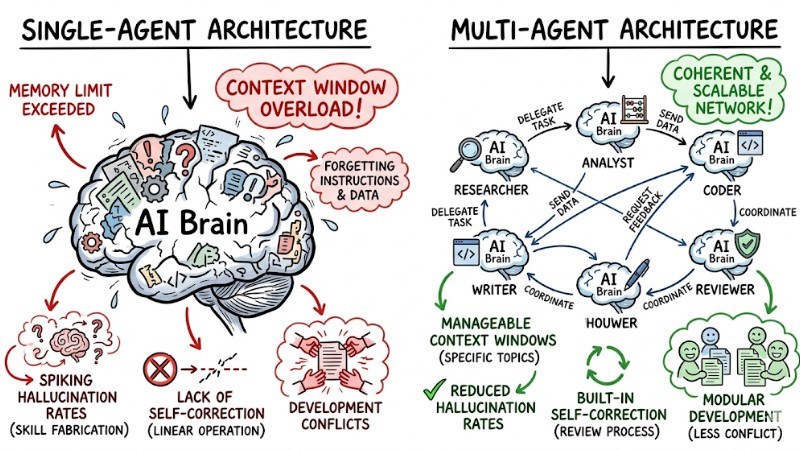
Compare Single-Agent vs Multi-Agent
Top 4 Core Multi-Agent Architecture Design Models Today
Picking the right design model directly dictates system performance. Below are the 4 foundational architecture patterns you must master:
1. Subagents (Centralized Orchestration via Supervisor)
The Subagents model operates on a top-down hierarchical structure (Centralized Orchestration). An Agent acting as the Supervisor interacts directly with the user, then invokes other Subagents strictly as tools to fetch data.
- Pros: Maintains a unified conversational context. Subagents operate independently without cross-contaminating information.
- Cons: Requires an extra API hop through the Supervisor, slightly inflating costs and latency.
- Best for: Projects featuring multiple discrete business pipelines requiring a single centralized control hub (e.g., A system aggregating financial reports from multiple branches).
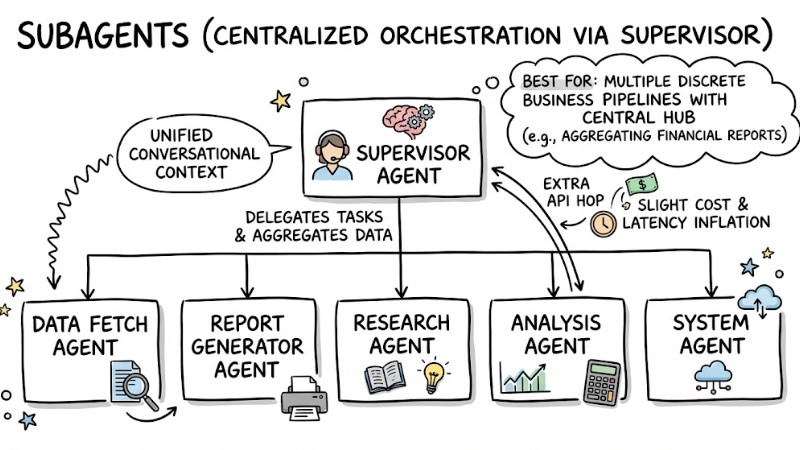
The Subagents model operates on a top-down hierarchical structure
2. Router (Parallel Dispatch and Processing)
The Router model was born to optimize speed. Upon receiving a request, the Router classifies it and pushes the query to multiple specialized Agents concurrently (Parallel Dispatch), then synthesizes the final output.
- Pros: Blazing fast processing speeds thanks to parallel execution. Coupled with stable performance per request turn.
- Cons: Difficult to maintain long-term chat history; burns routing CapEx for every single chat turn.
- Best for: Internal search engines, querying data from multiple disparate sources simultaneously.
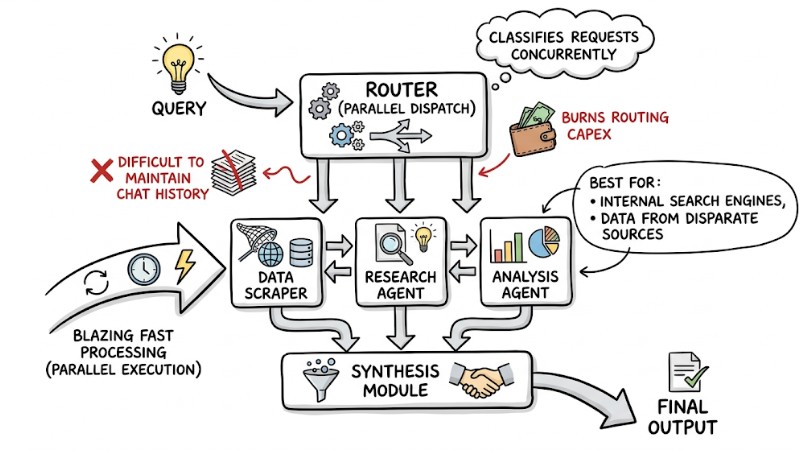
Query passing through a Router, splitting into multiple parallel processing arrows and converging at the Synthesis Module
3. Handoffs (State-based Routing)
Handoffs is a dynamic routing model driven by conversational context. When an Agent finishes its portion of the work, it updates the State and proactively hands off the user to a more suitable Agent.
- Pros: Extremely natural and seamless. Highly suited for sequential workflows with complex branching logic.
- Cons: Demands rigorous state management engineering, as it easily falls into infinite loops if the handoff logic breaks.
- Best for: Customer support scenarios. For example: A consulting Agent hands off to a billing Agent, which then hands off to a tech support Agent.
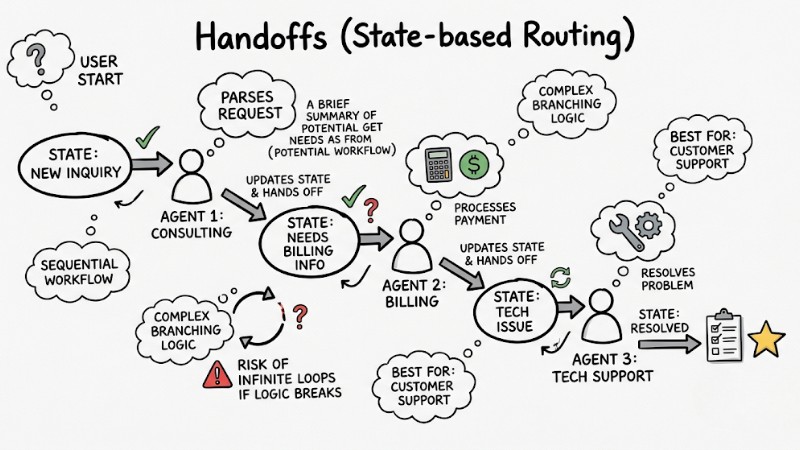
Handoffs is a dynamic routing model driven by conversational context
4. Skills (Prompt-based Specialization)
Unlike spinning up multiple physical Agents, the Skills model utilizes a central Agent but dynamically injects skill packages (prompts, scripts, APIs) right at the moment of request.
- Pros: Easily extensible functionality. Establishes clear boundaries for development squads (each team codes a specific skill).
- Cons: Context volume bloats rapidly when loading multiple skills, easily triggering token explosions.
- Best for: Enterprises looking to build a versatile AI assistant handling continuously mutating requests without wanting to architect a complex network.
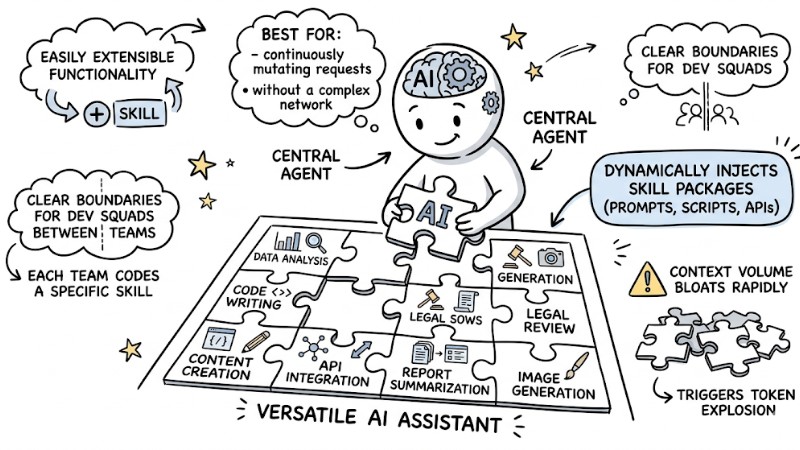
The Skills model utilizes a central Agent but dynamically injects skill packages
Comparison Table and Checklist for Selecting the Right Architecture Model
To make a rapid decision, cross-reference your project needs with the performance analysis table below.
| Criteria | Subagents | Router | Handoffs | Skills |
|---|---|---|---|---|
| Orchestration Mechanism | Centralized (Top-down) | Parallel Dispatch | Sequential Handoff | On-demand Loading |
| Parallel Execution | ✅ Good | ✅ Excellent | ❌ No | ❌ No |
| Chat History Retention | ✅ Good | ❌ Poor | ✅ Good | ✅ Good |
| Pipeline Control | Strict | Distributed | Flexible Branching | Rapid Scaling |
Checklist for pinpointing the right model:
- Do you need to query data from 5 different document sources simultaneously? Pick Router.
- Is your workflow formatted as: Fetch info -> Approve -> Checkout? Pick Handoffs.
- Do you have a single AI but want to inject 20 different micro-operations? Pick Skills.
- Do you need an assistant managing 3 expert assistants without letting them cross-communicate? Pick Subagents.
Top 3 Real-World Enterprise Applications of Multi-Agent Systems
1. Intelligent Document Processing
The system automates processing thousands of contracts by chaining multiple Agents. A Data Extraction Agent pulls the core clauses. A Compliance Agent scans for policy violations. Finally, a Routing Agent synthesizes and ships the report to management. This pipeline eliminates 90% of manual data entry time.
2. Market and Competitor Analysis
Enterprises deploy Agent networks running 24/7. A News Agent scrapes social media to assess PR risks. A Financial Agent parses competitors' financial reports. A Strategy Agent merges these two data streams to output a pricing strategy matrix for new products.
3. Personalized HR Training
Instead of pushing a generic course, an Assessment Agent evaluates the knowledge gaps of new hires. A Curriculum Agent autonomously designs customized learning roadmaps. A Teaching Agent acts as a tutor resolving queries. This pipeline helps enterprises effectively slash onboarding time.
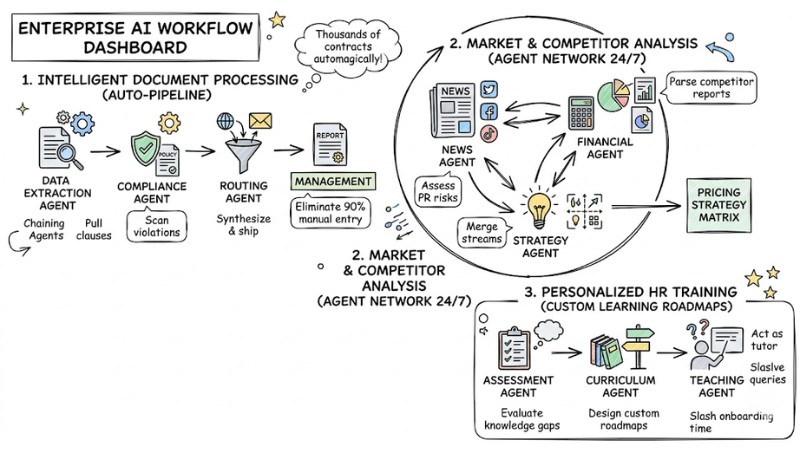
Automated AI Workflows within an enterprise
Foundational Advice When Starting to Architect Multi-Agent AI Systems
My advice is to absolutely avoid over-engineering the system right out of the gate. Instead, approach it via a natural evolution roadmap:
- Start with a single Agent: Maximize your Prompt engineering techniques.
- Expand via Tool Calling: Equip the Agent with tools (APIs, Search, Calculators) to handle peripheral tasks.
- Only upgrade to Multi-Agent when hitting a "bottleneck": When the codebase turns into spaghetti, branching logic becomes excessive, or the context window consistently throws overload errors, slice the system down to optimize costs.
Frequently Asked Questions (FAQ)
How do you differentiate Single-Agent and Multi-Agent?
A Single-Agent is a monolithic AI model hoarding everything from analysis to execution. Multi-Agent slices the problem into micro-chunks, delegating them to independent AIs that orchestrate together to ship the final output.
Which open-source framework should I use to build Multi-Agent systems?
Currently, there are 3 standout frameworks trusted by the community:
- LangGraph: Highly robust for execution flow control and state persistence.
- AutoGen: From Microsoft, excellently optimized for conversational patterns between Agents.
- CrewAI: Developer-friendly, easy to configure for beginners with a crystal-clear Role-playing mindset.
Will using multiple Agents cause API costs to spike?
Yes. Every time Agents communicate or hand off tasks, it burns tokens. To optimize, you must use smaller, cheaper AI models (like GPT-4o-mini or Claude 3 Haiku) for basic analytical tasks, exclusively reserving massive models for the final synthesis Agent.
What is Multi-agent Architecture?
Multi-agent Architecture is an AI system design approach where multiple independent agents coordinate to resolve complex tasks, sharing a common goal and communicating effectively.
Why is Single-Agent architecture no longer sufficient for large projects?
Single-Agent architectures hit hard limits regarding complex context management, scalability, and workload delegation. Massive projects require specialization and seamless orchestration that a monolithic agent struggles to meet.
What are the core Multi-Agent Architecture design models?
The four core models include: Subagents (centralized orchestration), Router (parallel dispatch), Handoffs (state-based routing), and Skills (prompt-based specialization).
When should you use the Subagents model?
The Subagents model fits perfectly when you need a supervisory agent orchestrating highly specialized agents across discrete domains, while demanding centralized workflow control.
What is the main benefit of the Router model?
The Router model allows parsing inputs, then routing to specialized agents for parallel processing, drastically boosting velocity and efficiency for complex queries.
When does the Handoffs model prove most effective?
Handoffs shine in sequential pipelines, where each agent possesses the capability to transfer control to the subsequent agent based on conversational state or input payloads.
How do you scale the capabilities of a single agent?
The Skills model permits a monolithic agent to load and utilize on-demand specializations via prompts, scaling functionality without complicating the overall architecture.
What are some real-world applications of Multi-Agent Architecture?
Common applications encompass intelligent document processing, competitive market analysis, and personalized HR training systems, where multi-agent collaboration delivers high yields.
How should you start designing a Multi-Agent Architecture?
Start with a simple agent, deploy effective prompt engineering, then bolt on tools before graduating to multi-agent architectures only when necessary to dodge over-engineering the problem space.
Read more:
- AI Agent Orchestration: 6 Optimal System Design Patterns
- Shared Memory Multi-Agent: The Most Effective AI Architecture Optimization
- AI Agent Architecture: A Comprehensive Developer's Guide
Mastering and correctly applying the 4 Multi-Agent Architecture models doesn't just solve tech limitation bottlenecks; it cracks open the era of total enterprise automation. Pick the smallest workflow in your company, deploy a Subagents or Handoffs model, and measure the transformation yourself today!
Tags