Multi-agent vs Single-agent: How to choose the optimal AI architecture

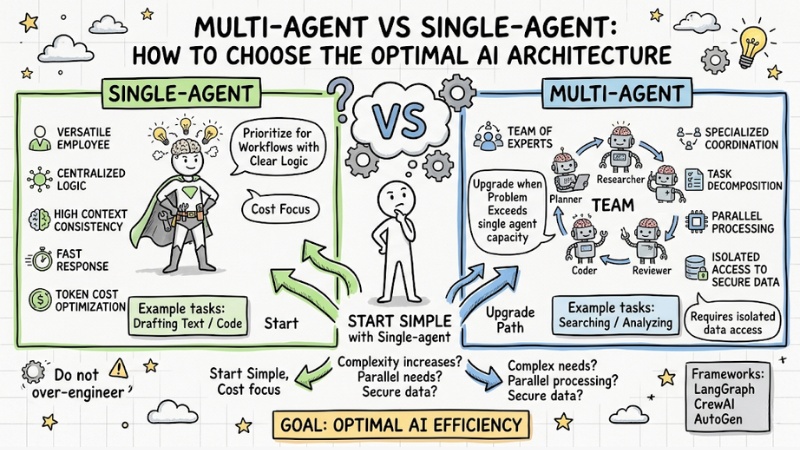
Choosing between a Multi-agent and Single-agent system is the most critical architectural decision when building an AI application. This article will help you determine the appropriate model based on complexity, budget, and performance requirements to optimize your system right from the start.
Key Points
- Architectural nature: Understand the difference between Single-agent (a versatile employee, centralized logic) and Multi-agent (a team of experts, specialized coordination) to make the correct foundational choice.
- When to choose Single-agent: Prioritize this option for workflows with clear logic that require high context consistency, fast response times, and cost (token) optimization.
- When Multi-agent is needed: Only upgrade when the problem exceeds the processing capacity of a single agent, requiring task decomposition, parallel processing, or isolated access to secure data.
- Read vs. Write strategy: Categorize your architecture based on the nature of the task (Multi-agent for searching/analyzing; Single-agent for drafting text/code) to achieve optimal efficiency.
- Suitable frameworks: Know how to leverage LangGraph (state management), CrewAI (specialized role assignment), and AutoGen (conversation orchestration) to implement the architecture.
- "Do not over-engineer" rule: Always start simple with a Single-agent and only transition to Multi-agent when complex needs truly demand it, helping save costs and system resources.
- FAQ resolution: Grasp "Shared State" management strategies to keep context stable, token cost optimization measures, and the security advantages of multi-agent architecture.
Core Differences Between Multi-agent vs Single-agent
The core difference between Single-agent and Multi-agent architectures lies in how the system divides responsibilities and coordinates to complete a task. Instead of just looking at the number of agents, visualize them as two completely different organizational working models. Specifically:
- Single-agent: Similar to a "versatile employee" handling the entire process from start to finish. All logic, tool access permissions, and processing context are centralized in a single agent, keeping the chain of thought and data seamless, easy to debug, with low risk of losing information between steps.
- Multi-agent: Like a "team of experts" jointly tackling a shared problem. The system breaks the problem down into segments, with each agent taking on a specialized role and coordinating with one another to achieve the goal.
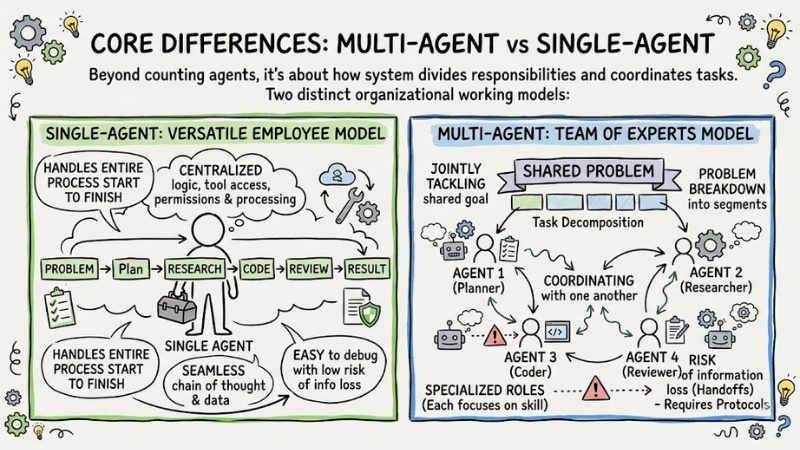
Core differences between Multi-agent vs Single-agent
Quick Comparison Table: Multi-agent vs Single-agent
| Criteria | Single-Agent | Multi-Agent |
|---|---|---|
| Complexity | Low complexity, easy to deploy. | High complexity, requires coordination. |
| Scalability | Limited scalability. | High scalability, easy to add modules. |
| Cost (Tokens) | Low cost (Tokens), efficient. | High cost (Tokens) (due to context handover overhead). |
| Debugging | Direct debugging, easy to trace. | Complex debugging, hard to predict. |
| Execution Model | Sequential execution model. | Parallel execution model. |
When Should You Use a Single-Agent?
A Single-agent is the optimal choice for problems with clear workflows that require high context consistency. When one agent holds the entire "chain of thought", the risk of data loss between steps is virtually zero.
Reasons to choose:
- Reliability: Avoid errors arising from handing off data between agents.
- Cost: Save tokens since there is no "communication" overhead between agents.
- Speed: Suitable for tasks requiring instant responses, such as a basic customer support chatbot.
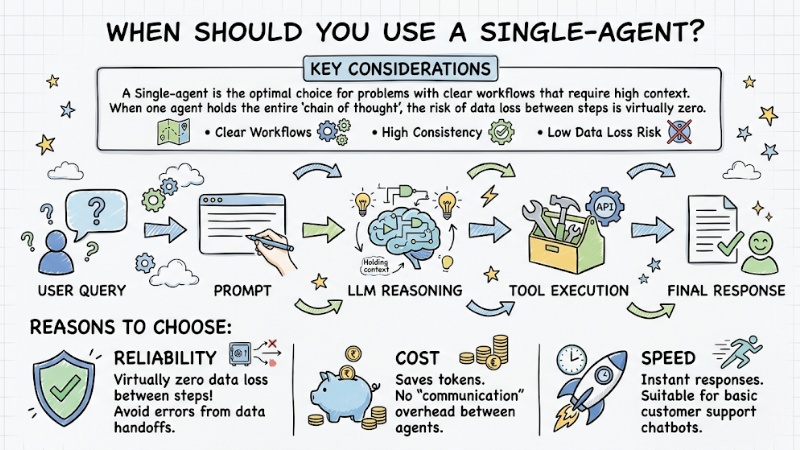
Use cases for a Single-Agent
When Should You Transition to a Multi-Agent?
You should only consider upgrading to a Multi-agent architecture when the problem starts to exceed the processing capabilities of a single agent, or when the need for administration, security, and coordination across departments becomes more complex.
At that point, splitting the system into multiple specialized agents not only helps break down the workload but also allows you to better control data access permissions and optimize overall processing performance.
Signs that a transition is needed:
- Task Decomposition: The problem is too large and needs to be broken down into sub-tasks (research, drafting, reviewing).
- Authorization: Need to isolate data between departments or across different secure environments.
- Parallel Processing: Need to execute multiple tasks concurrently to reduce overall wait time (latency).
Note: The biggest challenge is "Orchestration overhead" – the complexity and expense of coordination. Therefore, you need to avoid overusing it if the problem does not truly require complex coordination.
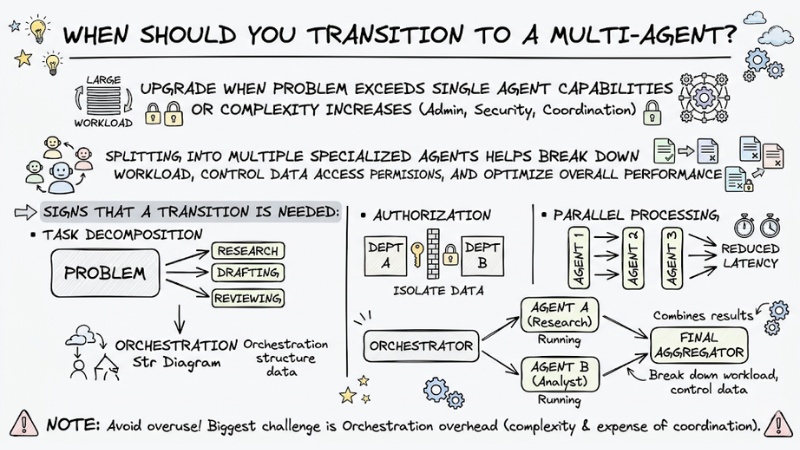
Use cases requiring a transition to Multi-Agent
Read vs. Write Strategy: Task Categorization Tips
Based on field experience, I recommend categorizing your architecture based on the nature of the action:
| Task Nature | Recommended Architecture | Reason |
|---|---|---|
| Read (Search, Analysis) | Multi-agent | Leverages parallel processing and multi-source search capabilities. |
| Write (Coding, Drafting) | Single-agent | Maintains consistent context and prevents stylistic inconsistency/drift. |
| Hybrid (Combination) | Phase separation | Uses Multi-agent for data aggregation and Single-agent for output synthesis. |
Considerations When Choosing Frameworks and LLMs
Choosing the right framework and LLM model from the start will help shorten development time, make it easier to scale later, and improve observability and monitoring across the entire system. Here are a few practical suggestions:
- LangGraph: Best suited for systems that need to manage complex states, branching task flows, and clear conditional routing.
- CrewAI: Effective when designing a system based on a role-based mechanism, where each agent assumes a specialized role in the AI's "working group".
- AutoGen: Powerful when needing to simulate or orchestrate back-and-forth conversations among multiple agents, suitable for complex collaborative scenarios.
You should always install tools like LangSmith to trace each agent, helping detect token bottlenecks or logic errors early on.
Frequently Asked Questions
How do Single-agent and Multi-agent systems differ?
A Single-agent is a system that centralizes all logic into a single agent. Conversely, a Multi-agent system divides responsibilities among multiple specialized agents, allowing for better modularity and scalability.
When should I start with a Single-agent system?
You should start with a Single-agent when you need fast deployment speed, low cost, or when the problem has a narrow scope, requiring unified context and sequential logic.
What are the advantages of a Multi-agent system?
A Multi-agent system allows for task parallelization, agent specialization, and solving multifaceted complex problems more efficiently, especially when there are clear security or organizational boundaries.
When should I consider transitioning to a Multi-agent system?
You should consider transitioning to a Multi-agent system when the problem starts to exceed security boundaries, requires the involvement of multiple teams, or when there are plans to develop and scale the system in the future.
How do "Read" and "Write" agents differ in AI architecture?
"Read" agents are usually suited for Multi-agent systems because they focus on gathering and analyzing information that can be processed in parallel. "Write" agents generate content or code, which is typically more effective with a Single-agent system to maintain consistency and avoid context fragmentation.
How can I manage costs when using a Multi-agent system?
You can optimize costs by using cheaper models for generic tasks and only utilizing expensive models for critical tasks, or by using efficient state management frameworks to minimize unnecessary context transmissions.
What is the most important factor when choosing between a Single-agent and Multi-agent system?
The most important factor is the specific requirements of the problem, complexity, speed requirements, cost, and scalability. There is no one-size-fits-all solution; the choice depends on the project's goals.
Is a Multi-agent system more expensive?
Yes, because the agents have to send context back and forth to each other during every exchange, increasing the amount of tokens consumed. Therefore, you should consider carefully before scaling up.
How can I keep the context stable when using multiple agents?
You should use a "Shared State" or centralized memory instead of forcing the agents to forward the entire conversation history to one another manually.
Should I "over-engineer" right from the start?
No. You should always start with a Single-agent architecture. If a Single-agent handles the problem neatly with just about 100 tokens, there is no reason to use a Multi-agent setup and accept wasting up to 500 tokens for the exact same result.
Is Multi-agent or Single-agent architecture safer for security?
Multi-agent is safer because you can limit tool access permissions for each specialized agent, rather than letting one agent hold full privileges.
See more:
- Self-hosted AI Agent: Build Your Own Maximum-Security AI Assistant
- Building Multi-tenant AI Agents: A Roadmap for SaaS Businesses
- 15 Important Multi-Agent Metrics for Evaluating AI Agent Systems
In summary, there is no "standard" architecture for every problem. The key is to clearly understand your project's goals, complexity level, and budget to make the right choice between a lightweight Single-agent system or a flexible Multi-agent one. Start simple with a Single-agent system, only scale to a Multi-agent when truly necessary, to optimize performance and cost for your AI system.