What Is Low-Code? A Look at Its Technical Architecture and Hidden Risks

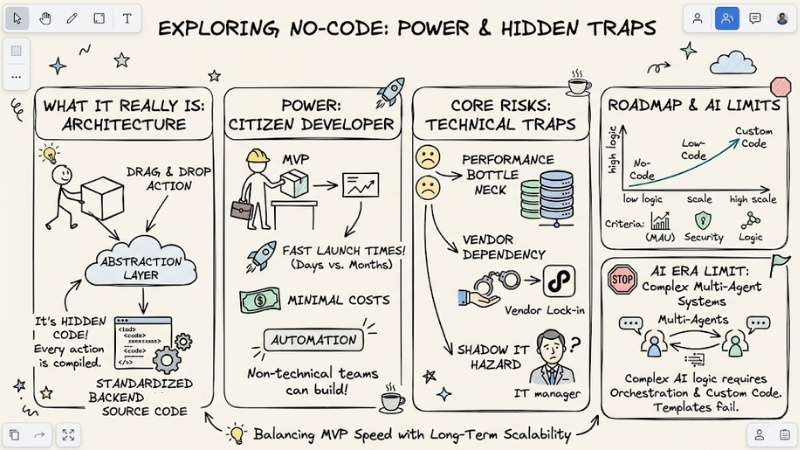
In modern software development, a sluggish development lifecycle creates serious "bottlenecks," leading to prolonged project backlogs. To solve this, low-code has emerged as a rescue architecture, helping to narrow the gap between business direction and IT execution capabilities. However, behind this simple drag-and-drop interface are core technical principles that every engineer needs to master. This article will analyze the nature of the underlying source code of this platform, evaluate system architecture, and warn of potential security risks that businesses may face.
Key points
- The nature of Low-code architecture: Understand that Low-code is not magic, but an abstraction layer that compiles drag-and-drop actions into standardized backend source code, helping to accelerate development speed (RAD) by many times.
- Audience stratification: Clearly define the boundaries between No-code (for business users/quick MVPs), Low-code (for engineers needing customization/infrastructure optimization), and Custom Code (for core/mission-critical systems requiring high performance).
- Maximizing scalability: Engineers are not limited by drag-and-drop interfaces but can "break" barriers by embedding code directly to optimize data queries and specific business logic.
- Managing Shadow IT risks: Identify the dangers when departments arbitrarily deploy software, requiring IT administration to apply detailed control policies like RBAC to prevent data leaks (PII).
- Dependency problems: Be wary of being "locked" into data and logic within a vendor's ecosystem; evaluate source code exportability and system portability before making long-term investments.
- A new era - AI Agents: Understand the shift from static Workflows (If/Else) to Agentic Workflows, where AI Agents replace drag-and-drop modules with real-time tool-calling capabilities.
- FAQ resolution: Clarify how to select tools based on a checklist, Vendor Lock-in risks, and the roadmap for combining Low-code with AI to create self-operating systems.
What is Low-code? The technical nature behind the drag-and-drop interface
Low-code is a software development approach based on the principle of source code abstraction. Instead of writing code line-by-line from scratch, this platform provides a visual development environment, helping developers and citizen developers (business users with basic IT knowledge) assemble applications through pre-packaged logic modules.
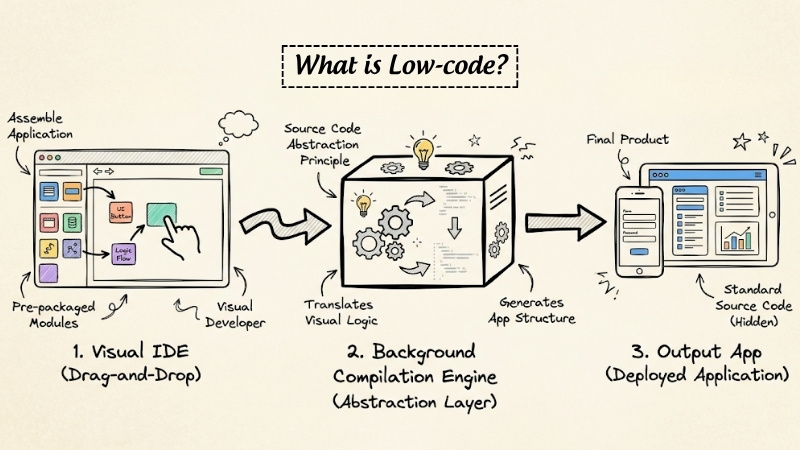
Low-code is a software development approach based on the principle of source code abstraction
Visual IDE and code generation mechanism
The nature of a Visual IDE (integrated development environment) is not a technological magic trick. Each action on this drag-and-drop interface is essentially a process of calling standardized code snippets that the system has pre-compiled at the backend layer.
These platforms use model-based logic to automate the creation of database tables, internal API and user interfaces (UI). This mechanism completely eliminates repetitive infrastructure configurations, promoting a development methodology focused on speed (RAD) with a speed measured in days instead of months as before.
System scalability
The defining difference of this architecture is that manual coding is minimized, not that the developer's work is entirely eliminated. When pre-packaged logic blocks do not meet highly specific business requirements, software engineers can completely leverage source code extensibility.
You can easily embed scripts using Python, Golang, or write native SQL commands directly to optimize queries, ensuring data integrity without being performance-limited by the UI interface.
Evaluating architecture: Low-Code, No-code, and traditional programming
The decision to choose low-code, no-code, or traditional programming depends entirely on system design. No-code is suitable for single tasks, while core systems requiring memory optimization must use pure code.
| Criteria | Traditional programming | Low-code | No-code |
|---|---|---|---|
| Target user | Software engineers, data scientists. | Developers, citizen developers. | Department personnel (Marketing, HR, Sales,...). |
| Deployment speed | Slow (Measured in months/years). | Fast (Measured in weeks/months). | Very fast (Measured in hours/days). |
| Customizability | Unlimited (100% resource control). | High (Support embedding APIs and custom code). | Low (Locked into existing templates). |
| Typical use cases | Core Banking, HFT, AI engines. | ERP, internal CRM, admin dashboards. | Landing pages, survey forms, static apps. |
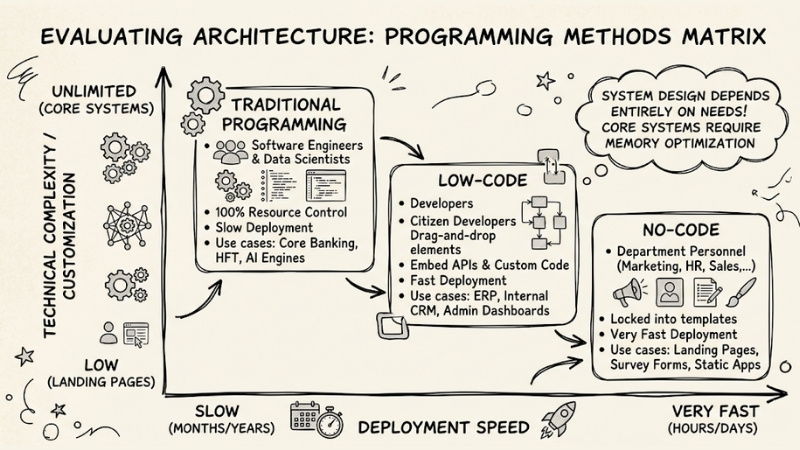
Evaluating architecture: Low-Code, No-code, and traditional programming
Advantages of low-code: Optimizing technology infrastructure
Applying a visual development model brings clear technical advantages to optimize technology infrastructure:
- Automating Business Process Management (BPM): Shortens data flows between departments, quickly digitizing internal approval processes.
- Freeing up IT resources: Reduces time spent on boring CRUD (Create, Read, Update, Delete) tasks, allowing engineers to focus on core architecture design.
- Synchronous deployment: Built-in CI/CD pipeline, automating the process of pushing code (deploy) from Staging to Production environments safely.
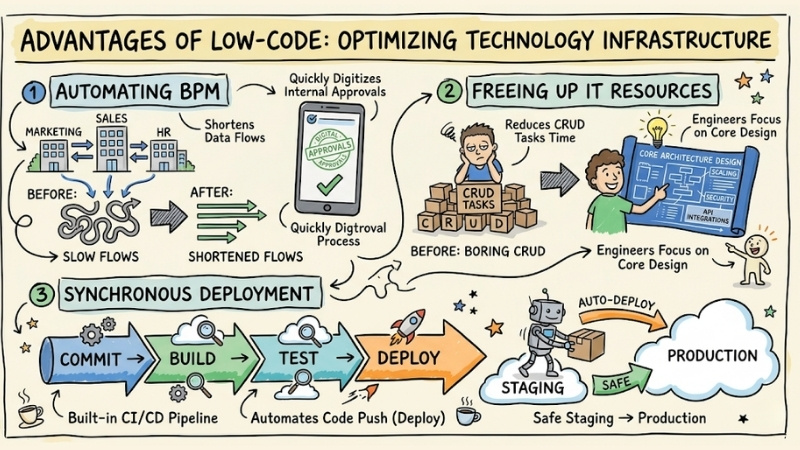
Advantages of low-code: Optimizing technology infrastructure
Disadvantages of low-code: Security risks and vendor dependency
Governance risk: The Shadow IT problem
The greatest danger when "democratizing" app creation is the explosion of Shadow IT - a phenomenon where business departments arbitrarily buy, install, and configure software without review from the company's security department.
When anyone can create API endpoints, the risk of data leaks is extremely high. To establish effective Shadow IT governance, the IT management team must configure RBAC at the most detailed level. This ensures that enterprise software scalability does not accidentally create deadly vulnerabilities.
Vendor dependency
A fatal flaw in the application lifecycle management of this platform is the risk of vendor dependency. If the platform provider suddenly increases license fees or charges for API usage based on volume, exporting source code to a separate On-premise infrastructure is usually impossible. Even if it is possible to export, the auto-generated code is often unformatted and completely worthless for independent maintenance and upgrading.
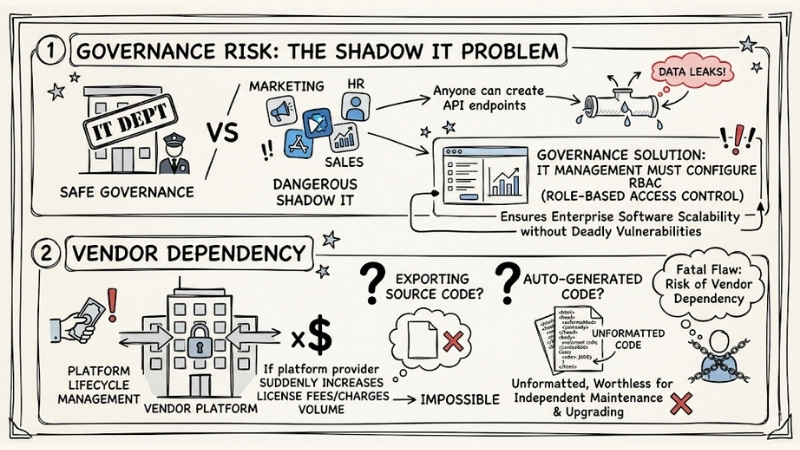
Disadvantages of low-code: Security risks and vendor dependency
A new era: The shift from low-code to AI Agents
The future of software architecture is witnessing a convergence between AI-assisted coding and AI agents. Instead of manually configuring rigid modules, engineers now only need to grant API access and define "goals" via text.
AI agents have the ability to automatically reason (Reasoning), plan (Planning), and call tools (Tool calling) in real-time to complete tasks, thoroughly resolving the passivity of traditional static processes.
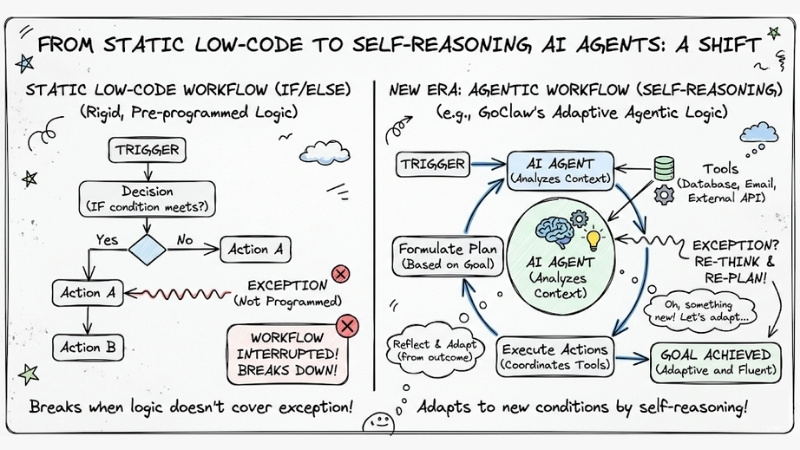
A new era: The shift from low-code to AI Agents
Frequently asked questions about using Low-code
What is Low-code in software development?
Low-code is an application development method through a visual interface, allowing users to drag-and-drop components instead of writing manual source code. This technology abstracts complex logic, helping to speed up application deployment.
What is the core difference between low-code and no-code?
Low-code is for both developers and business users, allowing intervention via custom source code. Conversely, no-code is limited to existing drag-and-drop tools and does not support complex source code expansion.
Why should businesses be careful with "vendor lock-in"?
"Vendor lock-in" keeps application data and logic "locked" within the vendor's infrastructure. This creates difficulties when the business wants to change platforms, increasing operating costs and risks if the vendor stops supporting it.
What is Shadow IT and how does it relate to low-code?
Shadow IT is when departments arbitrarily deploy software without IT department approval. If not managed well with security policies, low-code can create data leak vulnerabilities beyond control.
How to choose the right low-code platform?
When choosing, prioritize factors:
- Source code extensibility.
- Security management tools (RBAC, data leak prevention).
- API integration capability with existing systems to avoid data fragmentation.
What does the combination of AI Agents and low-code mean?
AI Agents allow process automation based on logical reasoning instead of just following static flows. This helps upgrade low-code applications from "drag-and-drop processes" into self-operating systems that make intelligent decisions.
See more:
- What Is an Orchestration Layer? Understanding Its Importance in System Architecture
- What is Agent Swarm? How Agent Swarm Automates Workflows
- What is Multi-Agent Workflow? Architecture, Models and Applications
Low-code is a practical technological stepping stone, acting as a powerful catalyst for the digital transformation roadmap by abstracting infrastructure complexity. This method fully respects the expertise of software engineers by repositioning them into core systems instead of getting stuck in simple internal projects.