What Is an Orchestration Layer? Understanding Its Importance in System Architecture

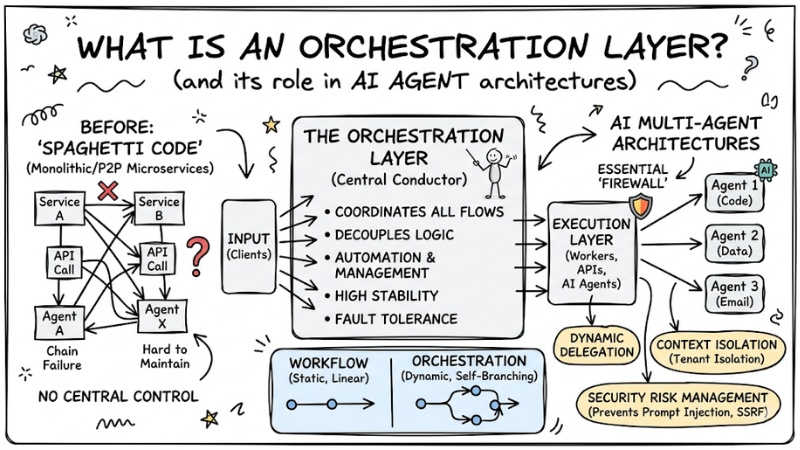
As distributed systems become increasingly complex, letting APIs, microservices, or AI Agents freely cross-call each other can easily turn architecture into "spaghetti code" – tangled, hard to maintain, and prone to chain failures when just one node goes down. This article will explain what the orchestration layer is and why enterprise Multi-Agent architectures are almost strictly required to have this layer.
Key Points
- The nature of the architecture: Understand the Orchestration Layer as the central coordinating layer that separates control logic from business logic, solving the "spaghetti code" problem in distributed systems and Microservices.
- Strict execution mechanism: Master the processing flow of the orchestration layer, ensuring the idempotency of tasks.
- Workflow vs. Orchestration: Clearly distinguish between Workflow (static, linear, pre-configured) and Orchestration (dynamic, self-branching, managing lifecycles and complex resources).
- Importance in AI Agent systems: Identify the Orchestration Layer as the critical "firewall" for Multi-Agent architectures, taking on roles in dynamic task delegation, context isolation, and security risk management.
- Optimization mindset: Accept latency trade-offs for absolute stability and fault tolerance in critical business processes.
- Technology selection: Prioritize high-performance system languages like Go (Golang) to build the orchestration layer with a small binary footprint, low RAM consumption, and ultra-fast startup times for AI Agent systems.
- FAQ resolution: Clarify the fundamental difference between Workflow and Orchestration, the importance of workspace isolation in enterprises, and why Orchestration is a mandatory security layer in distributed AI systems.
What is the Orchestration Layer? Its nature and position in system architecture
The Orchestration Layer is an intermediary software architecture layer responsible for automating the arrangement, coordination, and management of the execution flow of multiple independent processes, services, or AI Agents to complete a complex business process.
In modern system architectures, the orchestration layer is always centrally positioned, standing between the Client Layer (User Interface/Input Requests) and the Execution Layer (Workers, external APIs, or AI Agents).
This layer is established based on the principle of Decoupling. In legacy Monolithic architectures, orchestration logic and business logic were mixed. In Microservices, without an Orchestrator, services must communicate P2P, making data flow tracking very difficult. By separating the "control" part into an independent layer, the system becomes highly scalable, easier to debug, and more centrally managed.
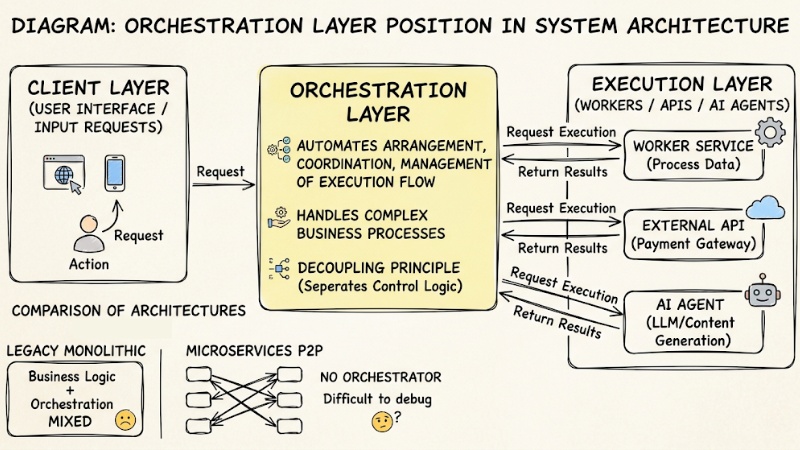
Diagram of the Orchestration Layer's position in System Architecture
Operational mechanism of the Orchestration Layer
To ensure thousands of processes run concurrently without conflict, a task execution engine inside the orchestration layer operates according to a highly strict procedure.
The basic processing flow includes:
- Receive Request: Ingest requests from users or external systems, converting them into smaller tasks.
- Analyze Dependencies: Break down the workflow into a DAG (Directed Acyclic Graph) to determine which tasks run first, later, or in parallel.
- Execute: Allocate resources and trigger the corresponding Workers/Agents via APIs.
- Error Handling: Automatically evaluate results, retry, or trigger fallback scenarios if failures occur.
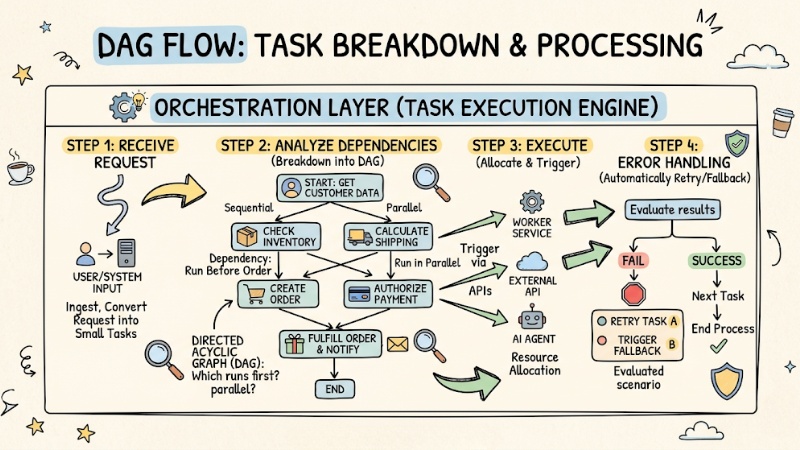
Operational mechanism of the Orchestration Layer
The task execution engine derives massive power from its state tracking capability. The system constantly persists the current state of each process into memory (Running, Pending, Success, or Failed).
When a real-world error occurs, such as OOM (Out of Memory) or a third-party API Timeout, the Orchestrator relies on state tracking to issue commands to rerun exactly the failed process without affecting the successfully completed ones. This process requires the system to ensure idempotency, meaning rerunning a task multiple times will safely return the exact same result.
Adding an intermediary layer will inevitably slightly increase the Latency of the entire request. However, system engineers view this as a worthy trade-off to achieve absolute stability.
Comparing Workflow and Orchestration
Many developers confuse static Workflow automation with dynamic Orchestration. Here is how to differentiate them:
| Criteria | Workflow | Orchestration |
|---|---|---|
| Nature | Static - Runs via configuration A -> B -> C. | Dynamic - Auto-branches based on Output or Errors. |
| Objective | Defines the sequence of execution steps. | Manages lifecycles, allocates resources, handles incidents. |
| Complexity | Linear, easy to set up for small scripts. | Complex, used for Microservices/Multi-Agent architectures. |
Why must Multi-Agent systems have an Orchestration Layer?
While in the early stages of AI, engineers often used Single-Agents (like AutoGPT) to solve sequential prompts, today, the trend has shifted to multi-agent systems. In this environment, the Orchestration Layer is not just a work-distribution tool, but the vital "firewall" of the system.
The necessity of the orchestration layer in AI Agent systems is demonstrated by 3 core factors:
- Dynamic task delegation: Instead of hard-coding every step, an "Orchestration Agent" (Parent orchestrator agent) receives requests from the user, automatically analyzes the context, and breaks down the problem. It then delegates to specialized Agents (like a coding Agent, data analysis Agent, email sending Agent) operating synchronously or asynchronously.
- Context isolation: In a Multi-tenant enterprise environment, the orchestration layer ensures that the workspace and conversation context of user A are completely isolated from user B. This prevents the AI from taking sensitive data from one project to answer another.
- High security: This is the most crucial factor. Granting direct internal API access to an LLM without an oversight orchestration layer will lead to Prompt Injection or SSRF risks. The Orchestrator enforces Tool Usage Policies, limiting permissions per Agent, per channel, and blocking suspicious API requests prior to execution.
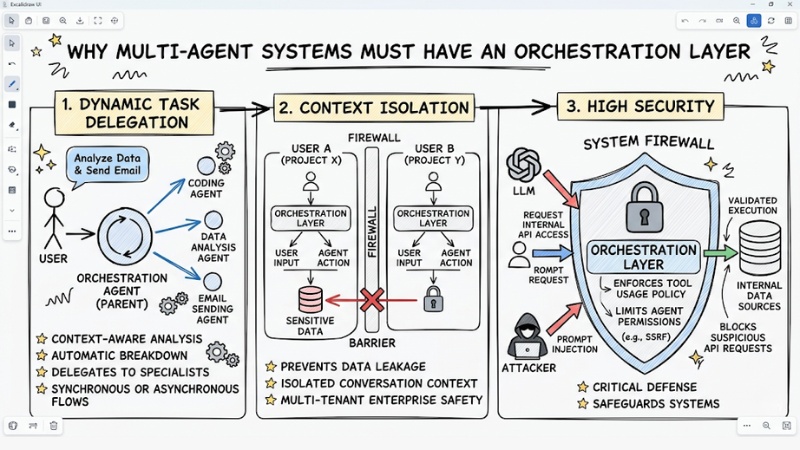
The importance of Multi-Agent in the Orchestration Layer
Frequently Asked Questions about the Orchestration Layer
What is the Orchestration layer?
The orchestration layer is an intermediary software architecture layer responsible for managing, allocating, and automating workflows among system components. It ensures tasks are executed in the correct sequence, handles incidents, and maintains a stable state for the entire distributed system.
What is the main difference between a Workflow and an Orchestrator?
A Workflow defines the sequence of execution steps (the what and how), and is static in nature. An Orchestrator is the execution system, managing the flow, auto-branching based on outputs, and handling errors in real time.
Why must a Multi-Agent System have an Orchestration Layer?
A Multi-Agent system without an orchestration layer will lead to context conflicts, security risks (like Prompt Injection), and a loss of control when delegating work. The Orchestration layer provides mechanisms for workspace isolation, access rights management, and safe monitoring for each agent.
How to mitigate security risks when deploying AI Agents?
You must deploy a multi-layered security model: Gateway authentication, global tool policies, per-agent controls, per-channel controls, and ownership rights. Crucially, API keys must be encrypted to protect user data from intrusion.
Does the Orchestration layer slow down the system?
Yes, adding an intermediary layer to manage tasks will slightly increase latency. However, this is a necessary trade-off to ensure synchronicity, error recovery capabilities, and consistency for complex enterprise systems.
See more:
- What is no-code? Opportunities, risks, and when you should use it
- What is Agent Swarm? How Agent Swarm Automates Workflows
- What is AIaaS? A detailed guide to Artificial Intelligence as a Service
In conclusion, understanding the orchestration layer correctly helps engineers avoid falling into the "over-engineering" trap. For simple linear scripts, a static workflow is sufficient. However, when transitioning to complex microservices architectures or enterprise-grade AI Agent systems, the orchestration layer becomes a mandatory tier to guarantee fault tolerance, data security, and scalability.