Misconceptions about AI Agents: What Enterprises Must Avoid to Maximize Performance

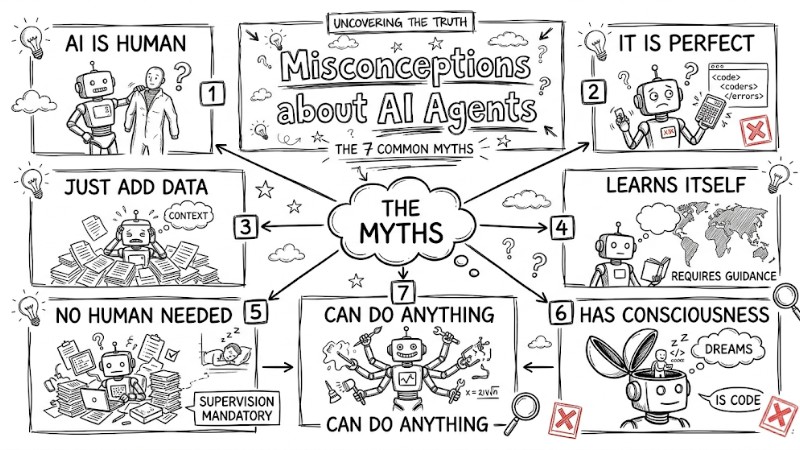
An AI Agent is an artificial intelligence system with clear goals, capable of planning and executing a sequence of actions to automate a portion of an enterprise's operational workflow. This article helps you distinguish AI Agents from chatbots, identify common misconceptions, and grasp practical setup principles for context-accurate deployment, optimizing both efficiency and costs.
Key Takeaways
- Distinct nature: Understand that an AI Agent is an autonomous "virtual employee" capable of self-planning and executing complex workflows, helping you clearly distinguish it from the passivity of traditional chatbots.
- Debunking myths: Identify and eliminate 7 common misconceptions about AI Agents, providing enterprises with a realistic perspective for safer AI adoption.
- Core setup skills: Pocket the techniques for writing precise Prompts and establishing clear permission boundaries using natural language, enabling non-IT personnel to smoothly control AI Agents.
- FAQ: Get answers to questions about optimizing context windows, the difference between Prompt and Context Engineering, data security levels, and recommendations on which department should deploy AI first to see the fastest ROI.
What is an AI Agent? A Quick Breakdown vs Enterprise Chatbots
An AI Agent is an automated system capable of understanding goals, planning, and utilizing tools to complete a sequence of tasks tied to a specific outcome. Unlike isolated Q&A interactions, an AI Agent is designed around goals and can combine multiple steps of reasoning and sequential actions to complete an end-to-end workflow.
Comparison Table: Enterprise Chatbots vs AI Agents:
| Criteria | Enterprise Chatbot (Standard LLM) | AI Agent |
|---|---|---|
| Proactivity | Responds to individual requests, waiting for the user to input commands for each step. | Pursues assigned goals, builds a sequence of logical reasoning steps, and deploys them sequentially until the task is complete. |
| Operational Mode | Conversation-centric, operating like a strict Q&A system, primarily querying and returning information. | Operates as a task assistant: receives a goal, autonomously scrapes relevant data, analyzes it, and synthesizes outputs tailored to the business context. |
| Task Execution | Primarily generates and responds with text-based content within a chat channel or conversational UI. | Capable of invoking tools and APIs to execute actions, e.g., sending emails, updating CRM data, or generating/editing files in internal systems. |
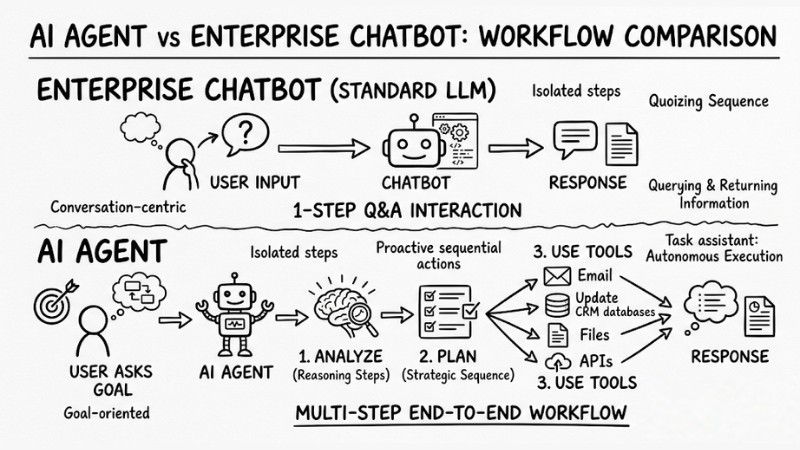
Compare Enterprise Chatbots vs AI Agents
Debunking 7 Common Misconceptions About AI Agents
Ineffective AI adoption often stems from misaligned expectations and uncontrolled deployments, leading to wasted resources and operational risks. Below are common misconceptions about AI Agents along with more practical approaches for enterprises.
AI Agents can be 100% automated and unsupervised
AI Agents do not achieve absolute perfection, and handing over full decision-making authority to the system easily spawns massive risks, especially when input data is unstandardized. A more viable deployment model is enforcing Human-in-the-loop, where the AI handles the bulk of the parsing and drafting workload, while humans retain the final approval gate for sensitive or high-impact tasks.
Feeding more documents makes the AI Agent better
Dumping too many documents in at once can bottleneck the system and spike the risk of AI hallucinations due to exceeding the model's effective context processing capacity. Enterprises should chunk documents into information blocks, only load the core directional content, and allow the AI to invoke detailed documents as needed, rather than loading the entire data repository in one go.
You need complex programming skills to build AI Agents
Many current No-code and Low-code platforms allow you to build and operate AI Agents via drag-and-drop interfaces and visual configurations, eliminating the strict need to write complex code. The critical competency is process-oriented thinking—clearly describing workflow steps and execution conditions, then translating them into a task pipeline for the AI Agent.
AI Agents will soon entirely replace humans
AI Agents primarily handle repetitive tasks, data processing, and crunching, freeing up human teams to hyper-focus on strategic, creative work, and complex human interactions. Enterprises achieve peak performance when treating AI Agents as productivity multipliers, while critical decisions, long-term roadmaps, and judgment-heavy interactions remain firmly in human hands.
Deploying AI Agents always requires massive CapEx
The evolution of flexible billing models and SaaS services helps enterprises access AI Agents without needing to drop massive infrastructure investments upfront. Instead of purely looking at software costs, enterprises should calculate ROI based on man-hours saved, workflow error reduction, and incremental revenue to evaluate actual performance.
A single multi-purpose AI Agent is all an enterprise needs
Assigning too many roles to a single Agent typically leads to context drift and degraded accuracy in specific operations. A much better approach is architecting a system of multiple specialized AI Agents, where each Agent owns a specific task cluster like customer support, HR record processing, or accounting data extraction, and they can orchestrate together in a multi-agent model when necessary.
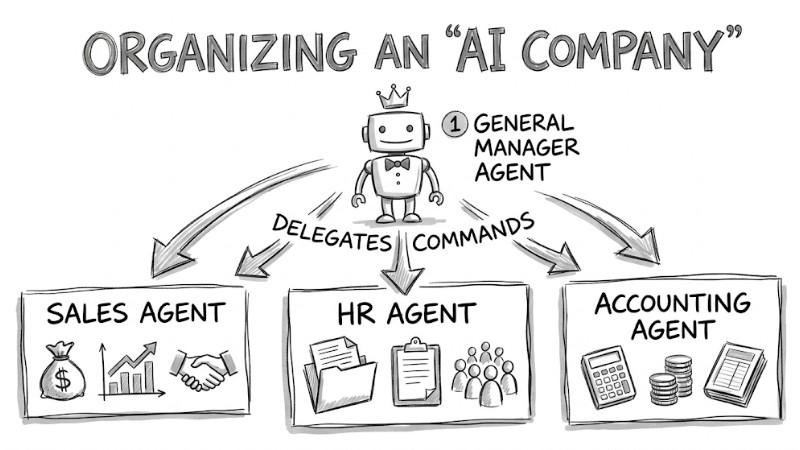
Central AI Agent Coordinating Department-Specific Agents
Buying an AI Agent tool automatically optimizes workflows
Tools only drive performance when the business workflow is already standardized, with clearly defined steps and associated responsibilities. Before piping a workflow into an AI system, enterprises must build instructional documentation and flowcharts, strictly defining the start points, end points, inputs, and outputs for every step so the AI Agent can trace them flawlessly.
Effective AI Agent Setup Principles for Non-Technical Users
To build a stable automation system, non-technical users do not need to focus on source code but should master the following two core setup techniques:
Mastering Context Engineering
You shouldn't demand the AI access all documents upfront; instead, enforce a Progressive disclosure mechanism to tightly control context. At tier one, provide the system with its role, goal, and base info framework. Then, configure the AI to only autonomously invoke deep-dive documents when encountering complex questions or edge cases requiring detailed references.
Prompt Engineering Skills
When delegating tasks to an AI Agent, the instructions must be highly specific, with clear boundaries and defined authority scopes to mitigate incorrect or off-topic responses. Enterprises can hardcode guardrails directly into the prompt, for example, strictly permitting the use of a single internal policy file, forbidding the generation of hallucinated discounts, and forcing a handoff to human support channels for requests exceeding protocol.
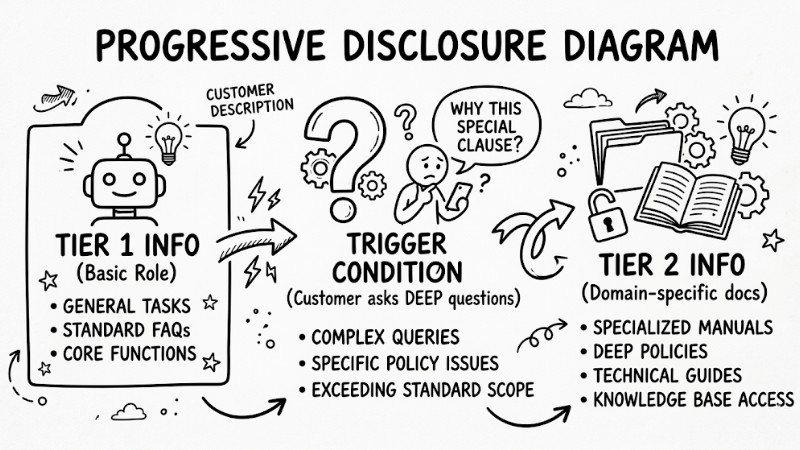
Information Layering Strategy in AI Agent Architecture
Below is an example of a standard prompt framework written in natural language:
Role: You are the Customer Support Agent for furniture company X.
Goal: Resolve inquiries regarding the return and exchange policy.
Permission boundaries (Guardrails):
- STRICTLY rely on the attached "Chinh_sach_doi_tra.pdf" file.
- ABSOLUTELY DO NOT hallucinate discount programs or promos outside the document's scope.
- If a customer gets aggressive and demands a manager, immediately provide the Hotline: 1900 xxxx.
Frequently Asked Questions (FAQ) Regarding AI Agent Misconceptions
How do you optimize the context window for an AI agent most effectively?
To optimize the context window, enterprises should chunk documents into short, highly queryable content blocks instead of dumping massive documents in all at once. You should hook it up with vector search or RAG so the AI only extracts and parses the exact text snippets relevant to the prompt, drastically boosting accuracy and slashing compute costs.
What is the biggest difference between Prompt Engineering and Context Engineering?
Prompt Engineering focuses on how you articulate requests and instruct the model to execute a specific task, such as demanding it to draft an email in a specific tone. Context Engineering focuses on architecting and managing the entire environment, including the data pipelines, reference docs, and information flows the model is permitted to access when generating outputs.
Are AI Agents safe for internal enterprise data?
AI Agents can operate safely if the enterprise enforces a strict data strategy, selects deployment platforms with crystal-clear security policies, and properly configures privacy settings. Enterprises must audit the Terms of Service, toggle flags preventing the vendor from using payload data for model training, and configure strict internal RBAC (Role-Based Access Control) for each data cluster.
Which department should SMEs start deploying AI Agents in to see the fastest ROI?
SMEs typically see rapid returns when deploying AI Agents in departments with highly repetitive workflows, like customer support, accounting invoice processing, or recruitment resume screening. These task clusters possess highly structured data, heavy volume, and crystal-clear telemetry metrics, making them perfect for piloting, benchmarking ROI, and scaling outward.
Read more:
- Popular Types of AI Agents: How to choose and Real-World Applications
- How AI Agents work: Autonomy and Functional Mechanisms
- AI Agents for Enterprise: An A-Z Practical Deployment Roadmap
AI Agents only deliver value when their true nature is understood, attached to standardized workflows, and configured with clear context, permissions, and telemetry mechanisms. When an enterprise perfectly fuses Context Engineering, Prompt Engineering, and a phased departmental deployment strategy, AI Agents become a robust, sustainable automation foundation rather than a fleeting tech trend, massively elevating operational performance and quality across the entire organization.
Tags