What are Autonomous Agents? Mechanisms, Classifications and Applications

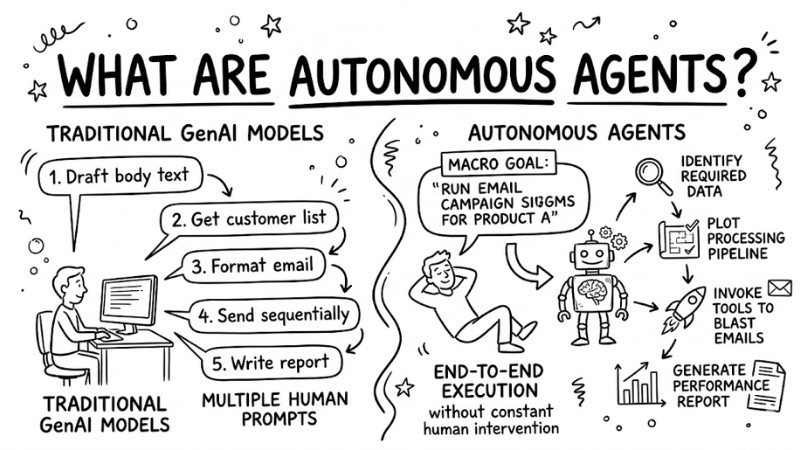
Autonomous Agents are AI systems capable of perceiving their environment, planning, and executing a sequence of actions to achieve a goal without continuous human intervention. This article explains the concept, operational mechanisms, types of autonomous agents, the differences from Generative AI, and real-world applications helping enterprises safely automate complex pipelines.
Key Takeaways
- Agentic Workflow Concept: Understand that this is a workflow driven by an AI Agent, capable of autonomous reasoning, planning, and independently executing complex task sequences to achieve goals.
- Core Characteristics: Master the 3 traits that make up a true autonomous agent.
- Operational Mechanism: Explore the system's closed 4-step loop that runs until the defined goal is met.
- Categorization: Identify the 7 tiers of autonomous agents, ranging from simple reflex, goal-based, and learning to multi-agent systems, helping you pick the right architecture for your enterprise problem.
- Tech Comparison: Clearly distinguish the differences in autonomy levels, Prompt requirements, and error-handling capabilities between Generative AI and Autonomous Agents.
- Practical Applications: Discover the sectors heavily adopting this tech, including autonomous virtual assistants, self-driving cars, enterprise automation, etc.
- Risk Management: Recognize the vital importance of the "Human-in-the-loop" model for sensitive decisions to ensure ethical safety and security.
- FAQ: Get answers to questions regarding enterprise scale suitability, the ability to build AI Agents without code, and internal data security risks.
What are Autonomous Agents?
Autonomous Agents are computer science systems designed to autonomously perceive their environment, make decisions, and execute actions to achieve a defined goal without continuous human intervention. Instead of waiting for granular, step-by-step prompts, you simply assign the final goal, and the Agent handles the planning and execution within its configured scope.
In reality, you can visualize the difference through a task deployment example:
- With a basic Generative AI model, users must provide step-by-step instructions like drafting the email body, opening the customer list, and sending it out to each person sequentially.
- With Autonomous Agents, users simply state a goal like "run an email campaign for product A," and the system identifies the required data, plots the processing pipeline, invokes tools to blast the emails, and generates a performance report based on pre-designed configurations and boundaries.
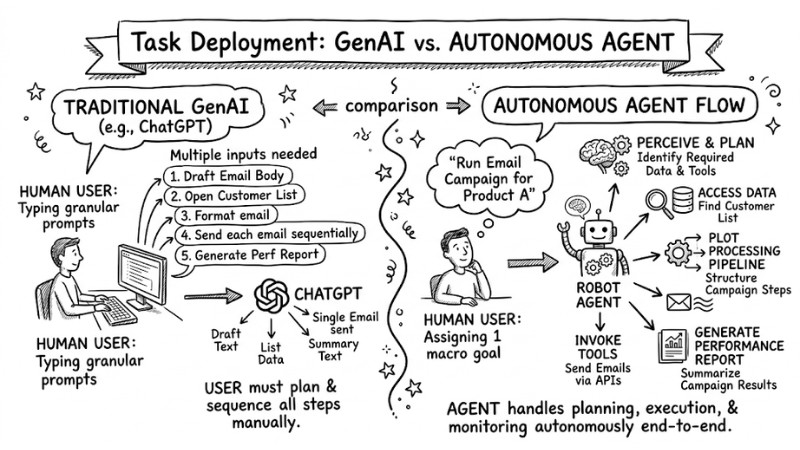
With Autonomous Agents, users simply define the goal; the system handles the rest
Core Characteristics of an Autonomous Agent
To be considered a true Autonomous Agent, the artificial intelligence system typically needs to simultaneously satisfy the three technical traits below:
1. Autonomy
The system is capable of operating independently within a defined environmental scope, eliminating the reliance on continuous human prompting at every granular step. Upon receiving a macro goal within its configured boundaries, the Agent can bootstrap the execution pipeline, select strategies, and proceed with subsequent steps until it hits a completed state or requires an approval gate.
2. Multi-step Planning
Instead of processing tasks in a single shot, an autonomous agent is capable of decomposing massive goals into smaller micro-tasks, determining priority queues, and orchestrating them sequentially or in parallel based on its reasoned logic. This mechanism empowers the Agent to handle complex pipelines like data scraping, analysis, decision-making, and action execution in a continuous chain.
3. Self-correction and Adaptability
Autonomous Agents are engineered to operate in environments with non-deterministic factors, thus requiring the capability to catch bugs, re-evaluate situations, and pivot plans when conditions shift. For example, if an Agent is executing the task "book the most optimal flight to Tokyo" and hits an error from an airline's system, it can loop back to the search step, pick an alternative airline, or route a different flight path within its defined policy limits instead of crashing the entire pipeline.
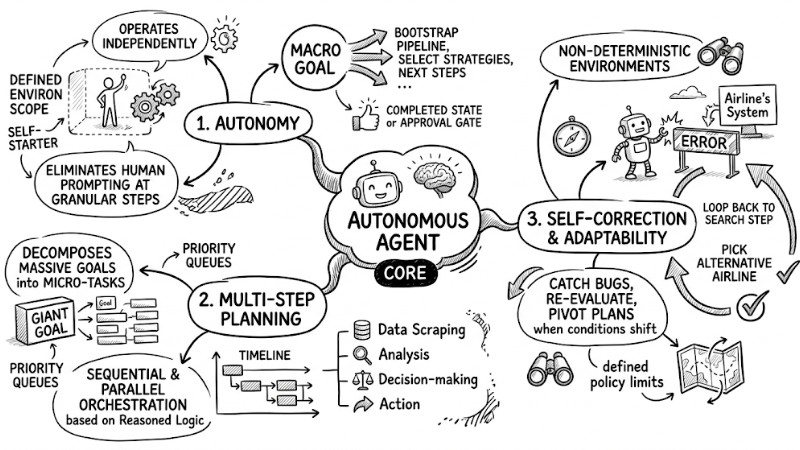
Core Characteristics of an Autonomous Agent
Operational Mechanism of Autonomous Agents
The workflow is typically structured as a closed loop consisting of four continuous steps, iterating until the defined goal is hit.
Step 1: Perception and Information Gathering
Before acting, the Agent needs to ingest data to understand its surrounding environment. The system utilizes perception capabilities via the following tools:
- Parsing text using Natural Language Processing (NLP).
- Extracting data via APIs from other software.
- Collecting physical signals from sensor arrays (for robots).
Battle-tested advice: Input data quality directly impacts decision quality, so if you grant access to inaccurate or unmanaged data sources, the system will easily output skewed results following the "Garbage in, Garbage out" principle.
Step 2: Processing & Planning
In this step, the system leverages large language models and machine learning techniques to analyze information, comprehend the goal, and decompose the request into smaller tasks.
For example, with the prompt: "Organize a birthday party for the boss," the Agent can slice it into micro-tasks like:
- Task 1: Search for a 5-star restaurant near the office.
- Task 2: Compile a guest list from an Excel file.
- Task 3: Design invitations and dispatch automated emails.
- Task 4: Contact the bakery via their website to order a cake.
Step 3: Decision-making & Actuation
Based on the plotted plan, the Agent selects a specific path and triggers the necessary tools for execution. The system can run restaurant searches, manipulate emails to send invites, or fill out order forms on relevant platforms, instead of merely providing text-based suggestions.
These actions are governed by permission configurations and tool scopes, ensuring the Agent only manipulates authorized systems.
Step 4: Learning Loop
When execution outputs fall short of requirements, like a restaurant reporting it's fully booked, the Agent logs the environmental feedback and tweaks the plan based on the fresh data. The system can drop the unviable option, loop back to the search step, and attempt alternative paths until it hits the goal or caps out at the configured loop limit.
Iterating through this perception, planning, action, and adjustment cycle helps the Agent incrementally improve decision quality in subsequent runs, provided the feedback payloads and update mechanisms are explicitly architected.
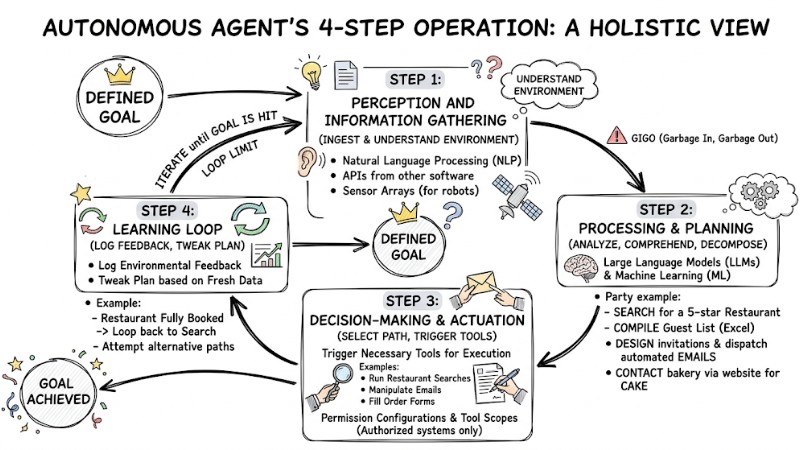
The Operational Mechanism of Autonomous Agents
Popular Types of Autonomous Agents
Autonomous AI agents feature multiple operational tiers, from instantaneous reactions to learning and orchestrating within complex systems. Identifying each type helps in selecting the right architecture for your specific application needs.
1. Simple Reflex Agents
Operates based on the current state, holding no memory and running zero historical data analysis. The system reacts to inputs using hard-coded rules, making it blazing fast but incapable of handling complex edge cases.
Example: A smart lighting system that automatically turns on when motion sensors detect someone passing by and turns off when the signal drops.
2. Model-Based Agents
Utilizes an internal model to simulate the environment and forecast the outputs of its actions prior to execution. Best suited for contexts requiring consideration of downstream consequences.
Example: A smart AC control app that learns a family's usage habits, predicts the optimal temperature setting based on the time of day, and adjusts it before users arrive home.
3. Goal-Based Agents
Operates around one or multiple defined goals, capable of plotting an action plan to step closer to that target. Typically deployed for tasks demanding long-term orientation and multi-step decisions.
Example: A delivery routing system for a fleet, generating a path to clear all daily orders with highly optimized total mileage and time.
4. Utility-Based Agents
Evaluates options based on a utility function, thereby prioritizing actions that yield the highest expected value. This approach balances costs, risks, and benefits when juggling multiple viable paths.
Example: An online ad platform that autonomously reallocates budgets across channels based on their capacity to drive the highest clicks or conversions per audience segment.
5. Learning Agents
Capable of boosting performance over time via feedback data, interactions, and historical experiences. Ideally suited for highly volatile environments.
Example: A content recommendation engine on a video platform that learns from watch history and engagement metrics to dynamically tweak the suggested video feed for individual users.
6. Hierarchical Agents
Organizes tasks in a hierarchical structure, slicing massive macro-goals into sub-tasks and processing them tier by tier. This seamlessly manages and deploys complex pipelines in an orderly fashion.
Example: A smart building management system decoupling tasks into tiers like elevator ops, security, and HVAC; each agent layer handles a specific hardware cluster and reports up to the central orchestrating agent.
7. Multi-Agent Systems
Comprises multiple agents operating concurrently within a single environment, orchestrating, sharing data payloads, and delegating tasks to tackle massive-scale or distributed problems.
Example: A food delivery platform utilizing multiple agents to dispatch orders to drivers, optimize routing, and dynamically adjust priority queues based on geolocation, weather, and ETAs.
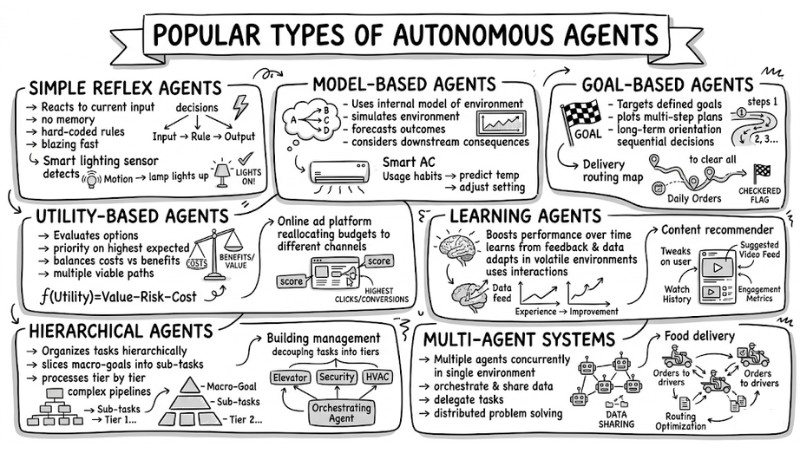
Popular Types of Autonomous Agents
The Differences Between AI Agents, Generative AI, and Autonomous Agents
To select the right approach for your problem space, you must clearly distinguish the roles of Generative AI, AI Agents, and Autonomous Agents within the same ecosystem. The table below summarizes the differences in autonomy levels, prompt ingestion, self-correction capabilities, and standout examples for each type:
| Criteria | Generative AI | AI Agent (Traditional) | Autonomous Agent |
|---|---|---|---|
| Autonomy Level | Takes prompts and responds per turn, unable to sustain long-term goals. | Executes a task sequence based on a hard-coded script or workflow, with bounded autonomy within that scope. | Pursues high-level goals, capable of autonomously planning, selecting tools, and maintaining the pipeline until completion within its configured boundaries. |
| Prompt Requirements | Demands highly specific prompts for every turn, usually requiring exact formatting and desired execution steps. | Ingests commands per task or per step within the architected flow, leaning heavily on the system's pre-configured setup. | Primarily receives the macro end-goal description; the system autonomously decomposes it into steps and decides the deployment strategy. |
| Self-Correction Capability | Typically lacks mechanisms to spin up new strategies, only responding based on the injected context. | Can handle specific anticipated bugs within the script, but struggles to adapt to out-of-scope edge cases. | Capable of re-evaluating the situation, attempting alternative paths, or hot-swapping tools when encountering runtime errors. |
| Standout Examples | ChatGPT, Claude, Midjourney | Script-based CS chatbots, internal FAQ assistants. | Systems like AutoGPT, BabyAGI, or custom Autonomous Agent deployments for deep research and multi-step ops. |
Based on battle-tested deployment experience, here is my advice to help you pick the right tool:
- Generative AI: Ideal for content generation, coding assistance, document parsing, or quick Q&A, where users proactively dictate every step and validate outputs immediately after each turn.
- AI Agent (Scripted Virtual Assistants): Suited for highly structured workflows like Q&A, form processing, or executing static step sequences within system bounds, cutting repetitive manual work but offering little flexibility for brand-new edge cases.
- Autonomous Agent: Perfect for when an enterprise wants to delegate complex tasks like massive-scale market research or multi-channel campaign orchestration, provided you strictly architect the goals, permission scopes, and telemetry mechanisms to ensure safety and compliance.
Real-World Applications of Autonomous Agents
1. Autonomous Smart Virtual Assistants (AutoGPT, BabyAGI, AgentGPT)
These platforms expand LLM capabilities into multi-step autonomous execution systems: users just drop a macro-goal, and the Agent autonomously slices it into a to-do list, scrapes data, processes payloads, and synthesizes the final output.
This model saves hours of research and deployment overhead but can spiral into infinite loops if the goal is too vague, simultaneously racking up massive API bills when left running. The primary user base includes marketers, researchers, and indie devs needing to rapidly prototype ideas.
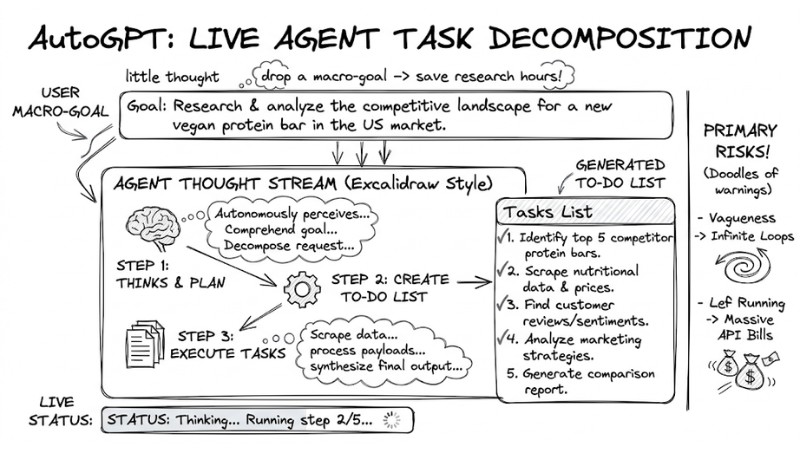
The AutoGPT UI running a live task decomposition process
2. Autonomous Vehicles
Self-driving cars like Tesla and Waymo utilize cameras, radar, and LiDAR coupled with AI models to perceive environments, evaluate traffic states, and make split-second decisions to accelerate, brake, or switch lanes in real-time.
This application slashes reliance on driver inputs and mitigates human-error anomalies, but still faces immense risks in extreme edge cases and demands airtight legal frameworks and safety protocols. Logistics, passenger transit, and robotaxi models are the sectors reaping the clearest benefits.
3. Business Automation
Within the enterprise, Autonomous Agents can triage emails, identify VIP clients, extract data payloads from CRMs, and draft contract or form templates to push up the chain for executive approval.
This deployment crushes administrative overhead and boosts data entry consistency, though hooking into legacy systems and locking down data security can be heavily complex. It is typically deployed in HR, finance and accounting, sales, and CS departments within orgs that have achieved baseline data digitization.
4. Financial Analysis and Automated Trading Bots
Autonomous Agents in finance can fuse price data, volume, news, and social signals to run market sentiment analysis, thereby dynamically tweaking trading strategies on ultra-short timeframes.
These systems deliver blazing-fast reaction speeds and enforce strict strategic discipline, but if multiple systems react concurrently to false data payloads, they can trigger massive market volatility. They are best suited for quant funds, pro traders, and financial institutions operating airtight risk management protocols.
5. Multi-Agent Systems & Industrial Robots
Within a multi-agent system, numerous Agents assume discrete roles like planning, executing, auditing, and orchestrating to close out massive-scale tasks, e.g., orchestrating warehouse robots or manufacturing assembly lines.
This model optimizes movement routing, accelerates order processing speeds, and tackles problem spaces vastly exceeding the bandwidth of a monolithic Agent, but it demands massive compute resources and a highly experienced engineering squad to architect, monitor, and maintain. Software engineering firms, automated manufacturing plants, smart warehouses, and IoT networks are the typical adopters.
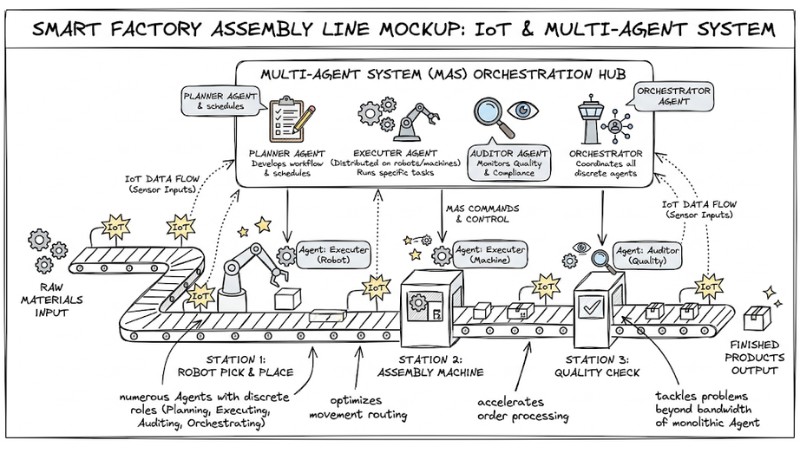
A smart factory assembly line integrated with IoT and a Multi-agent system
Pros and Cons of Deploying Autonomous Agents
Massive Operational Benefits
Correctly understanding and exploiting the benefits of Autonomous AI Agents helps enterprises carve out a massive competitive moat:
- Fully automates manual grunt work, freeing human bandwidth to hyper-focus on strategic thinking.
- Processes, synthesizes, and crunches massive data payloads in a fraction of the time.
- Runs 24/7 with absolute zero dependency on human working hours.
- Radically optimizes headcount and operational CapEx over the long term.
Risk Warnings and AI Ethics
High autonomy equals massive risk if the agent is granted over-scoped, uncontrolled access, especially regarding sensitive data and irreversible actions like financial transactions or mutating system configurations.
Enterprises must enforce a human-in-the-loop model for decisions impacting capital, customer data, or high-risk actions. Here, the Agent preps the workaround and pitches the proposal, while a human retains the final approval gate to guarantee compliance with ethical standards, security, and legal regulations.
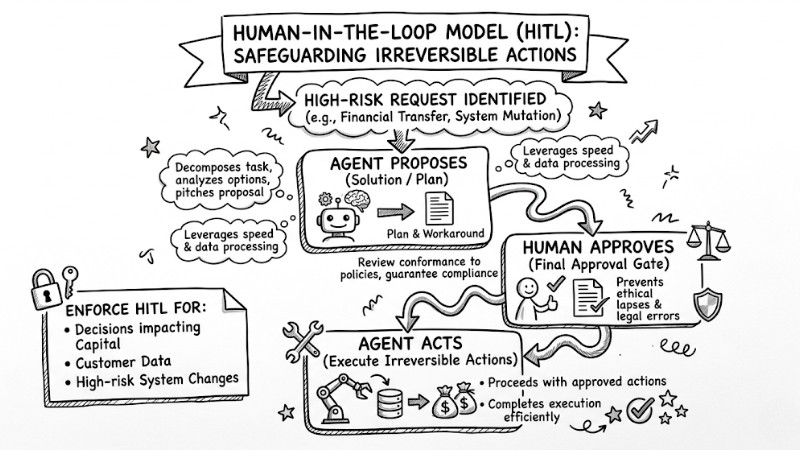
The Human-in-the-loop model
Frequently Asked Questions
What is the simplest way for a beginner to build an Autonomous Agent?
The easiest path for beginners to spin up an Autonomous Agent is using browser-based No-code platforms like AgentGPT or Godmode. You simply log in and type your goal in natural language, and the system autonomously deploys an agent to execute the required steps.
Will Autonomous Agents entirely replace humans?
Current Autonomous Agents primarily act as co-pilots, autonomously handling repetitive or heavy-lifting operations, while humans strictly remain in charge of setting goals, dictating strategic roadmaps, and validating the final outputs.
What data does an Autonomous AI Agent need to bootstrap operations?
To bootstrap operations, an Autonomous AI Agent needs at least three core elements: a crystal-clear goal from the user, an interactive environment hooking into systems via API access or relevant platforms, and a core model like an LLM (e.g., GPT-4, Claude 3) to handle parsing, reasoning, and planning.
Read more:
- What is Agent Engineering? The Process of Bringing AI Agents into Production
- Misconceptions about AI Agents: What Enterprises Must Avoid to Maximize Performance
- AI Agents for Enterprise: An A-Z Practical Deployment Roadmap
Autonomous Agents crack open an entirely new layer of automation, where AI doesn't just answer questions but autonomously organizes workloads, orchestrates tools, and incrementally improves via real-world telemetry. Once an enterprise masters their traits, selects the right problem space, and strictly maintains human-in-the-loop gates for sensitive decisions, Autonomous Agents will rapidly morph into the ultimate foundation for spiking operational performance and building a long-term competitive moat.