What is a Multi-Agent System? Overview and Top 7 Practical Use Cases

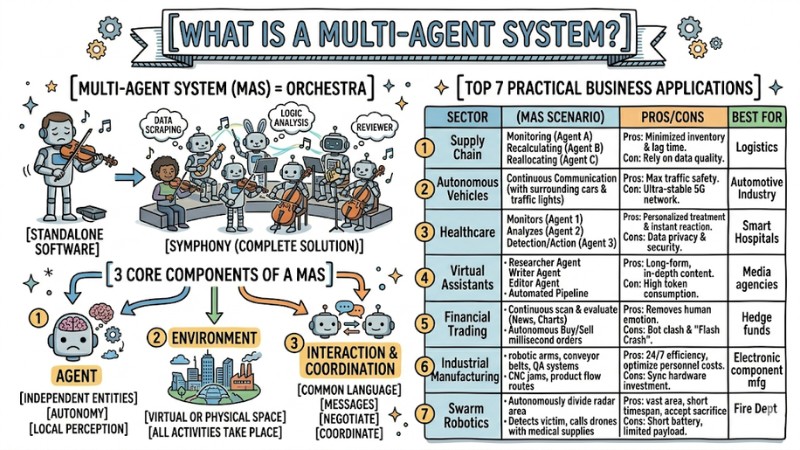
When relying solely on a single AI model, businesses quickly hit a ceiling when facing complex operational problems. This is where a Multi-Agent System becomes the optimal solution. Unlike a chatbot that only does Q&A, this system creates a network of artificial intelligences that communicate, debate, and coordinate to get work done. In this article, I'll help you clearly understand what a Multi-Agent System is. You'll grasp how it operates, distinguish the boundary with traditional AI, and pocket 7 practical use cases ready to upgrade your business operations.
Key Takeaways
- Multi-Agent System Essence: A distributed artificial intelligence system where independent agents interact, debate, and coordinate to solve complex problems beyond the scope of a single entity.
- 3 Core Pillars: Master the roles of the Agent, Environment, and Interaction & Coordination to build a solid foundational system.
- Architectural Thinking: Distinguish the boundary between sequential Single Agent systems and parallel, decentralized Multi-Agent Systems (MAS).
- Strategic Applications: Explore 7 practical scenarios (Logistics, Healthcare, Finance, Manufacturing...) where MAS delivers breakthrough ROI metrics.
- Cooperation Mechanism: Understand how Agents operate through cooperative (resource sharing) and competitive (debating, cross-testing) models.
- Deployment Challenges: Identify barriers regarding compute resources and orchestration complexity to plan proper infrastructure investments.
- Risk Management: Apply Human-in-the-loop principles to control critical decisions, ensuring AI ethics and system safety.
What is a Multi-Agent System?
A Multi-Agent System is a branch of Distributed Artificial Intelligence. It is an environment where multiple AI Agents operate, interact, and solve problems that exceed the capabilities of a standalone software application.
To easily visualize it, consider an independent AI Agent as an excellent violinist. However, to play a complete symphony, you need an orchestra. A Multi-Agent System is exactly that orchestra. Each musician (Agent) plays a different instrument, listens to the rhythm of the person next to them, and adjusts their volume to produce a perfect piece of music.
Applying MAS is completely different from opening 3 ChatGPT tabs simultaneously. In a Complex Adaptive System, these AIs automatically divide the workload. One Agent specializes in data scraping, another in logic analysis, and another acts as a reviewer before reporting the results to you.
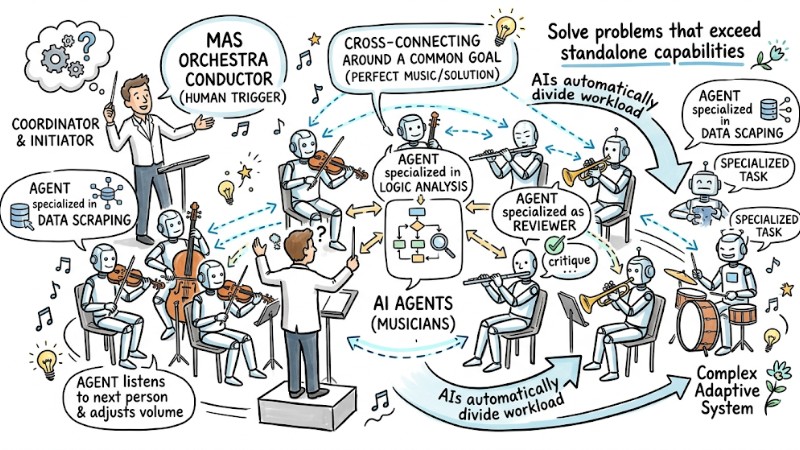
A Multi-Agent System is a branch of Distributed Artificial Intelligence
3 Core Components of a Multi-Agent System
A standard multi-agent system always operates on 3 basic pillars:
Agent
These are independent entities (software or robots) possessing Autonomy. They can perceive, make decisions based on Local perception, and execute actions without continuous human intervention.
Environment
The environment is the space where all Agent activities take place. It can be a virtual environment (accounting software, gaming systems, stock markets) or an actual physical environment (manufacturing plants, logistics warehouses).
Interaction & Coordination
Agents don't operate blindly because they possess the ability to interact through a common language or protocol. This allows them to pass messages, negotiate, coordinate, or even debate to find the best solution.
The Value Difference Between Single Agent and Multi-Agent Systems
The core difference between Single Agent and Multi-Agent Systems lies in system architecture thinking: Sequential processing vs. decentralized processing.
Below is a comparison table to help you clearly shape your platform selection strategy:
| Criteria | Single Agent System | Multi-Agent System (MAS) |
|---|---|---|
| Core Structure | Centralized, step-by-step sequential processing. | Distributed Computing, parallel processing. |
| Fault Tolerance | Very low. A single point of failure crashes the whole system. | Very high. If one Agent fails, another automatically takes over. |
| Processing Speed | Slow when dealing with massive data volumes. | Fast, thanks to the divide-and-conquer mechanism. |
| Scalability | Limited by the capacity of a single model. | Unlimited. Just plug a new Agent into the network. |
| Operating Costs | Cheap, easy to maintain and initially set up. | Expensive, requires robust hardware infrastructure. |
Battle-tested tip: If your business only needs to answer customer emails using templates, a Single Agent is enough. However, if you want the AI to read emails, check inventory, automatically order from suppliers, and issue invoices, you absolutely must invest in a Multi-Agent System. This system possesses Emergent Behavior - autonomously discovering new, more efficient ways of doing things without prior programming.
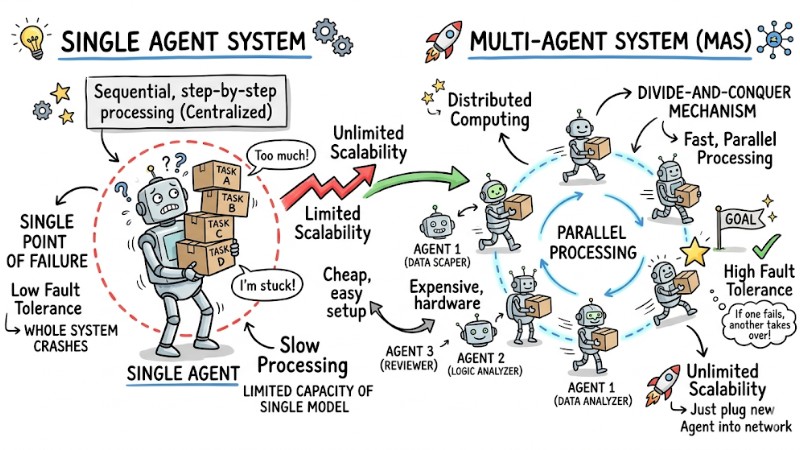
The Value Difference Between Single Agent and Multi-Agent Systems
How Smart Agent Networks Work Together
Instead of diving deep into source code algorithms, I'll summarize the MAS operating mechanism through the lens of Game Theory. Agents typically work in 2 main paradigms:
Cooperative System: Agents share data and resources to achieve a Common Goal.
- Example: In a fleet of autonomous delivery vehicles, vehicle A notifies vehicle B of an upcoming traffic jam so vehicle B can reroute.
Competitive System: Agents have opposing goals, constantly debating and finding each other's flaws to optimize the final outcome.
- Example: One Agent is tasked with generating source code, while another acts as a hacker constantly trying to attack that code snippet to uncover vulnerabilities.
Top 7 Practical Business Applications of Multi-Agent Systems
Applying MAS is creating a massive competitive advantage. Below are 7 sectors directly benefiting from this technology.
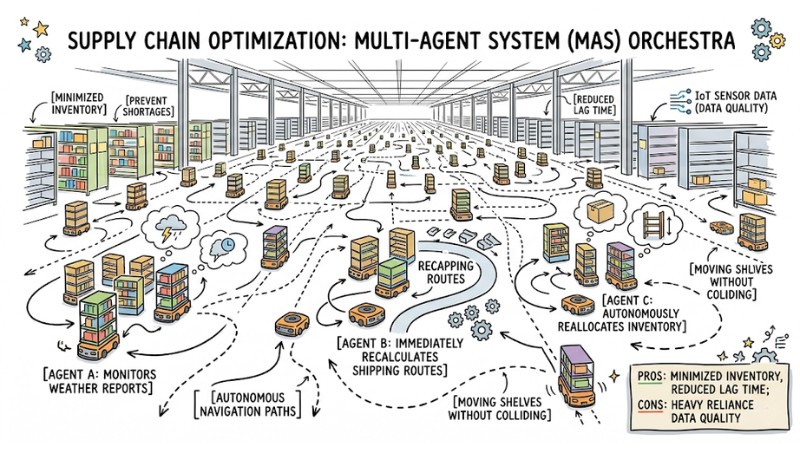
Amazon warehouse with hundreds of Kiva robots autonomously navigating and moving shelves without colliding
1. Supply Chain Optimization
- Scenario: Agent A monitors storm weather reports. Agent B immediately recalculates shipping routes. Agent C autonomously reallocates inventory in the warehouse to prevent shortages.
- Pros/Cons: The pros are minimized inventory and lag time. The con is heavy reliance on input data quality (IoT sensors).
- Best for: Logistics conglomerates, large-scale import-export businesses.
2. Autonomous Vehicles Operation
- Scenario: Each self-driving car is an Agent. They continuously communicate with surrounding cars and traffic lights (Autonomous Systems) to maintain safe distances and optimize speed.
- Pros/Cons: Maximizes absolute traffic safety. The con is the need for an ultra-stable 5G network with near-zero latency.
- Best for: The automotive industry, autonomous taxi services.
3. Healthcare and Medicine
- Scenario: Agent 1 monitors the patient's heart rate. Agent 2 analyzes the medical history. Upon detecting anomalies, Agent 3 automatically sends an emergency alert to the on-call doctor and preps an expected treatment protocol.
- Pros/Cons: Personalized treatment and instant reactions. The biggest risk is medical data privacy and security.
- Best for: Smart hospitals, public healthcare systems.
4. Upgrading Multi-Threaded Virtual Assistants (Multi-Agent LLMs)
- Scenario: You ask the AI to write a book. The "Researcher" Agent finds materials. The "Writer" Agent drafts it. The "Editor" Agent checks grammar and flow. Everything happens in an automated pipeline.'
- Pros/Cons: Generates long-form, in-depth content with high accuracy. The con is high token consumption (API costs).
- Best for: Media agencies, software development companies, journalism.
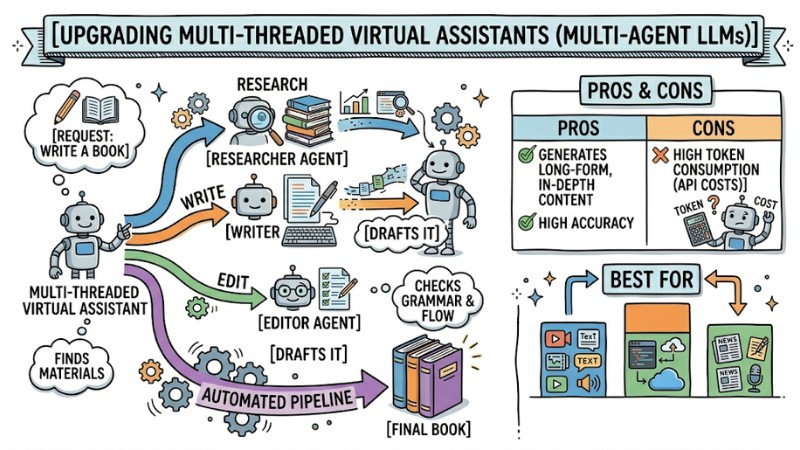
Upgrading Multi-Threaded Virtual Assistants
5. Automated Financial Trading
- Scenario: Dozens of Agents continuously scan various stock exchanges. They evaluate macro news, analyze technical charts, and autonomously place buy/sell orders in milliseconds.
- Pros/Cons: Removes human emotion from trading, maximizing profits. However, it can easily lead to a "Flash Crash" if bot systems clash with one another.
- Best for: Quantitative hedge funds, commercial banks, crypto exchanges.
6. Industrial Manufacturing Automation (Cyber-Physical Systems)
- Scenario: In a smart factory, robotic arms, conveyor belts, and quality assurance systems continuously swap status updates. If a CNC machine jams, the product flow automatically routes to another machine.
- Pros/Cons: Achieves 24/7 efficiency, optimizing personnel costs. Requires a massive initial capital investment to sync hardware.
- Best for: Electronic component manufacturing plants, automotive assembly, consumer goods.
Industrial Manufacturing Automation
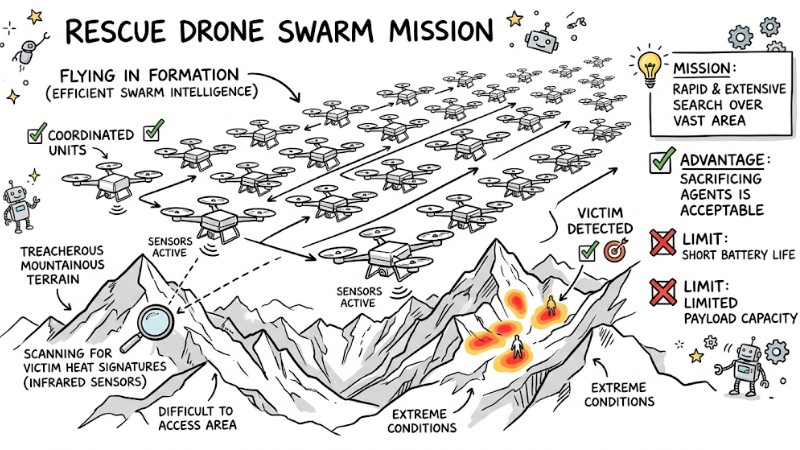
7. Swarm Robotics in Rescue Missions
- Scenario: Applying Swarm Intelligence, hundreds of tiny drones are deployed into an earthquake zone. They autonomously divide the radar scanning area. When one drone detects a victim, it calls over drones carrying medical supplies.
- Pros/Cons: Covers vast areas in short timespans; sacrificing a few damaged drones is acceptable. The cons are short battery life and limited payload capacity.
- Best for: Fire departments, military forces, national search and rescue organizations.
3 Major Challenges When Deploying Multi-Agent AI Systems
The power of MAS is undeniable, but bringing it into the real world faces 3 core technical hurdles:
Cost and Compute Resources
Maintaining dozens of concurrently running Agents demands massive server capacity, from processing power to data storage and transmission capabilities. In practice, network bandwidth easily bottlenecks when Agents constantly exchange information back and forth.
- Solution: Apply Edge Computing or rent dedicated Cloud infrastructure instead of buying your own physical servers.
Orchestration Complexity
When operational rules aren't strictly defined from the start, Agents can easily fall into infinite loops or obstruct each other, making the system chaotic and hard to control. In this context, tracing back to pinpoint exactly which Agent caused the bug when the final output is skewed becomes incredibly difficult.
- Solution: You must use Agent-based Modeling to simulate and test rigorously before actual deployment.
Network Security Risks
A distributed architecture brings many advantages in flexibility and scalability, but also opens up new attack surfaces for the system. If just one low-level Agent is hijacked by a hacker, it can easily become a "backdoor" to broadcast malicious data across the entire network.
- Solution: The system must enforce cross-encryption security mechanisms and continuous identity authentication between agents to mitigate risks.
Frequently Asked Questions (FAQ) About Multi-Agent Systems
Will Multi-Agent Systems completely replace humans?
No. Multi-agent systems only replace humans in massive data processing, monitoring, and Automated Reasoning at the tactical level. Strategic decision-making authority (budget approvals, ethical risk assessments, business direction) always remains with humans. MAS acts as a "super-advisor" helping you make faster and more accurate decisions.
Should Small and Medium Enterprises (SMEs) adopt MAS right now?
SMEs absolutely CAN benefit from MAS, but you absolutely should not build it from scratch (R&D). The cost of sustaining an AI engineering team and maintaining servers will quickly drain your cash flow. The most optimal solution is to use SaaS (Software as a Service) platforms with built-in Multi-Agent pipelines. You just pay a monthly subscription to neatly handle marketing, sales, or customer support workflows.
How do Multi-Agent LLMs differ from standard ChatGPT?
ChatGPT is a Single Agent operating on a linear model: You ask - the AI answers. If the output is wrong, you have to feed it a new prompt. Conversely, Multi-Agent LLMs (Large Language Models) create a closed loop. It autonomously breaks down your question, assigns Agent A to research, Agent B to debate, and Agent C to refine the wording. They automatically fix each other's errors over multiple iterations before returning the most complete and in-depth result to you.
What is the main difference between a Single Agent and a Multi-Agent System?
A Single Agent System only has one AI handling everything, prone to a single point of failure. Conversely, a Multi-Agent System with multiple independent agents boasts better fault tolerance, flexible scalability, and the ability to handle complex problems requiring tight task delegation and coordination.
How do multi-agent systems work together?
Agents in a MAS can operate under two main paradigms: cooperative, sharing info to achieve a common goal (e.g., AI agents in a chatbot pipeline); or competitive, having opposing goals to discover an optimal solution (e.g., agents in a fighting game).
How are Multi-Agent Systems applied in supply chain management?
MAS helps optimize shipping, warehousing, and order routing as agents autonomously analyze data, forecast demand, and make instantaneous decisions to adjust schedules, minimize errors, and boost logistics efficiency.
How do autonomous vehicles use Multi-Agent Systems?
In an autonomous fleet, AI agents in each vehicle coordinate with one another to share traffic info, adjust speeds, avoid collisions, and optimize shared routes, ensuring safe and efficient travel for the entire fleet.
What role do Multi-Agent Systems play in healthcare?
MAS supports remote patient monitoring, automates preliminary diagnostic workflows, manages medical schedules, and allocates resources efficiently, helping elevate service quality and reducing the load on medical staff.
How are Multi-Agent LLMs different from standard large language models?
Multi-Agent LLMs simulate multiple AI Agents working together, capable of reasoning, planning, and debating each other to deliver more profound answers. Standard ChatGPT operates in a more linear Q&A model.
What are the applications of Multi-Agent Systems in financial trading?
MAS is applied to execute automated stock trades, manage portfolios in real-time, and effectively detect fraud by having agents analyze market data and make buy/sell decisions based on predefined strategies.
How can industrial manufacturing automation apply Multi-Agent Systems?
In smart factories (Cyber-Physical Systems), MAS helps monitor production processes, allocate resources, flexibly adjust schedules based on real-time conditions, and optimize labor productivity.
How does Swarm Robotics use MAS in rescue operations?
Autonomous robots in a MAS coordinate to map hazardous zones, pinpoint victims, and jointly transport relief equipment, boosting speed and operational efficiency in emergency situations.
What is the biggest challenge when deploying a Multi-Agent System?
One of the massive challenges is the initial capital expenditure for hardware infrastructure, compute resources, and network bandwidth. However, Cloud-based solutions are helping lower this barrier.
What is the orchestration complexity challenge in a Multi-Agent System?
Establishing clear communication rules and task assignments for agents is critical to prevent conflicts or duplicated work. If the initial rules are skewed, the system can operate highly inefficiently.
What are network security risks in MAS?
Since agents are tightly linked, if one agent is attacked or compromised, it can trigger a domino effect, impacting the entire system and posing a risk of sensitive data leaks.
Read more:
- What are Autonomous Agents? Mechanisms, Classifications and Applications
- What is Agent Engineering? The Process of Bringing AI Agents into Production
- What is Agentic Workflow? Autonomous AI Solutions for Enterprise
Multi-Agent Systems are not just a short-term tech fad; they are the inevitable future of the automation era. By shifting from using standalone AI tools to setting up self-orchestrating AI networks, your business will break through in operational productivity and radically optimize costs. If you are looking for solutions to set up specialized AI workflows for your enterprise, leave a comment below or contact us today for the most practical deployment roadmap.