What is Agentic Workflow? Autonomous AI Solutions for Enterprise

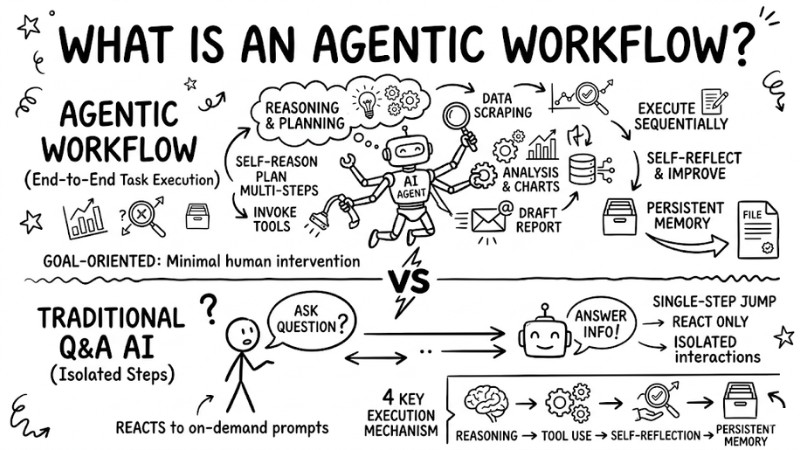
Agentic Workflow is a method of organizing workflows around AI Agents, where the system can autonomously reason, plan, and use tools to fully complete a complex task. This article explains the concept of Agentic Workflow, compares its differences with RPA, and covers its operational mechanisms, technical components, real-world applications, and caveats when deploying it in enterprise operations.
Key Takeaways
- Agentic Workflow: Understand that this is a workflow driven by an AI Agent, capable of independent reasoning, planning, and executing a sequence of complex tasks to achieve a goal.
- Comparison with RPA: Distinguish the superiority of Agentic Workflow over traditional RPA automation through its ability to self-handle errors and dynamically adjust strategies instead of merely running on static scripts.
- Operational Mechanism: Master the 4-step execution loop of an Agentic Workflow, enabling the AI to process tasks step-by-step in a controlled manner.
- Technical Architecture: Identify the 3 foundational layers of the system: Large Language Models, tools & memory layers, and the orchestration system.
- Cross-industry Applications: Discover how Agentic Workflows powerfully optimize domains like IT support, market research, CRM management, financial analysis, and supply chain management.
- Risk Management: Recognize the critical importance of maintaining the "Human-in-the-loop" principle for sensitive decisions to guarantee operational safety.
- FAQ: Get answers to questions regarding enterprise scale suitability, the ability to build AI Agents without writing code, and internal data security risks.
What is an Agentic Workflow?
An Agentic Workflow is a process driven by an AI Agent, where the system self-reasons, plans, invokes tools, and executes multiple sequential steps to complete a complex task with minimal human intervention. Unlike isolated Q&A models, an Agentic Workflow is designed around a goal, allowing the AI to proactively decompose tasks, select suitable tools, and pivot its execution strategy on the fly.
If a standard AI model is treated as an on-demand response system primarily supplying info based on user prompts, an Agentic Workflow serves as a complete task pipeline delegated to an AI Agent to execute end-to-end.
For example, when assigned the goal to "draft a competitor report", the Agent can autonomously scrape data, analyze it, synthesize metrics, generate charts, and export the report file. Simultaneously, it leverages self-reflection mechanisms to catch bugs during execution and tweak the plan if necessary, aligning with the characteristics of AI systems capable of self-improvement over time.
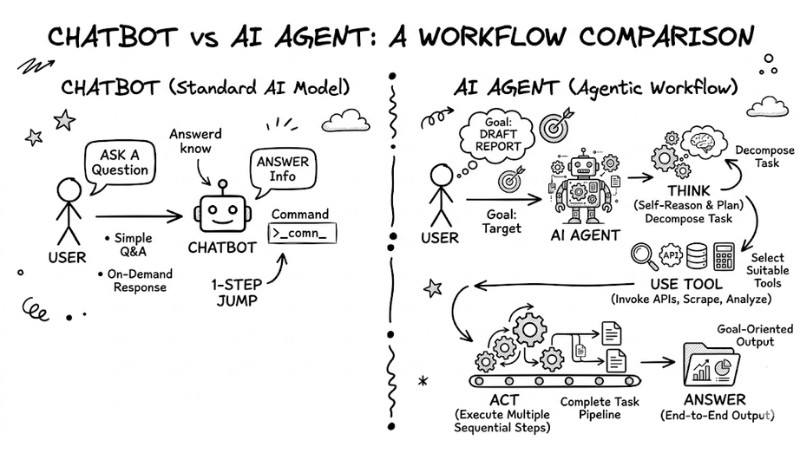
Key Differences Between Chatbots and AI Agent
The Difference Between Agentic Workflows and Traditional Automation (RPA)
Many enterprises easily confuse autonomous AI with rule-based automation solutions like RPA, whereas these two approaches differ fundamentally in execution mechanics, error handling capabilities, and flexibility levels. The table below summarizes the key differences between traditional automation and Agentic Workflows within modern enterprise operations:
| Criteria | Traditional Automation (RPA) | Agentic Workflow |
|---|---|---|
| Operational Mode | Runs on rigid rule sets, typically if/then logic, executing repetitive actions on predefined interfaces or systems. | Runs on reasoning, context, and goals, allowing the AI to analyze situations, pick the next step, and select appropriate tools during execution. |
| Error Handling | When encountering off-script errors or UI changes, the pipeline typically crashes and requires human intervention to fix. | Can apply self-healing patterns, where the Agent self-evaluates the root cause, tries alternative strategies, or swaps to a fallback tool to resume the pipeline. |
| Flexibility Level | Best for stable data and workflows with low variance; struggles to adapt when data structures, UIs, or execution steps shift. | Designed to operate in dynamic environments, highly adaptable to fresh data, varied formats, and ad-hoc requirements stemming from natural language. |
The self-healing capability within an Agentic Workflow manifests when the system detects a tool failure, pivots to another tool, or recalculates its execution sequence to hit the goal instead of outright crashing the pipeline. Furthermore, the AI within an Agentic Workflow can dynamically choose between multiple tools—for instance, figuring out when to use web search versus hitting an internal database or executing a code snippet, depending on the specific task requirements.
RPA still holds its ground for data scraping, data entry, and static templated steps, whereas Agentic Workflows are perfectly suited for pipelines demanding judgment, multi-step reasoning, and continuous exception handling.
How does the Execution Mechanism of an Agentic Workflow Run?
The mechanism of an Agentic Workflow is typically structured as a loop comprising reasoning, tool use, self-reflection, and memory updates, allowing the AI to process tasks step-by-step under strict control. This pipeline can be illustrated through an example of handling a complaint email from a VIP customer.
Step 1: Reasoning and Planning
Instead of generating an immediate response, the AI first parses the email content, extracts key data payloads, and decomposes the task into micro-steps.
For example, upon receiving the email, the AI reads and identifies: The customer is complaining about delayed shipping. The AI autonomously plots a 3-step plan:
- Check the order ID in the system.
- Check the status with the shipping carrier.
- Draft an apology email attaching a discount code aligned with company policy.
Step 2: Function Calling and Tool Use
With the plan in place, the AI invokes authorized tools like the shipping carrier's API to query the order status and hits the CRM system to check customer data. Every operation here is executed via function calling, with parameters and intentions explicitly defined in the tool configurations.
Step 3: Self-Reflection
During runtime, if it hits a snag like an API timeout or missing data, the Agent can apply a self-reflection pattern to evaluate intermediate outputs and pivot its strategy. For instance, if the shipping API is unresponsive, the system can swap to scraping the web portal or utilizing a fallback data source aligned with the architected pipeline.
Step 4: Persistent Memory
Upon completing the session, the Agent logs the short-term context of the current run and updates its long-term memory regarding the customer and the resolution applied. In future interactions, this payload helps the system recognize context—for example, knowing the customer previously suffered a shipping issue—and dynamically adjusts the content, priority queue, or resolution flow to match customer care policies.
Battle-tested advice: When configuring the system, you must always set an "iteration limit" for the AI. Otherwise, when hitting an unsolvable logic bug, the AI will infinitely loop through trial/error steps, hanging the system and torching massive amounts of server compute budget.
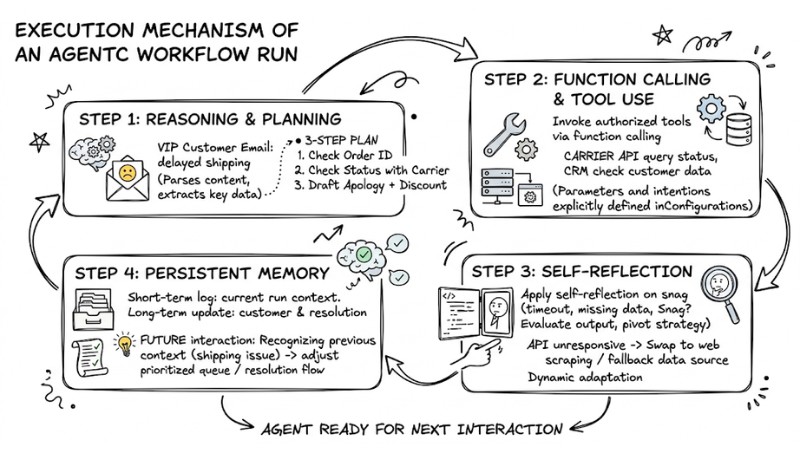
The Inner Workings of Agentic Workflows
Technical Components Building an Autonomous AI System
To architect a complete Agentic AI system, the stack must orchestrate three foundational layers: large language models, the tools and memory layer, and a task orchestration framework.
Large Language Models (LLMs)
LLMs like GPT-4 or Claude 3 act as the reasoning engine, helping the system comprehend natural language, synthesize information, and output the subsequent logical steps in the pipeline. This model layer handles parsing requests, planning, and selecting execution strategies aligned with the assigned goals.
External Tools and Memory Systems
The tools and memory layer empowers the AI Agent to access the outside world and persist knowledge over time, including APIs for web searching, code execution, or hitting production databases. For long-term memory, vector databases coupled with RAG techniques allow the system to store and rapidly fetch relevant internal payloads, slashing context costs and boosting output accuracy.
Agent Orchestration Frameworks
The orchestration layer is responsible for sequencing tasks, routing between multiple Agents and tools, while managing state, messaging, and cross-communication in multi-agent scenarios. Standout orchestration frameworks today include LangGraph, heavily relying on state graphs and loops, and CrewAI, which structures Agent teams by roles mirroring a professional enterprise squad.
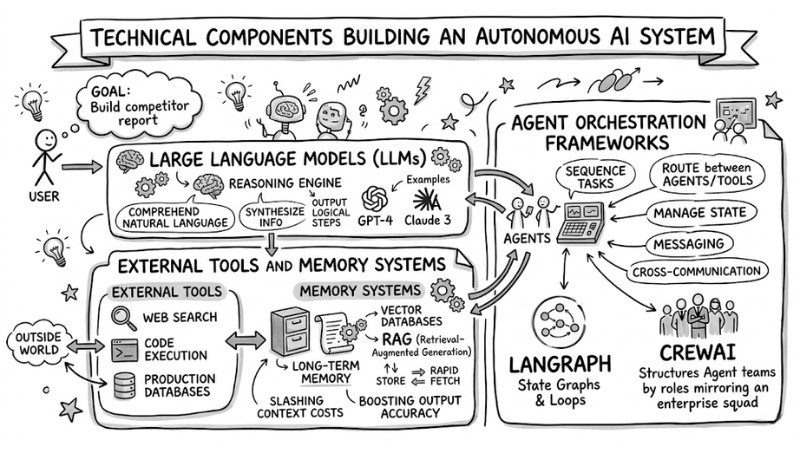
Technical Components of an Autonomous AI System
Agentic Workflow Applications Optimizing Operations
The operational scalability of Agentic Workflows is currently being heavily exploited across various enterprise departments.
IT Support
Agentic Workflows in IT Support can autonomously resolve common tickets like password resets, account unlocks, log parsing, executing service-repair scripts, and mutating ticket statuses. The system helps architect an always-on service desk, cutting wait times and standardizing resolutions for repetitive scenarios.
This model processes massive request volumes 24/7, offloading Tier 1 support, though hardware failures or complex infrastructure bugs still demand direct technician intervention. This deployment perfectly fits enterprises with massive internal networks, IT service hubs, and organizations running professional ITSM pipelines.
Market Research Assistants
In market research, an Agentic Workflow can autonomously scrape data from competitor domains, e-commerce platforms, social media, and open-source intelligence, then synthesize it into comparison matrices and trend reports to drive decision-making.
The capability to scrape and crunch massive datasets drastically slashes report prep time, though it still requires domain experts to configure filtering criteria to dodge noisy data or unreliable sources. This approach is widely adopted by marketing agencies, R&D departments, and market analyst squads equipped to vet and interpret outputs.
CRM Automation
Within a CRM, an Agentic Workflow helps enrich customer profiles utilizing multi-source data and dynamically drafts personalized outreach or nurturing content per segment. The system can also recommend next-step tasks for sales reps based on engagement scores and interaction history.
By leveraging contextual payloads, the sales team gains actionable data to prioritize pipeline deals and pivot outreach tactics, requiring upfront CapEx in API integrations and cross-platform data syncing. This model delivers massive ROI for B2B Sales teams, Customer Success units, and customer support departments running mature CRM pipelines.
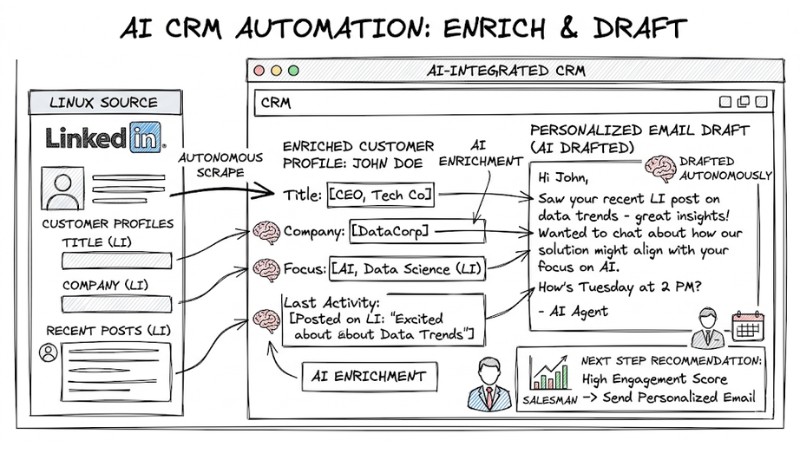
AI-Powered CRM: Automating LinkedIn Data Extraction and Personalized Email Drafting
Financial Analysis
In finance, an Agentic Workflow can autonomously pull metrics from accounting software, banking APIs, internal ledgers, and spin up consolidated tables, analytical charts, or trigger alerts upon detecting anomalies. Many orgs deploy this model to back up periodic reporting and monitor financial metrics in near real-time.
This approach slashes manual operations and spikes data consistency, shipping with strict prerequisites for security, RBAC (Role-Based Access Control), and regulatory compliance. Units like accounting departments, banks, hedge funds, and enterprises demanding continuous financial telemetry are typically early adopters.
Supply Chain Management
In supply chain ops, an Agentic Workflow can monitor inventory, cross-referencing sales data, seasonality, promos, and external variables to forecast demand, simultaneously proposing or firing off purchase orders to vendors. Certain systems also bake in alerts when predicting stock-outs or identifying inventory exceeding thresholds.
By leveraging multi-source data, enterprises gain the leverage to optimize inventory routing and mitigate supply chain disruptions, though accuracy remains heavily bottlenecked by the quality and freshness of input data. This model is exceptionally suited for retail, manufacturing, and logistics enterprises running relatively standardized warehouse and order management architectures.
Pros and Cons of Deploying Agentic Workflows
Operational Benefits
Agentic Workflows slash the need for direct human supervision over repetitive tasks that still demand a degree of judgment, thanks to the ability to autonomously process based on goals and context. When deployed properly, enterprises can crush operational overhead, eliminate bottlenecks in manual pipelines, and reallocate human bandwidth toward higher-level strategic initiatives.
Risks and the Human-in-the-Loop Principle
Granting AI the authority to propose or execute autonomous actions spawns massive challenges regarding risk governance, ethics, and accountability in high-impact decisions. Irreversible actions like wiring refunds, transferring funds, dropping databases, or personnel-related decisions should always sit behind a human approval gate, where the Agent preps the workaround and pitches the proposal, while the manager ultimately approves or rejects it based on the exact context.
Frequently Asked Questions (FAQ)
Which enterprise scales are suited for Agentic Workflows?
Agentic Workflows are viable for both massive conglomerates and SMEs; the difference lies in the application scope. Large enterprises typically hook them into supply chain, finance, and cross-departmental operations, whereas SMEs deploy them to automate repetitive pipelines and spike productivity with lean teams.
Can I build AI Agents if I don't know how to code?
Absolutely. Modern No-code/Low-code platforms allow you to drag-and-drop, configure execution logic, and hook up basic APIs to spin up Agentic Workflows with zero coding required.
What is the biggest difference between Non-agentic and Agentic workflows?
Non-agentic is a turn-based Q&A flow: one prompt, one response, then full stop. Agentic is assigning a macro goal; the AI autonomously plots multi-step plans, invokes tools, handles edge cases, and only reports back when the pipeline hits completion.
Will my internal data leak when using autonomous AI?
There is a risk if you pump sensitive payloads through public APIs without properly configuring privacy guardrails and terms of service. Enterprises should evaluate enterprise tiers or Local LLMs running on isolated infrastructure, coupled with strict RBAC and access telemetry to lock down data security.
Read more:
- What is Agent Engineering? The Process of Bringing AI Agents into Production
- AI Agents for Enterprise: An A-Z Practical Deployment Roadmap
- Misconceptions about AI Agents: What Enterprises Must Avoid to Maximize Performance
Agentic Workflows transition enterprises from merely using AI as a Q&A tool to deploying AI as an execution engine for multi-step pipelines tied to clear goals and operational outputs. By grasping the correct architecture, deploying it against fitting workflows, and strictly maintaining human approval gates at sensitive nodes, enterprises can safely and sustainably exploit the raw power of autonomous AI.
Tags