How to Transition from Single-Agent to Multi-Agent Systems

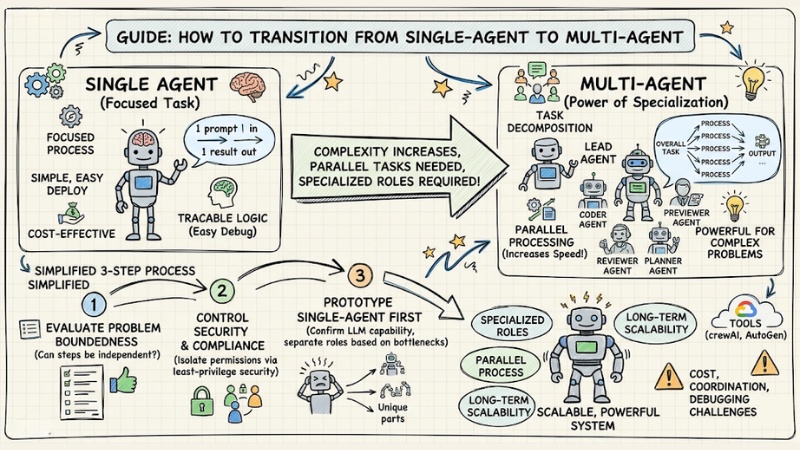
When starting out, most businesses usually choose to build a Single Agent for ease of deployment and control. However, as the problem becomes more complex, requiring parallel processing of multiple tasks and specialized roles, transitioning to a multi-agent architecture will make the system more powerful but also brings challenges in cost, coordination, and debugging. This article will share practical secrets for you to transition from single-agent to multi-agent safely, optimally, and with long-term scalability.
Key Points
- The importance of architecture: Clearly understand the impact of Agent architecture on performance and cost to avoid wasting resources from the start.
- The value of Single-Agent: Master the reasons why Single-Agent is the safest, most cost-effective, and easiest-to-debug choice for focused tasks.
- The power of Multi-Agent: Know how to leverage Multi-Agent to specialize roles and process complex problems in parallel that a single Agent cannot handle.
- Head-to-head comparison: Understand the differences between Single-Agent and Multi-Agent to have a basis for choosing the right solution for the project scale.
- Transition roadmap: Apply a scientific 3-step process to safely and optimally transition to a Multi-Agent architecture while controlling costs.
- Supporting tools: Access popular Frameworks (such as CrewAI, AutoGen) that make Multi-Agent implementation professional and methodical.
- Managing challenges: Know how to face issues with communication, state synchronization, and risk management when upgrading the system.
- FAQ Resolution: Receive practical advice on when to scale, how to manage costs, and flexible combination strategies between architectures.
What is an AI Agent and why is architecture important?
An AI Agent is an autonomous system, using an LLM as a reasoning engine to plan, use tools, and execute tasks without continuous manual intervention. The architecture of an AI Agent system is exactly how you design these parts to work together, and it directly affects both performance and operating costs.
Choosing the wrong Agent architecture from the start leads to two main consequences: either a system that is too simple to solve complex problems, or a system that is too bulky, causing resource waste, increasing operating costs (tokens), and making debugging difficult.
Single-Agent System: The optimal solution for focused tasks
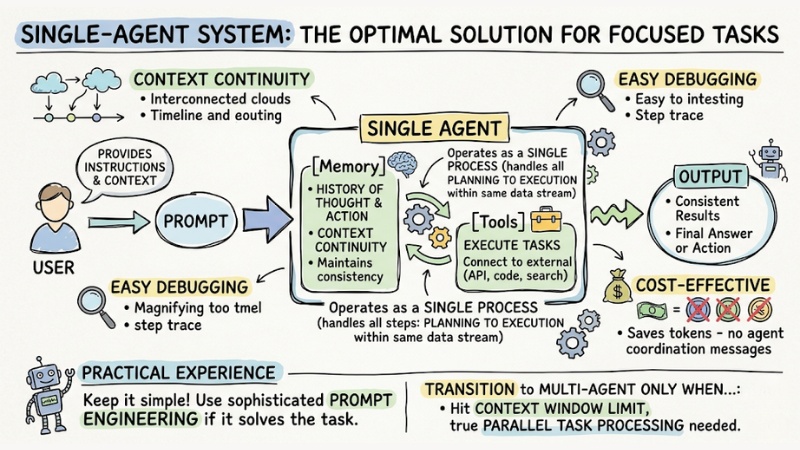
Single-agent operates as a "single process." It handles all steps from planning to execution within the same data stream.
- Context Continuity: The Agent maintains the entire history of thought and action, helping ensure consistency from start to finish.
- Easy Debugging: Every execution step happens sequentially, making it easy for you to trace logic errors.
- Cost-effective: Saves tokens because there is no need to spend on coordination messages between agents.
Practical Experience: Don't overcomplicate the problem immediately. If sophisticated Prompt Engineering can solve the task well, keep the Single-agent structure. Transitioning to Multi-agent should only be considered when you reach the context window limit or require true parallel task processing.
Single-Agent System: The optimal solution for focused tasks
Multi-Agent System: The power of specialization
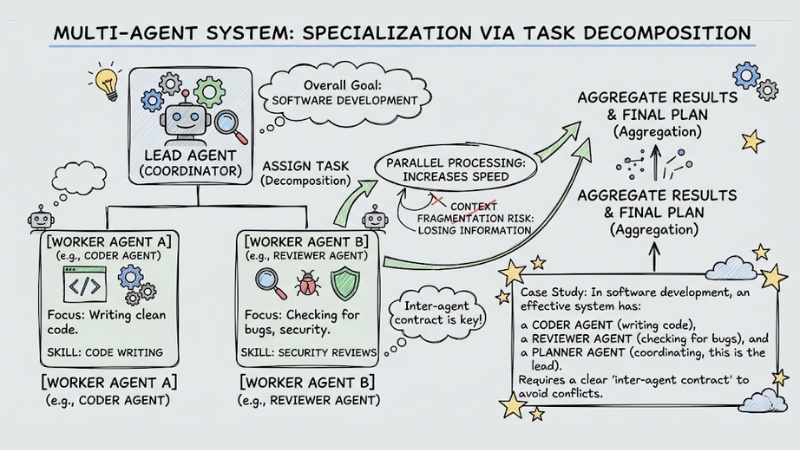
Multi-agent systemizes Task Decomposition. Specifically, a "Lead Agent" will coordinate "Worker Agents" specialized in each specific task.
- Task decomposition: Each agent only focuses on one skill (for example: one agent specializes in writing code, one agent specializes in security reviews).
- Parallel processing: Increases response speed by executing multiple tasks at the same time.
- Context fragmentation risk: This is the biggest challenge. Transferring information between agents requires strict protocols; otherwise, agents will lose information or misunderstand the goals.
Case Study: In software development, an effective Multi-agent system often includes: a Coder Agent (writing code), a Reviewer Agent (checking for bugs), and a Planner Agent (coordinating). This separation helps specialize the process but requires a clear "inter-agent contract" to avoid conflicts.
Multi-Agent System: The power of specialization
Head-to-head comparison: Single-Agent and Multi-Agent
| Criteria | Single-Agent | Multi-Agent |
|---|---|---|
| Complexity | Low, easy to deploy. | High, requires coordination. |
| Execution | Sequential. | Parallel. |
| Cost (Token) | Low. | High (due to communication overhead). |
| Maintenance | Simple. | Complex (difficult to debug). |
| Autonomy | Good for narrow tasks. | Highly effective for large-scale tasks |
3-step process for transitioning from Single-Agent to Multi-Agent
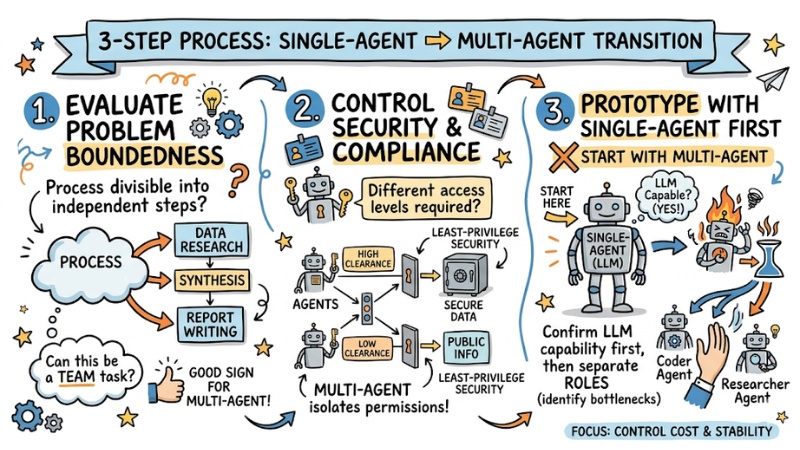
To move from a simple Single-Agent system to a more complex Multi-Agent architecture while still controlling cost and stability, you can follow this 3-step process:
- Evaluate Problem Boundedness: If your process can be divided into independent steps (for example: data research, synthesis, report writing), that is a good sign to consider Multi-agent.
- Control security and compliance: If parts of the task require different levels of data access, Multi-agent helps you isolate permissions (least-privilege security) better.
- Prototype with Single-agent first: Never build Multi-agent from the start. Start with a single Agent to confirm the LLM's solving capability, then separate roles based on identified bottlenecks.
3-step process for transitioning from Single-Agent to Multi-Agent
Popular frameworks for building AI Workflow Automation
- AutoGen (Microsoft): Powerful for coordinating agents following a conversational model.
- CrewAI: Role-based and workflow-focused, very intuitive for businesses.
- MetaGPT: Integrates standard operating procedures (SOP) for software development into agent systems.
Simple declaration example in CrewAI:
Defining specialized agent roles
researcher = Agent(role='Researcher', goal='Find trends', tools=[SearchTool])
writer = Agent(role='Writer', goal='Draft report', tools=[FileTool])
Core challenges when upgrading architecture
When expanding from single-agent to multi-agent, the system becomes not only more powerful but also much more complex; here are the core challenges you must control well:
- Inter-agent Contract: Clearly define the input/output data formats between agents. Without this rule, the system will fall into "collective hallucination."
- Human-in-the-loop (HITL): Always insert human checkpoints at critical bottlenecks to ensure the final output meets quality standards.
- State Management: Ensure state is synchronized between agents so that important contextual information is not lost.
FAQ on transitioning from Single-Agent to Multi-Agent
How to know when Multi-agent is needed?
When the task is too large for a single Prompt to contain all instructions, or when you need a clear separation between logic streams (such as Reasoning Logic and Tool Execution Logic), then this is the time you need Multi-agent.
Is the cost of Multi-agent really higher?
Yes. Message passing between agents consumes many context tokens. You need to balance the benefits (accuracy, speed) against the operating costs.
Does Multi-agent experience more "Hallucination"?
Not necessarily, but debugging is harder. If one agent fails, it can drag down the entire chain behind it. Therefore, an independent testing process for each agent is mandatory.
Can Single-agent and Multi-agent be combined?
Yes, this is the most common architecture: Use Multi-agent to handle large workflows, but in each of those workflows, the executing Agents are Single-agents optimized for small tasks.
How are Single-agent and Multi-agent systems different?
A Single-agent system uses a single AI to process everything, while a multi-agent system is a "team" of specialized AIs working together, often led by one AI.
When should a Single-agent system be prioritized?
A Single-agent system should be prioritized when you need to handle sequential, less complex tasks, want to save costs, and ensure easy monitoring. This is a good starting point to test ideas.
What are the main benefits of using a Multi-agent system?
Multi-agent systems help increase parallel processing capability, allow task specialization, and solve complex, multifaceted problems that a single agent struggles to handle.
What is the biggest challenge when deploying a Multi-agent system?
Managing context and coordination between agents is very difficult when deploying a Multi-agent system, and token costs can also increase significantly.
Should you start with a Multi-agent system immediately?
No, the general advice is that you should start with a single-agent system to test feasibility and optimize before expanding to multi-agent.
See more:
- Guide to managing AI agent permissions to ensure system safety
- Detailed guide for implementing the OpenClaw Multi-Agent system
- Optimizing Coding Agent Codebase: 7 Best Practices for Devs
The optimal AI architecture is not the most complex one, but the architecture that solves the right problem at the most reasonable cost. Start with a Single-Agent prototype to verify value, then step-by-step expand to Multi-Agent when needs and complexity truly demand it.