AI HR Agent: Definition, benefits and 7 practical applications

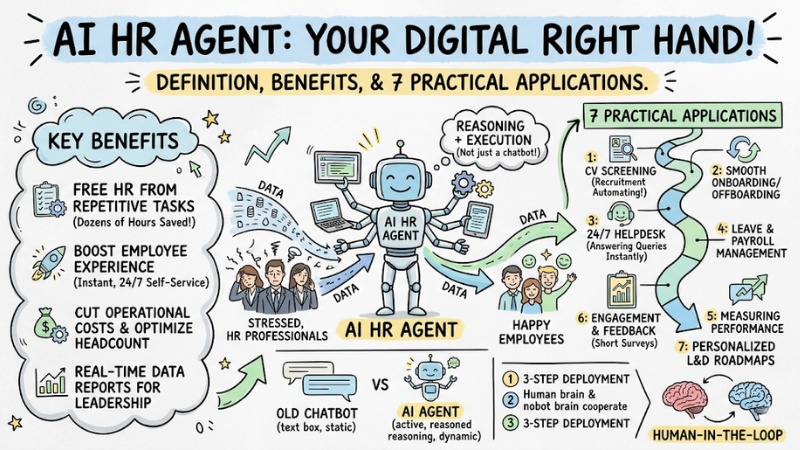
HR departments are wasting dozens of hours every week on repetitive administrative procedures, from processing records and answering internal questions to updating data. In this context, AI Agent HR emerges as a powerful “right hand.” Beyond mere mechanical Q&A, this technology can automatically execute workflows, extract data, and solve problems in real-time. This article will help you clearly understand the concept of AI Agent HR, analyze the differences compared to traditional chatbots, and explore 7 practical applications to radically transform digital HR processes.
Key Points
- Defining AI Agent HR: Understand that an AI Agent is an autonomous "digital assistant," capable of reasoning and executing complex tasks instead of just passively answering text like old chatbots.
- Strategic Value: Freeing HR teams from dozens of administrative hours per week, allowing them to focus on developing culture and people strategies.
- Improving Employee Experience: Providing 24/7 self-service with instant support anytime, anywhere, increasing employee engagement and satisfaction.
- Cost and Data Optimization: Minimizing administrative headcount needs as the company scales, while providing real-time data reports for leadership.
- 7 Practical Applications: Explore how AI automates everything from recruitment (CV screening), onboarding/offboarding, helpdesk queries, and payroll/leave management to measuring performance and engagement.
- Safe Deployment Strategy: Learn a 3-step process including integration into existing HCM systems, strict adherence to data security, and the thorough application of the "Human-in-the-loop" model (human makes the final decision).
- Frequently Asked Questions (FAQ): Addressing doubts about AI ethics, personal data privacy, and the coordination between human emotional intelligence and AI's logical processing capabilities.
What is an AI Agent HR? Differences from a Standard HR Chatbot
The Concept of AI Agent in Human Resource Management (HRM)
AI Agent HR is autonomous virtual assistant software designed to automate and optimize HR management operations. Unlike automated response systems based on existing scripts, an AI Agent has the ability to "think" to complete a full task.
AI Agents operate based on Natural Language Processing (NLP) and Large Language Models (LLM) to understand complex contexts. A practical tip is to view AI Agent HR as a digital HR workforce capable of retrieving data, sending emails, updating systems, and automatically approving basic requests.
Distinguishing AI Agent HR and Traditional HR Chatbots
The core difference lies in the execution capability and the level of autonomy.
| Criteria | Traditional HR Chatbot | Agentic AI HR |
|---|---|---|
| Operation | Static, dependent on pre-defined scripts (If-Then logic). | Flexible, autonomous reasoning, and solving complex problems. |
| Communication | One-way, keyword-based text responses. | Multimodal interaction with deep contextual understanding. |
| Execution Capability | Provides document links or instructions for employees to do it themselves. | Directly performs tasks (e.g., auto-updating systems, scheduling meetings). |
| Learning | No self-learning; requires manual script updates by humans. | Continuous learning from new data to provide personalized answers. |
Illustrative Example: How an AI Agent Works in Practice
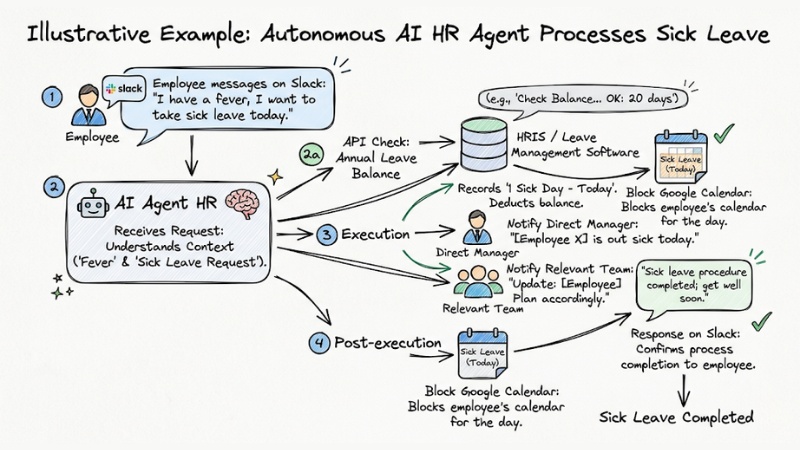
To clearly understand the autonomy of Intelligent HR Assistants, let’s look at how the system handles a sick leave request via a self-service portal:
- Employee messages on Slack: "I have a fever, I want to take sick leave today."
- AI Agent receives: Understands the context, automatically checks the annual leave balance on HRIS platforms.
- Execution: AI records the leave day, deducts from the balance, and automatically sends notifications to the direct manager and relevant team.
- Post-execution: AI blocks the employee's Google Calendar for that day and responds on Slack: “Sick leave procedure completed; get well soon.”
Illustrative Example: How an AI Agent Works in Practice
Why Should Businesses Invest in AI Agents for HR?
Freeing HR from Repetitive Administrative Workloads
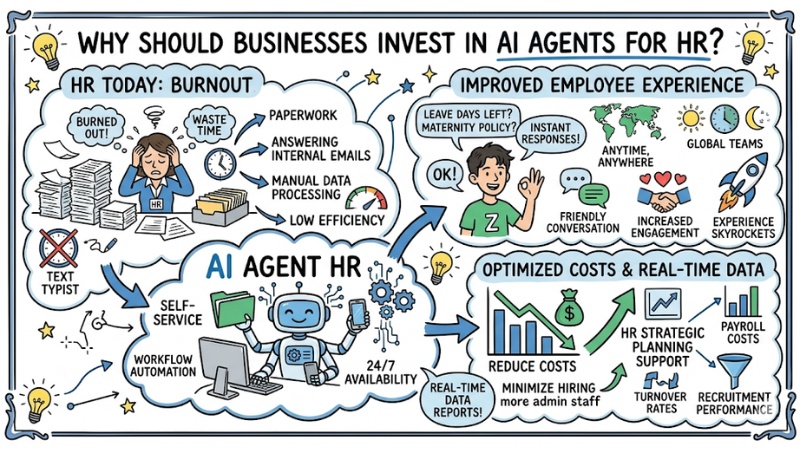
In reality, HR departments waste a lot of time on paperwork, answering internal emails, and manual data processing. This workload causes burnout and reduces overall efficiency.
AI Agent HR can radically solve this pain point by automating administrative tasks. Workflow automation systems will automatically collect documents, categorize requests, and update records. As a result, administrative efficiency skyrockets, allowing your HR team to return to their true expertise: building culture and developing people instead of acting as "text typists."
Improving Employee Experience
Modern employees, especially Gen Z, expect instant responses. They don’t want to wait 24-48 hours just to know how many leave days they have left or what the maternity insurance policy is.
- Self-service: AI Agents empower employees to look up information themselves anytime, anywhere.
- 24/7 Availability: The system operates without days off, removing timezone barriers for multinational companies.
- Increased Engagement: Natural, friendly, and personalized conversation capabilities help increase employee engagement with the business.
Optimizing Operational Costs and Providing Real-Time Data
From a senior management perspective, an AI Agent is a potential investment that helps significantly reduce costs in the future. Specifically, by applying business automation, you can minimize the need to hire more admin staff as the company size grows.
At the same time, AI is capable of retrieving data in real-time. Instead of waiting for HR to compile manual reports each month, leaders can ask the AI to provide real-time data insights on turnover rates, payroll costs, or recruitment performance. This directly supports HR strategic planning.
Businesses need to invest in AI Agents for the HR department
Top 7 Leading Applications of AI Agent HR
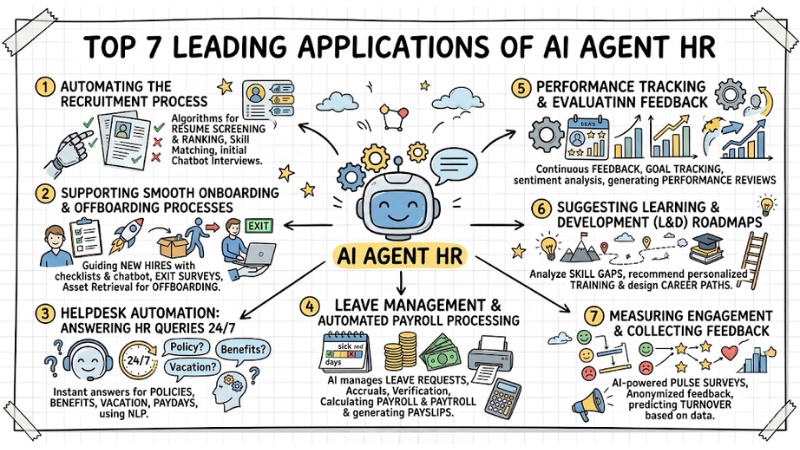
1. Automating the Recruitment Process
AI Agents completely change the landscape of finding suitable personnel by reading and understanding thousands of CVs in minutes. The system automatically extracts skills, matches them against job descriptions, and scores suitability.
When integrated with recruitment management systems, the AI automatically sends interview invitations and schedules them with candidates. This solution is particularly excellent for mass recruitment and helps eliminate unconscious human biases in the preliminary round.
2. Supporting Smooth Onboarding and Offboarding Processes
The processes for welcoming new employees (Onboarding) and resigning (Offboarding) often include dozens of small steps that are easily missed. AI Agent supports employee onboarding and offboarding processes through:
- Onboarding: Automatically creating email accounts, granting software access, sending employee handbooks, and personalized 30-day training roadmaps based on each position.
- Offboarding: Automatically revoking system access, guiding task handovers, and sending exit survey forms.
3. Helpdesk Automation: Answering HR Queries 24/7
AI Agents act as a vibrant internal knowledge library. Thanks to its communication power, it can instantly answer regulations on dress codes, remote work policies, or travel expense reimbursement processes.
A superior point of AI Agent HR is its proactive problem escalation capability. When encountering sensitive questions or those outside the database (such as harassment complaints), the AI Agent will automatically create a ticket and forward it to the appropriate HR specialist along with the entire chat history.
4. Leave Management and Automated Payroll Processing
Payroll lookups, Personal Income Tax (PIT) queries, and leave management are the questions that consume the most HR time. AI Agent connects with Payroll processing software to fully automate this flow.
An employee just needs to ask: "How much tax was deducted this month?". The AI will extract the correct figures for that individual. However, payroll data is strictly confidential. A mandatory requirement is that the AI system must apply strict end-to-end encryption.
5. Performance Tracking and Evaluation
During the performance management process, the AI Agent automatically collects KPI data from project management software, recording task completion frequency and feedback from colleagues. From there, the AI creates 360-degree evaluation drafts with specific evidence using real-time data retrieval.
However, AI can only measure "quantity" and "progress." The biggest limitation is that AI cannot evaluate the working attitude, effort, or emotional intelligence of personnel.
6. Suggesting Learning & Development (L&D) Roadmaps
The AI system analyzes current skills and career goals of each employee to design personalized learning and development roadmaps. It automatically suggests internal courses and reminds them of professional certification exam schedules.
This is also a powerful tool in upskilling HR staff to understand, use, and manage AI tools in HR work, helping the HR team stay updated with the latest digital skills through periodically sent courses.
7. Measuring Engagement and Collecting Feedback
Instead of waiting for annual surveys, AI Agents send short surveys to measure employee engagement continuously. Through Conversational AI, the system performs sentiment analysis based on internal conversations (with anonymized data). The AI will early detect signs of burnout or collective resignation risks to warn leadership.
Top 7 Leading Applications of AI Agent HR
Core Considerations When Deploying AI Agent HR
Data Security and Compliance with Legal Regulations
When granting HR data access to AI, protecting privacy and human resource data safety is the number one priority. Businesses must apply system design principles to ensure legal compliance:
- Absolutely do not use free open-source AI platforms (like the free version of ChatGPT) to upload payroll information or internal evaluations.
- Establish an Audit logs system to record every AI decision.
- Ensure strict Compliance monitoring with international standards such as GDPR or the EU AI Act (for businesses with personnel in Europe).
The "Human-in-the-loop" Model: AI Supports, Humans Decide
AI is not perfect and can absolutely be affected by algorithmic bias in recruitment or evaluation. That is why the Human-in-the-loop (HITL) model must be mandatory.
The AI Agent acts as the collector, analyzer, and recommender. Humans perform personnel supervision and hold the final decision-making power. This approach helps minimize legal risks and maintains humanity in management.
Seamless Integration with Existing Systems
An AI Agent standing alone, unable to connect with company data, is a useless system. The true power of an AI Agent lies in its ability to integrate via APIs with Human Capital Management (HCM) software.
Practical deployment experience suggests you should start by integrating AI to answer queries on Slack/Teams, then expand connections to core systems like Workday or BambooHR.
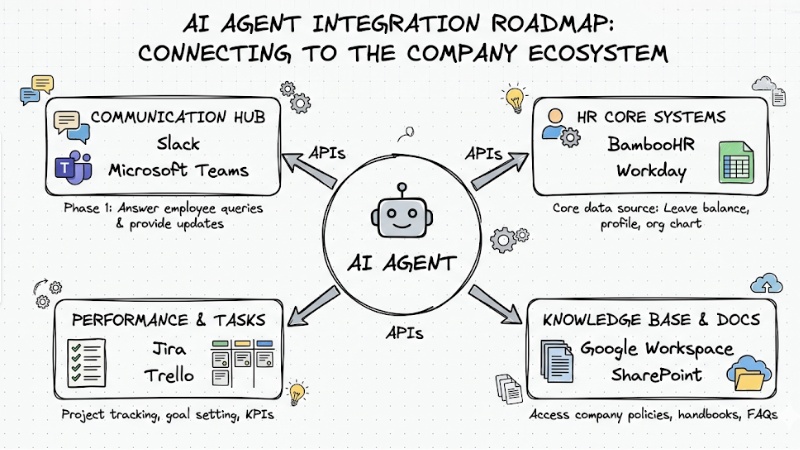
API network model connecting AI Agent with satellites
Frequently Asked Questions about AI Agent HR
Will AI Agents completely replace HR staff?
Absolutely not. AI Agents are born to carry the load of repetitive administrative tasks, calculations, and paperwork. HR staff will be freed up to focus on HR strategy, conflict resolution, psychological counseling, and building company culture—things that require emotional intelligence that AI cannot replicate.
Is employee data safe when a company applies AI Agents?
Yes, provided the business uses paid Enterprise AI solutions that support end-to-end encryption. These systems comply with international security certifications such as SOC 2, ISO 27001, and GDPR, ensuring internal data is not leaked or used to train public language models.
How to measure ROI when using AI Agent HR?
You can measure ROI through 3 main indicators: the number of administrative working hours reduced each month, the Ticket Deflection Rate (the percentage of internal questions successfully solved by AI without HR), and the increase in eNPS scores (Employee Net Promoter Score).
How is AI Agent HR different from a standard HR chatbot?
AI Agent HR has the capability to act autonomously, handle complex processes, and learn from data, while traditional chatbots only answer based on fixed scripts and lack execution capabilities.
Why do businesses need AI Agents for the HR department?
AI Agents help free HR staff from time-consuming administrative work, improve employee experience through 24/7 support, and optimize operational costs via automation.
Do AI Agents help automate the recruitment process?
Yes, AI Agents can screen records, score candidates, schedule interviews, and perform initial interactions with candidates, helping speed up recruitment and reducing the burden on recruitment teams.
How do AI Agents support employee onboarding and offboarding?
AI Agents can guide new employees through procedures, provide necessary documents, collect information, and manage the asset recovery process, ensuring a seamless experience for both stages.
Can AI Agent HR answer HR queries 24/7?
Certainly. AI Agents operate continuously, providing instant answers to common questions about policies, benefits, and payroll, ensuring employees are always supported without waiting.
Can AI Agents handle payroll and leave tasks?
Yes, AI Agents can integrate with payroll and leave management systems to look up information, process leave requests, and update data automatically and accurately.
Do AI Agents support employee performance evaluations?
AI Agents can collect performance data and feedback from multiple sources and assist in creating evaluation drafts, helping managers have a more holistic view, but the final decision still belongs to humans.
Read more:
- What is an AI Ops Agent? How to optimize IT operations and reduce downtime
- AI Agent SEO: How to Set Up Content Automation and Keyword Optimization Workflows
- Optimizing AI Agent Developer Workflow: Enhancing Programming Efficiency
AI Agent HR is no longer a vision of the future; it is the current standard for resource optimization. By turning AI into an autonomous assistant, HR departments can escape the administrative "trap" to truly become strategic partners to the board of directors. Start your digital transformation today by reviewing the most time-consuming repetitive processes in your HR department, and choose the simplest process to test automation.