AI Agent SEO: How to Set Up Content Automation and Keyword Optimization Workflows

Are you exhausted by repetitive daily SEO tasks, from data extraction and rank tracking to hours of manual technical error auditing? Right now, the solution to free up your time is an AI Agent SEO. This system helps automate your entire workflow, transforming raw data into specific actions, allowing you to focus more on strategy instead of constant manual operations.
Key Takeaways
- Definition of AI Agent SEO: Understand that an AI Agent is a "digital personnel" capable of reasoning, planning, and executing complex SEO task chains rather than just providing passive text responses.
- Benefits of Using AI Agent SEO: Grasp the flexibility of AI in handling context and self-correcting errors, completely replacing the rigid (If-Then) rules of old tools.
- 3 Core Components: Explore the combination of the LLM brain, real data connectivity (API/MCP), and skills defined through Prompt Engineering.
- 7 Practical Applications: Optimize everything from Content Decay analysis and Topical Authority research to technical audits, Schema generation, and On-page automation.
- 5-Step Deployment Roadmap: A standard process ranging from task orchestration and system command setup to the critical "Human-in-the-loop" checkpoint.
- Optimal Deployment Platforms: Choose tools suited to your technical level, from No-code platforms (Gumloop) to specialized solutions (n8n) or local setups (Claude MCP).
- FAQ: Clarify the collaborative role between AI and SEO Writers, actual operational costs, and vital notes to avoid Google penalties.
What is AI Agent SEO? Differences from Standard Marketing Automation
Definition of AI Agent SEO: Autonomous SEO agents
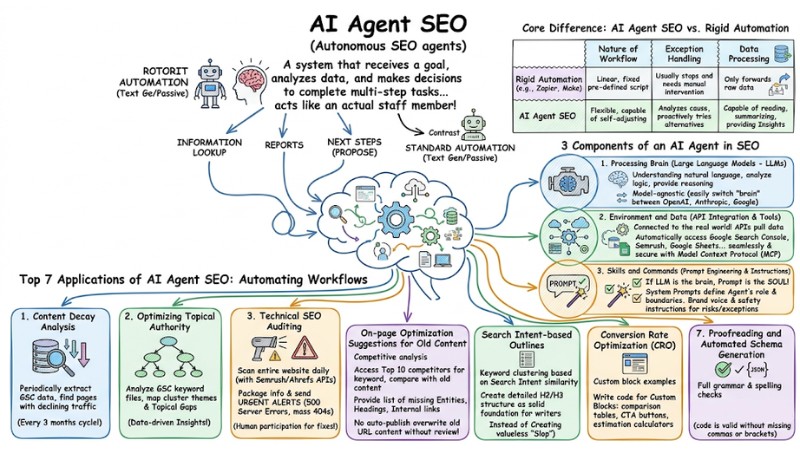
An AI Agent SEO (SEO Agent Assistant) is a software system capable of automatically executing multi-step sequences. This system receives a goal, analyzes data itself, and makes decisions to complete a chain of SEO tasks.
Unlike standard text generation tools, an AI Agent SEO acts like an actual staff member. They have the ability to look up information, synthesize reports, and propose the next steps without needing constant commands from you.
Core Difference: AI Agent SEO vs. Rigid Automation
Traditional Rigid Automation tools operate under strict rules like "If A happens, do B." In contrast, an AI Agent possesses context-aware decision-making and loop self-correction capabilities.
| Comparison Criteria | Rigid Automation (e.g., Zapier, Make) | AI Agent SEO |
|---|---|---|
| Nature of Workflow | Linear, fixed according to pre-defined processes or scripts. | Flexible, capable of self-adjusting plans to reach the goal. |
| Exception Handling | Usually stops and requires manual intervention when an error occurs. | Analyzes the cause and proactively tries alternatives to continue. |
| Data Processing | Only forwards raw data between applications. | Capable of reading, summarizing, and providing Insights. |
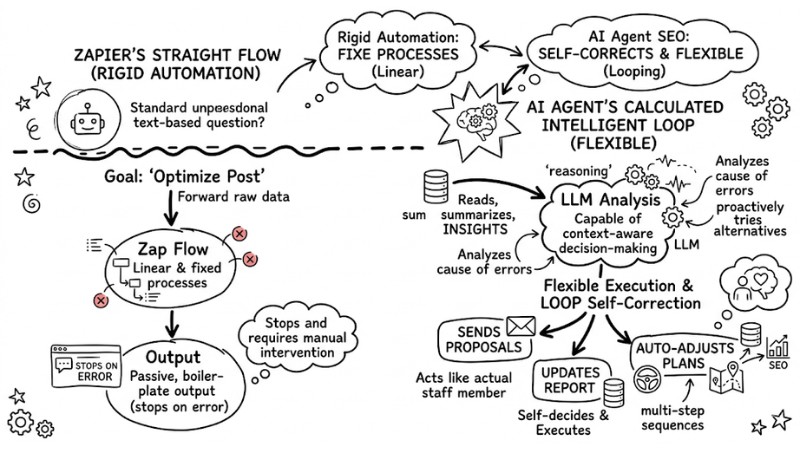
Zapier's straight flow compared to the calculated intelligent loop of an AI Agent
3 Components of an AI Agent in SEO
1. Processing Brain (Large Language Models - LLMs)
LLMs act as the Processing Engine (Core Processor) of the entire system. This brain helps the AI Agent understand natural language, analyze logic, and provide reasoning. Modern systems are Model-agnostic, allowing you to easily switch the "brain" from OpenAI (ChatGPT) to Anthropic (Claude) or Google (Gemini) based on task difficulty.
2. Environment and Data (API Integration & Tools)
To function, the Agent needs to be connected to the real world. Integrating APIs allows the Agent to pull data directly from third parties. The system can automatically access Google Search Console, Semrush, or Google Sheets. Model Context Protocol (MCP) technology ensures this data movement is seamless and secure.
3. Skills and Commands (Prompt Engineering & Instructions)
If the LLM is the brain, Prompt engineering is the soul that shapes its skills. System Prompts define the Agent's role and boundaries, helping maintain a consistent Brand voice and providing safety instructions for handling risks or exceptions.
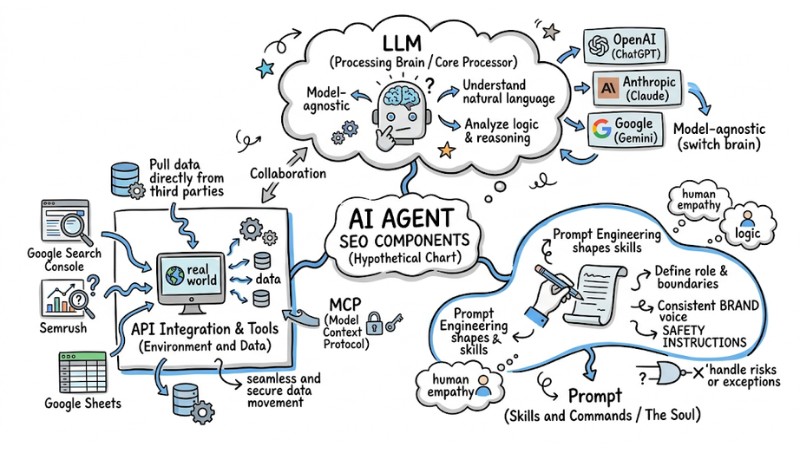
The 3 pillars of an AI Agent include LLM, Data API, and Prompt
Top 7 Applications of AI Agent SEO: Automating Workflows
1. Content Decay Analysis
The Agent can automatically extract GSC data periodically to find pages with declining traffic. It compares current metrics with the previous month to list URLs needing urgent intervention.
Practical Experience: The ideal cycle for scanning Content Decay is every 3 months. Scanning too frequently (weekly) creates data noise due to natural ranking fluctuations.
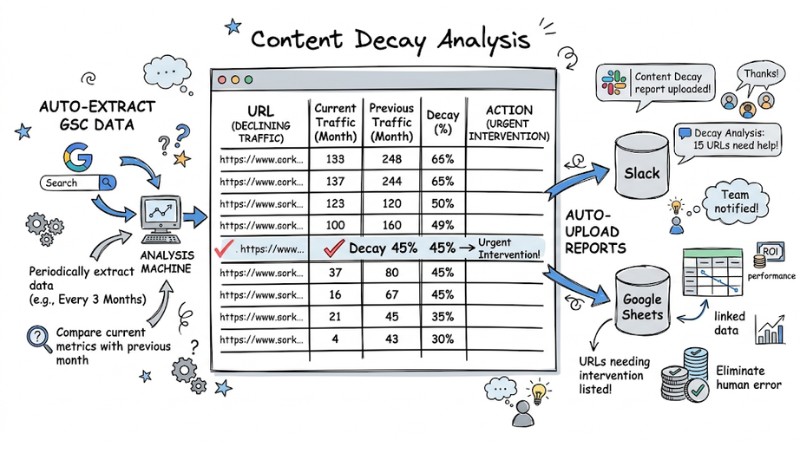
Content Decay reports are automatically sent to Slack/Google Sheets
2. Optimizing Topical Authority
The AI system feeds CSV files containing thousands of keywords from GSC to find cluster themes where the website has an advantage, automatically mapping out Topical Gaps. This provides Data-driven insights, telling you exactly which article to write next to dominate a topic.
3. Technical SEO Auditing
Agents integrating Semrush or Ahrefs APIs can scan the entire website daily. Upon detecting anomalies, the system packages the info and sends alerts to the team.
Warning: Only use AI for urgent alerts (e.g., 500 Server Errors, mass 404s). Fixing technical errors must involve direct human participation.
4. On-page Optimization Suggestions for Old Content
The Agent accesses the Top 10 competitors for a target keyword, compares them with your old content, and provides a list of missing Entities, Headings, or Internal links.
***Practical Experience: ***Never grant the Agent "auto-publish" rights to overwrite old URL content without review.
5. Building Search Intent-based Outlines
Instead of creating valueless "Slop," use an Agent to create outlines. The Agent performs Keyword clustering based on Search Intent similarity, resulting in a detailed H2/H3 structure as a solid foundation for writers.
6. Conversion Rate Optimization (CRO)
Beyond text, Agents can write code to create Custom Blocks like comparison tables, Call-to-action buttons, or estimation calculators to increase on-page conversion.
Below is an example of HTML/CSS code to create a simple CTA button that the Agent can generate on demand:
<style>
  .seo-cta-btn {
    display: inline-block;
    padding: 12px 24px;
    background-color: #007BFF;
    color: #ffffff;
    text-decoration: none;
    font-weight: bold;
    border-radius: 5px;
    transition: background-color 0.3s ease;
  }
  .seo-cta-btn:hover { background-color: #0056b3; }
</style>
<a href="/lien-he" class="seo-cta-btn">Get a Free SEO Consultation</a>
7. Proofreading and Automated Schema Generation
For spell checking and grammar standardization, you can completely delegate this to AI. In particular, AI Agents excel at generating JSON-LD Schema code for the data structure of your articles.
The Schema code generated by the Agent ensures that no commas or curly braces are missing, preventing compiler errors.
<script type="application/ld+json">
{
  "@context": "https://schema.org",
  "@type": "FAQPage",
  "mainEntity": [{
    "@type": "Question",
    "name": "What is an AI SEO Agent?",
    "acceptedAnswer": {
      "@type": "Answer",
      "text": "It is an LLM-powered system that automates complex, multi-step SEO workflows and tasks autonomously."
    }
  }]
}
</script>
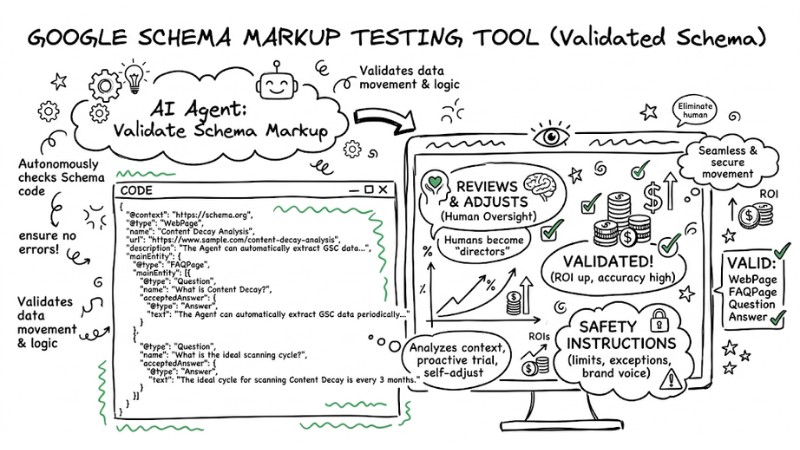
Valid Schema code is tested using Google's tool
5-Step Guide to Setting Up AI Agent SEO (No-Code)
Step 1: Task Orchestration
You start by mapping out your current workflow and converting them into Boolean variables (True/False values).
Example: Set the condition "Has the article dropped out of the Top 10?". If Yes -> Trigger the Agent to send a Report. If No -> Skip. Breaking down the logic this way helps prevent the system from becoming cluttered.
Step 2: Write System Prompts
Leverage ChatGPT itself to act as an expert to write Prompts for your Agent.
You can refer to the following command: "Interview me about the article writing process. Then create a professional system Prompt to assign as Agent Skills". Then, copy this result to serve as the core brain.
Step 3: Choose a Deployment Platform
At this point, you need to decide on the environment to run the system:
- If you want a fast, easy-to-use setup, choose Cloud-hosted.
- If you need absolute security for internal company data, choose Self-hosted (self-hosting on a personal server), though it will require more maintenance effort.
Step 4: Grant Tool Access
For the Agent to know the way into the data repository, you must provide API credentials (Authentication Keys). Go to the settings of tools like OpenAI, Ahrefs, or GSC and click the Generate API Key button. Then, copy that string of characters and paste it into the Connections section on the Agent creation platform.
Step 5: Set up Human-in-the-loop
"Human-in-the-loop" is a mandatory loop involving human intervention. This is one of the most important steps determining the safety and effectiveness of the system.
Practical experience: Always add a "Wait for approval" node before any sensitive action such as: Sending mass emails to partners, Deleting posts, or clicking the Publish button on the website.*
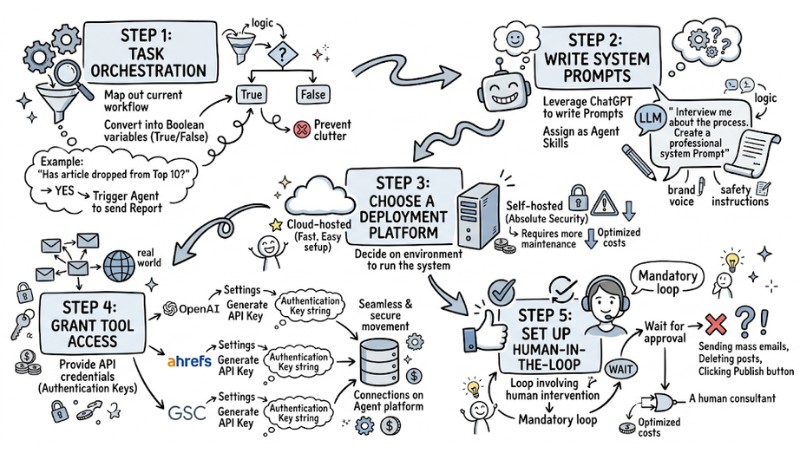
5 steps to set up an AI SEO agent for those who don't know how to code
Top 3 Popular Platforms for AI Agent SEO Deployment
Gumloop
- Pros: Grid-based interface, extremely intuitive No-code drag-and-drop. Native integration with a wide range of popular SEO tools.
- Cons: Dependent on the provider's server, occasional interruptions during system maintenance.
- Best for: In-house teams, Managers wanting a fast setup without coding.
Claude MCP
- Pros: Excellent long-context understanding. Runs directly via Claude Desktop, helping to keep local data secure.
- Cons: Requires some technical knowledge for initial environment configuration.
- Best for: Freelancers, independent SEOs needing an in-depth data analysis assistant.
n8n
- Pros: Capability for Multi-model chaining (connecting multiple different AI models). Freedom to fine-tune source code, no functional limits.
- Cons: Complex interface, workflows are prone to breaking when platforms update their APIs.
- Best for: Technical SEOers, teams with a background in Data or Developers.
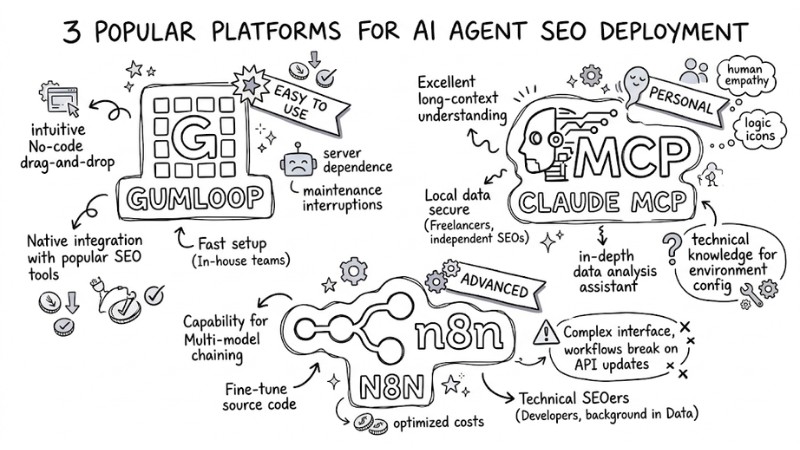
3 popular platforms for implementing AI Agent SEO
The "Golden" Rule for AI in SEO Management
The golden principle when applying AI Agents to SEO management is to always remember that this is a goal-oriented system. However, you should absolutely not exploit that automation power to spam mass low-quality articles every day, as racing for quantity can easily lead to the website being heavily penalized during Google's Helpful Content Updates.
In every Digital Marketing strategy, the role of humans (Human SEO) remains the driver of the strategy: AI handles manual tasks, while you focus on strategic thinking and making the final decisions.
FAQ
Can AI Agents replace SEO Writers?
No. They act as collaborative tools, helping writers create outlines, cluster keywords, and proofread faster.
Can I use AI Agent SEO without coding knowledge?
Absolutely. Modern no-code platforms allow you to set up automated workflows with simple drag-and-drop actions.
What tasks should NEVER be 100% delegated to AI?
Finalizing keyword strategy, deleting or overwriting website content, and full server structure intervention.
How much does it cost to maintain an AI Agent SEO system?
A fixed platform fee (approx. $20-$50/month) plus API token usage fees (extremely cheap compared to manual labor).
How is AI Agent SEO different from standard Marketing Automation?
AI Agent SEO is more flexible, context-aware, and self-correcting, whereas standard automation follows rigid, linear rules.
Read more:
- What is AI Agent Marketing? Benefits and 7 Optimal Application Methods
- What is an AI Sales Agent? Comparing AI Sales Agents vs. Chatbots
- Multi-Agent Systems for Business: A Breakthrough in AI Operations
Applying an AI Agent SEO brings two core values: freeing you from massive manual workloads and minimizing repetitive errors. SEO management is now a game of how you optimize automated data flows. Don't hesitate—register for an account on Gumloop or n8n and set up an automated 404 error audit Agent for your website today!
Tags