What is an AI Ops Agent? How to optimize IT operations and reduce downtime

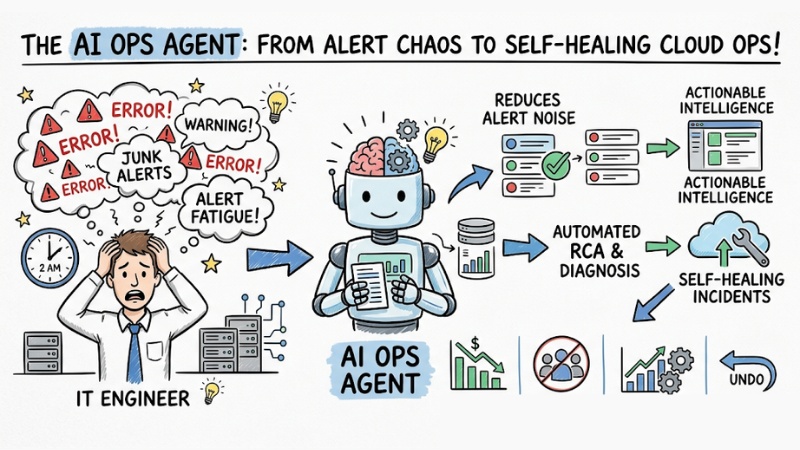
Are you burnt out by system error alerts at 2 AM? Most IT engineers have been "bombed" by thousands of junk alerts, causing them to miss or react slowly to truly critical incidents. That is exactly why AI Ops Agent was born: Not just to reduce alert noise but to change how cloud infrastructure is operated. In this article, I will explore with you how to build and deploy AI Ops Agent into current infrastructure, from filtering alert noise to automated diagnosis and "self-healing" incidents in real-world cloud environments.
Key Points
- Defining Agentic AIOps: Understand that AI Ops Agent is an autonomous system combining Generative AI (context analysis) and Agentic AI (execution capability) to remediate incidents instead of just passive alerting.
- Solving "Alert Fatigue": Capture how AI replaces thousands of noisy alerts with "Actionable Intelligence", automatically grouping incidents and providing remediation solutions with just one click.
- 4-Step Closed-Loop Process: Understand the operational roadmap from comprehensive data collection (Metrics/Logs/Traces), anomaly prediction, root cause analysis (RCA) to automated fix execution.
- Core Business Benefits: Explore real-world values from reducing Downtime costs, eliminating expensive "War-room" meetings, automating RCA to optimizing Cloud infrastructure costs.
- Real-World Application: Learn how to deploy advanced tasks like auto-scaling resources, predictive maintenance, isolating security incidents, and instant configuration rollbacks.
- 4-Step Deployment Roadmap: A practical process from infrastructure assessment, tool selection, pilot testing with a "Human-in-the-loop" mechanism to setting up safety boundaries (Guardrails) for Production environments.
- Frequently Asked Questions (FAQ): Clarifying concerns about security (RBAC), input data requirements (Telemetry), and how AI Ops Agent collaborates with rather than completely replacing SRE/DevOps engineers.
What is an AI Ops Agent (Agentic AIOps)?
Core definition of Agentic AIOps
Agentic AIOps (AI Ops Agent) is an autonomous artificial intelligence system designed for IT operations management (ITOM). Instead of just sending alerts when an error occurs, AI Ops Agent has the ability to automatically investigate the root cause, propose solutions, and directly intervene in the system to remediate the incident without human intervention.
The perfect combination of Generative AI and Agentic AI
For an AI Ops Agent to operate effectively, it needs two core components:
- Generative AI (The Brain): Uses large language models (LLMs) to aggregate massive data. It translates complex error logs into natural language, making it easy for humans to read and understand.
- Agentic AI (The Limbs): Handles independent decision-making capabilities. It directly executes commands such as restarting servers, rolling back configurations, or scaling resources.
Pro Tip: For an AI system to truly deliver value, you must grant deep access (API access) to the Agentic AI. If you only stop at the "data reading" level, you are wasting the potential of this technology. Establish clear security boundaries instead of completely restricting the AI's power to act.
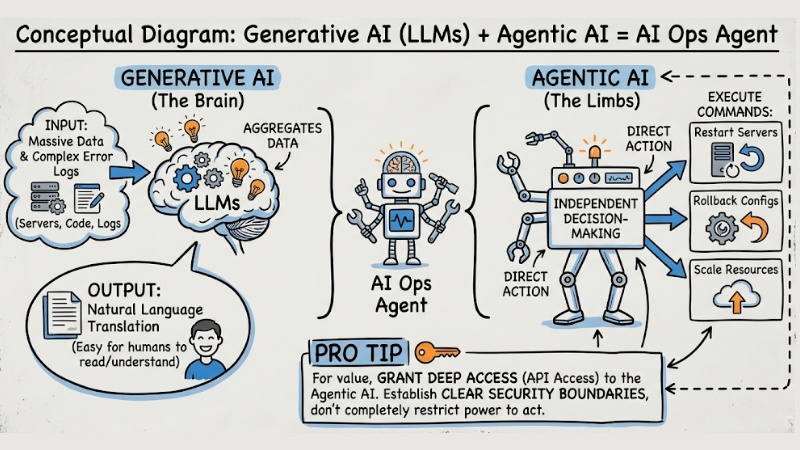
Agentic AI Ops is an autonomous artificial intelligence system designed for IT operations management
Differences between AI Ops Agent vs traditional AIOps
Comparison of traditional AIOps and Agentic AIOps
| Criteria | Traditional AIOps | Agentic AIOps (AI Ops Agent) |
|---|---|---|
| Operating Logic | Based on human-defined rules and static thresholds. | Context-aware learning; adapts to the environment in real-time. |
| Data Processing | Fragmented; often limited to individual monitoring tools (silos). | Integrated cross-domain data for a holistic/comprehensive view. |
| Action | Only issues alerts (Passive). | Directly remediates incidents (Proactive/Self-healing). |
Solving "Alert Fatigue"
"Alert Fatigue" (Alert Fatigue Syndrome) is a nightmare for every Site Reliability Engineering (SRE) engineer. Old AIOps often generate thousands of noisy alerts when a small service fails, causing a domino effect. AI Ops Agent solves this with Actionable Intelligence; it filters out noise, groups thousands of alerts into a single incident, and provides exactly one "Approve Fix" button.
Example of AI Ops Agent Self-healing capability
Imagine at 2 AM, a sudden traffic spike causes the Microservices system to overload. With the old system, the on-call engineer would be woken up by dozens of calls. With AI Ops Agent, the AI automatically scans logs and identifies a RAM shortage in the database cluster. It automatically creates a ticket, calls the API to scale up resources, logs the process, and closes the ticket. The next morning, the SRE just needs to review the report.
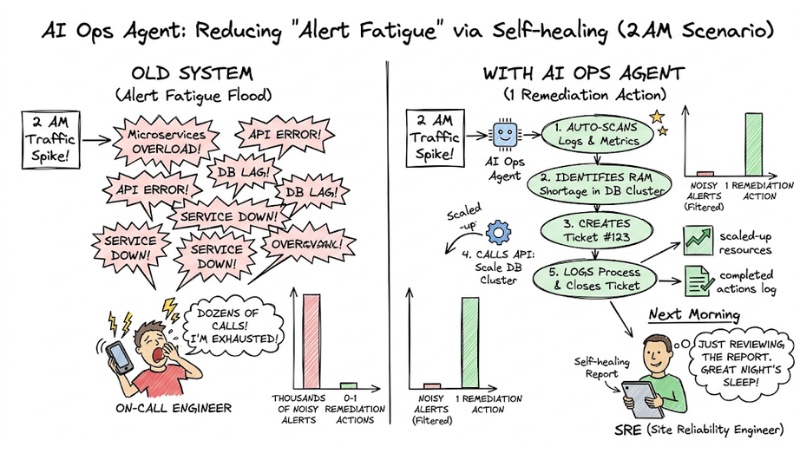
With AI Ops Agent, AI automatically scans logs, identifying RAM shortage in the database cluster
4 standard operational steps of an AI Ops Agent
How AI Ops Agent automates the Incident Lifecycle
The incident lifecycle automation process takes place in 4 closed-loop steps:
- Comprehensive data collection: AI continuously absorbs Telemetry Data through a Cross-domain Observability layer. Data includes Metrics (Prometheus), Logs (Logstash), and Traces (Jaeger).
- Anomaly detection: Processing millions of data points per second. AI predicts potential disruptions before end-users sense latency.
- Root Cause Analysis (RCA): AI reviews Cloud-native architecture, analyzing dependencies between services to find the exact line of code or network configuration causing the error.
- Execution of solution: Through the Agent-cloud interface (ACI), AI communicates with the orchestrator (such as Kubernetes) to execute safe remediation commands.
Experience warning
The ultimate principle in AI is "Garbage In, Garbage Out". Your AI Ops Agent will become useless if your current Observability system provides junk data, lacks standardization, or is fragmented between environments. Therefore, you should clean your monitoring data before providing it to the AI.
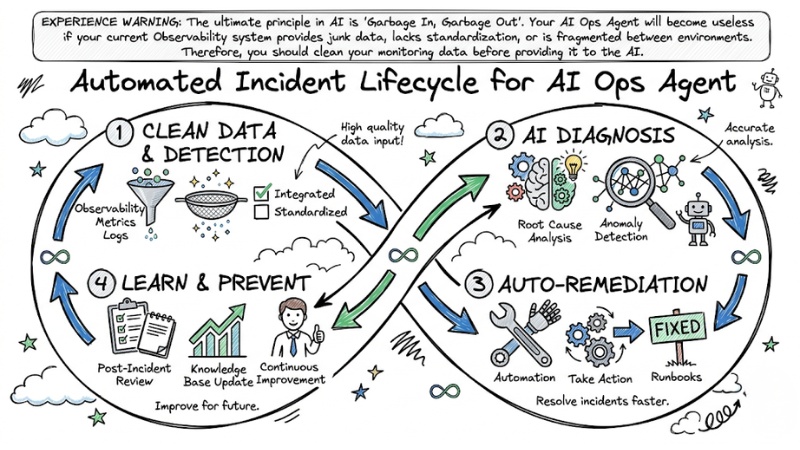
4 standard operational steps of an AI Ops Agent
Top 7 core benefits businesses receive from AI Ops Agent
1. Minimize Downtime costs
Every minute of system disruption causes heavy financial damage. Therefore, AI Ops Agent continuously analyzes data to forecast and prevent risks before they occur. By detecting early signs of anomalies, the AI system will automatically trigger remediation scenarios. Thus, businesses minimize downtime and directly protect revenue.
2. Eliminate War-room meetings
Traditional "War-room" meetings often last long and easily lead to cross-departmental finger-pointing. To solve this, AI Ops Agent acts as a source of transparent information. This system will pinpoint the exact location of the incident and propose a fix immediately, helping engineers save time on arguments.
3. Optimize Root Cause Analysis (RCA)
The manual root cause analysis (RCA) process usually consumes a lot of engineering time. Currently, AI Ops Agent can chain billions of data points from Logs and Metrics thanks to superior contextual reasoning. Because of this, AI easily links seemingly unrelated events to find the true culprit in just minutes.
4. Zero-maintenance through self-learning
Old monitoring systems often generate thousands of false alerts due to the use of fixed measurement thresholds. Conversely, AI Ops Agent has the ability to auto-adjust through self-correcting feedback loops. Artificial intelligence will learn from the real-time environment, helping the engineering team avoid manual rule configuration updates.
5. Filling the DevOps talent gap
The process of recruiting and retaining good DevOps engineers is always expensive. When deployed, AI Ops Agent will operate 24/7 to carry the entire load of repetitive maintenance tasks. This effective support helps the current personnel easily manage a massive infrastructure system without needing to hire more people.
6. Effective Microservices management
Microservices architecture brings flexibility but increases operational complexity. At this point, AI Ops Agent will act as an overall Orchestrator. Artificial intelligence automatically draws dependency maps to monitor thousands of small services, thereby preventing a small error from bringing down the entire system.
7. Optimize Cloud Infrastructure Management
Most businesses waste budget on unused cloud resources. Thanks to continuous scanning, AI will detect and automatically clean up "zombie" servers (running in the background but not processing tasks) and redistribute the load. Automating this resource scaling process helps businesses save a significant amount of Cloud maintenance costs.
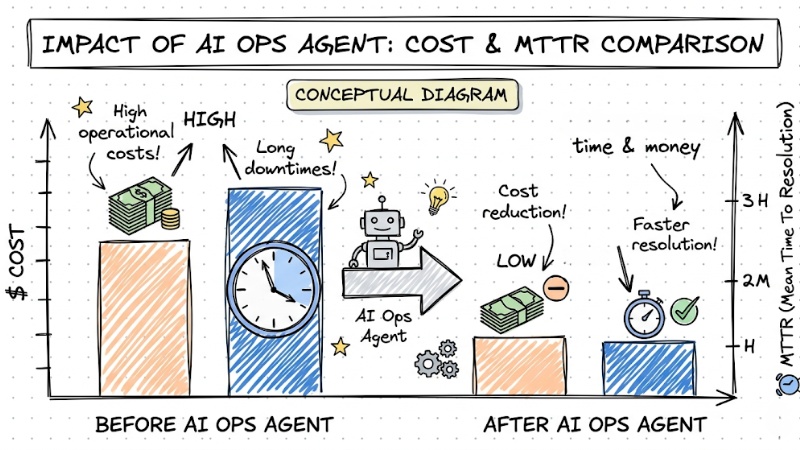
Comparing cost/MTTR before and after using AI Ops Agent
Top 5 real-world applications of AI Ops Agent
1. Automated resource scaling
When detecting a sudden traffic spike (example: Black Friday), AI Agent automatically forecasts and configures an increase in the number of servers. It also automatically scales back down when the campaign ends to save costs.
2. Predictive maintenance
Instead of waiting for a hard drive to fail or an SSL certificate to expire, AI analyzes the smallest signs of degradation. It schedules hardware replacement or automatically renews certificates before an incident occurs.
3. Hybrid and Multi-cloud management
Provides a single, intelligent view for businesses using AWS, Azure, and on-premises servers simultaneously. AI will automatically reroute traffic if one of the cloud providers encounters an incident.
4. Isolate security incidents
As soon as signs of a DDoS attack or ransomware are detected, AI will automatically isolate the infected network partition. This prevents the risk of spreading while waiting for the security team to intervene deeply.
5. Configuration recovery
If a software update causes a system crash, AI will detect it within seconds. It automatically generates commands and triggers the Rollback process to the most recent stable version.
An example of how an AI could reason to automatically generate rollback commands for a Kubernetes deployment.
apiVersion: apps/v1
kind: Deployment
metadata:
  name: payment-service
spec:
  replicas: 3
  template:
    spec:
      containers:
      - name: payment-app
   # AI automatically changes the tag back to version v1.2.0 (the stable version before the incident occurred).
        image: registry.example.com/payment-app:v1.2.0
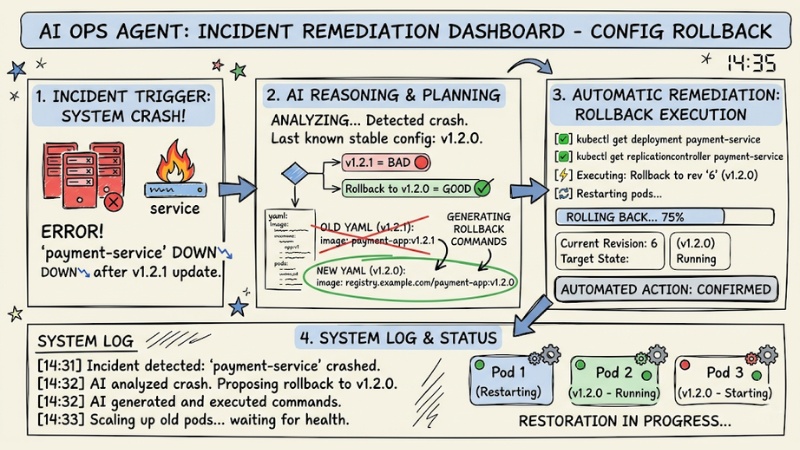
AI Agent is executing the "Scale up pods" command
4-step roadmap for deploying AgentOps into an operational system
Step 1: Infrastructure platform assessment
You should start by checking monitoring layers to ensure your system has collected full logs, metrics, and distributed tracing before bringing AI in for processing.
Step 2: Selecting the appropriate tools
Look for platforms that support deep integration of agentic AI into the architecture. That platform must be capable of understanding your business's specific structure instead of just providing generic templates.
Step 3: Run Pilot (Trial simulation)
You deploy AI in a test environment, using error simulation tools to check how the AI reacts. At this step, you must use a Human-in-the-loop mechanism (humans approve before the AI runs commands).
Step 4: Establish Guardrails (Safety boundaries)
When moving to Production, please limit AI's permissions (RBAC) and only allow AI to automatically execute low-risk tasks. For core infrastructure change tasks, configure AI to send a proposal with an "Approve" button to the manager.
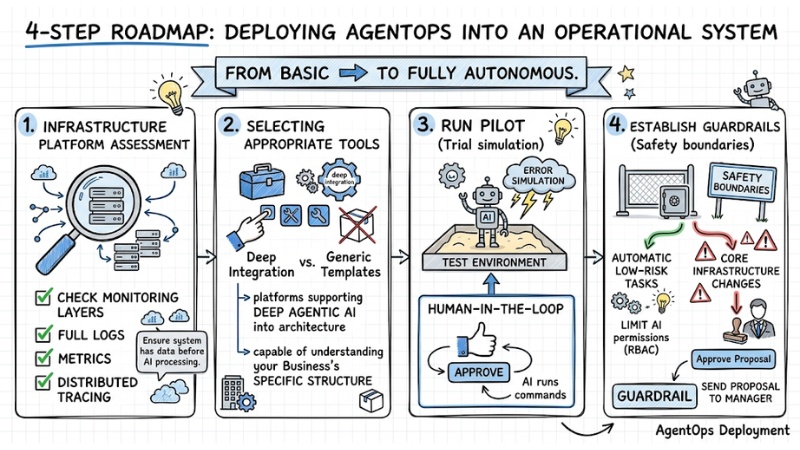
4-step roadmap for deploying AgentOps into an operational system
Frequently Asked Questions about AI Ops Agent (FAQ)
Does AI Ops Agent replace SRE engineers?
No. AI Ops Agent handles repetitive tasks and large-volume data analysis. This frees SREs from junk alerts, helping them focus on designing system architecture and optimizing platform performance.
How to ensure AI doesn't accidentally bring down the system?
You control AI through Role-Based Access Control (RBAC) and Guardrails design principles. For critical tasks, you apply a "1-click approval" process, requiring human confirmation before AI is allowed to execute configurations.
What data does the system need to prepare for AI to operate?
AI Ops Agent requires accurate Telemetry data. The core data trio includes: Logs (system journals), Metrics (performance indicators like CPU, RAM), and Traces (the request path through microservices).
What is the biggest difference between Agentic AIOps and old monitoring tools?
Old tools use static rules to send alerts when a threshold is exceeded. Meanwhile, Agentic AIOps uses Contextual reasoning to understand the nature of the problem and directly act to fix the error independently.
What process does AI Ops Agent follow to self-remediate incidents?
The process includes 4 steps:
- Integrate multi-domain data (metrics, logs, traces).
- Intelligent analysis, incident prediction.
- Generate detailed, actionable information (RCA).
- Automatically execute remediation actions such as scaling, rollback, or reroute.
What are the main benefits when a business deploys AI Ops Agent?
Core benefits include minimizing downtime, eliminating expensive "war rooms", shortening RCA time, automating common incident remediation, solving DevOps personnel shortages, and optimizing complex cloud infrastructure management.
What are the real-world applications of Agentic AIOps?
Common use cases include auto-scaling resources on demand, predictive maintenance for hardware/software failures, seamless multi-cloud/hybrid environment management, isolating and handling network security incidents, along with automated configuration rollback capabilities.
What kind of data does AI Ops Agent require for the operational system?
The system needs to provide full and high-quality Observability data, including Metrics (performance data), Logs (event journals), and Traces (end-to-end access traces) from every component in the infrastructure.
Read more:
- AI Agent SEO: How to Set Up Content Automation and Keyword Optimization Workflows
- What is AI Agent Marketing? Benefits and 7 Optimal Application Methods
- Multi-Agent Systems for Business: A Breakthrough in AI Operations
Starting the era of autonomous IT operations, AI Ops Agent is not a temporary technology trend, it is the inevitable future of IT infrastructure management. The ability to self-detect, self-diagnose, and self-heal helps businesses save millions of dollars by minimizing downtime and optimizing human resources. Start assessing the maturity of your business's Observability system today to get ready to lead the Agentic AIOps wave!