What is AI Agent Marketing? Benefits and 7 Optimal Application Methods

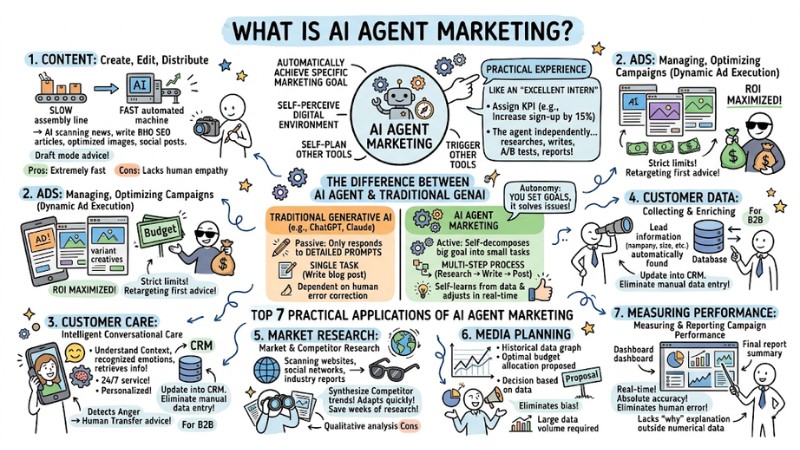
AI Agent Marketing, or marketing with AI Agents, is an artificial intelligence system capable of autonomously analyzing, making decisions, and executing marketing campaigns without human intervention at every step. An AI Agent is not just a passive tool waiting for commands; it operates as a true member of your Marketing team. This article will deconstruct how AI Agent Marketing reshapes workflows, helping you automate tedious tasks and optimize campaign performance immediately.
Key Takeaways
- Definition of AI Agent Marketing: Understand that an AI Agent is an autonomous digital personnel capable of planning and executing campaigns on its own, rather than just responding passively like traditional Generative AI.
- Large-Scale Personalization: Use AI to analyze real behavior, creating and distributing 1-on-1 messages to millions of customers simultaneously with high accuracy.
- 7 Practical Applications: Explore specific scenarios from content creation and ads management to market research and automated reporting.
- Safe Deployment Strategy: Learn the standard 3-step process: Define goals, clean data, and always maintain a "Human-in-the-loop" mechanism to ensure AI always aligns with brand orientation.
- FAQ: Address concerns about data security, deployment capability for small and medium enterprises (SMEs), and how AI Agents complement rather than replace Marketing personnel.
What is AI Agent Marketing?
AI Agent Marketing is artificial intelligence software designed to automatically achieve a specific marketing goal. They are capable of self-perceiving the digital environment, self-planning, and triggering other tools to complete tasks.
Practical Experience: I always advise businesses to view an AI Agent as an "excellent intern." You assign a KPI (e.g., Increase email sign-up rate by 15%), and the agent will independently research the customer segment, write content, send A/B test emails, and automatically report the final results to you.
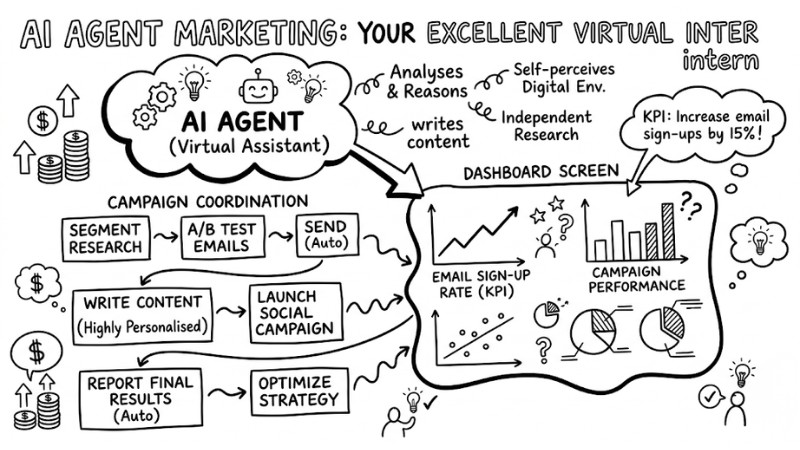
AI Agent Marketing is artificial intelligence software designed to automatically achieve a specific marketing goal
The Difference Between AI Agent Marketing and Traditional Generative AI
Many people still confuse AI Agent Marketing with content generation tools (Generative AI) like ChatGPT or Claude. However, the biggest difference between an AI Agent and traditional Generative AI lies in the ability to self-initiate. Specifically:
| Criteria | Traditional Generative AI | AI Agent Marketing |
|---|---|---|
| Operational Mechanism | Passive. Only responds when given a detailed prompt. | Active. Self-decomposes big goals into small tasks. |
| Task Execution | Performs a single task (e.g., Writing a blog post). | Operates in a multi-step process (e.g., Research -> Write -> Post). |
| Adjustability | Completely dependent on human error correction. | Self-learns from data and adjusts in real-time. |
Instead of having to hand-hold every step, you only need to set goals for the AI Agent. Its autonomy allows the AI Agent to solve issues that arise along the way.
Multi-agent Systems
In complex campaigns, using a single AI Agent is not enough. At this point, you should consider using Multi-agent Systems (MAS). Multi-agent Systems are networks where specialized agents communicate and work together.
Example: A research agent (Planner) finds insights -> transfers data to a content agent (Writer) to write a post -> sends a request to an image agent (Designer) to create a banner. This cross-coordination process happens smoothly without you acting as a bridge.
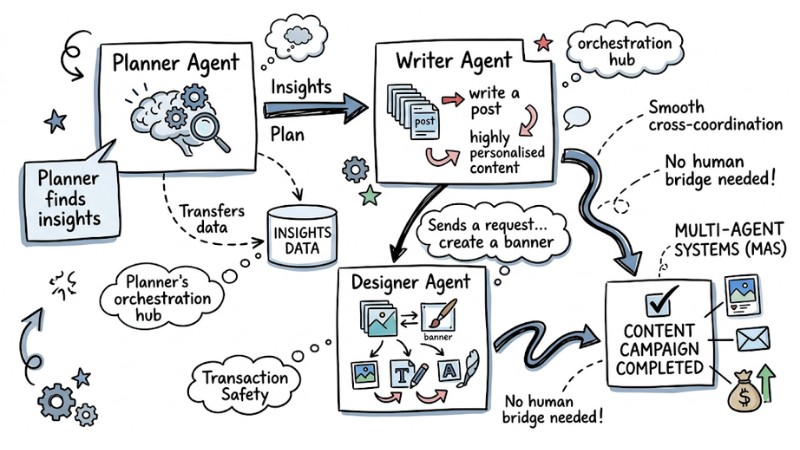
Three agents communicate, transmit data, and complete a content campaign
Core Benefits of Applying AI Agents in Marketing
Automating and Optimizing Workflows
AI Agents completely eliminate "manual labor" in the digital space. Now, your staff will no longer find themselves copying-pasting data from ad platforms to Excel or struggling to transfer files between departments.
Systematic arrangement handled by AI helps applications talk to each other. Applying agentic marketing workflows can save your team 40-50% of their time, freeing energy for strategic decisions.
Personalized Customer Experience at Scale
Previously, personalization was limited to automatically inserting a customer's name into an email. With AI Agents, the level of personalization is taken to a new height.
AI Agents are capable of analyzing millions of behavioral data points to understand exact needs. Then, they automatically create and distribute 1-on-1 messages to thousands of customers simultaneously, ensuring they appear for the right person at the right time in the customer journey.
Real-Time Performance Optimization
Forget waiting until the end of the month to learn from reports; AI Agent Marketing monitors campaign performance 24/7. By using predictive analytics and reasoning under uncertainty, the AI will automatically turn off underperforming ads. Simultaneously, they shift the budget to customer segments generating conversions right while the campaign is running.
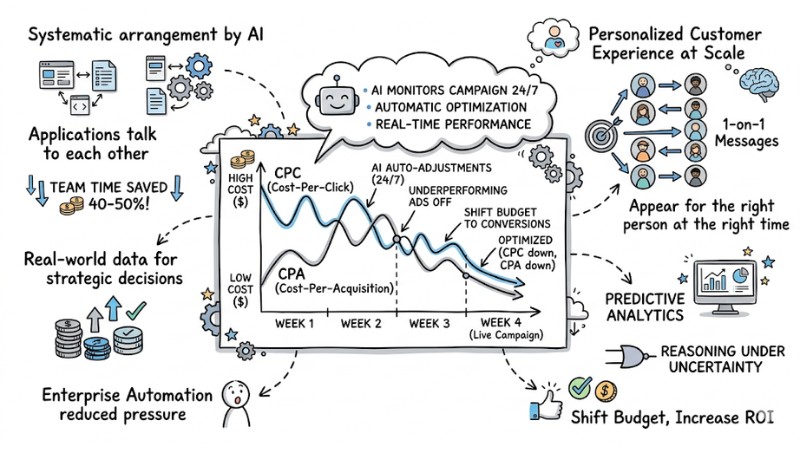
The line chart shows the continuously changing advertising costs, which are automatically adjusted for optimal results by AI
Top 7 Practical Applications of AI Agent Marketing
1. Creating, Editing, and Distributing Content
AI Agents transform content production from a slow assembly line into an automated machine. Based on Large Language Models (LLMs), agents automatically scan industry news, create outlines, write SEO-standard articles, optimize images, and automatically schedule posts across social media platforms.
- Pros: Extremely fast content production speed, maintains consistency of brand identity.
- Cons: Sometimes lacks deep human empathy and disruptive perspectives.
- Best for: Content Marketing teams needing to produce a large volume of blog posts and social posts daily.
Advice: Don't let the AI publish directly. Set the agent to draft mode so you can breathe soul into the writing before making it public.
2. Managing and Optimizing Ad Campaigns (Dynamic Ad Execution)
Instead of coordinating staff to directly monitor Ads Manager, you can assign this to an AI Agent Marketing. They will automatically create dozens of ad variants (creative, copy) and conduct continuous A/B testing.
- Pros: Ability to adjust according to real-time context, maximizing ROI.
- Cons: Can burn budget quickly if strict spending limits are not set from the start.
- Best for: Performance Marketers, Media Buyers managing large budgets across multiple platforms.
Advice: Start by letting the AI Agent optimize Retargeting campaigns first. Once the model has learned enough, expand to Cold Audiences.
3. Intelligent Conversational Customer Care
Intelligent conversational customer care using AI Agents is a perfect upgrade from old scripted Chatbots. AI Agents understand the conversation context, recognize customer emotions, and can automatically retrieve information from the CRM system to resolve complaints, instead of just giving robotic answers.
- Pros: 24/7 service, personalized responses, helps significantly reduce pressure on Telesale/Customer Care teams instead of manually handling the entire volume of repetitive interactions every day.
- Cons: May handle crisis communication situations requiring high subtlety clumsily.
- Best for: B2C and E-commerce businesses with an overwhelmingly large daily message volume.
Advice: Always program a flow to transfer directly to a human consultant when the AI detects that a customer is showing signs of anger.
4. Collecting and Enriching Customer Data
Collecting and enriching customer data with AI Agents allows them to automatically search for lead information (job title, company size, interaction history) from multiple sources and update it into the Customer Relationship Management (CRM) system.
- Pros: Eliminates manual data entry, provides deep context for Sales.
- Cons: Dependent on the quality of public data sources.
- Best for: B2B Marketing and Sales teams.
5. Market and Competitor Research with AI Agents
AI Agents scan websites, social networks, and industry reports to synthesize competitor trends and strategies.
- Pros: Ability to adapt quickly to market fluctuations, saving weeks of research.
- Cons: Qualitative analysis (nuance assessment) is sometimes inaccurate.
- Best for: Marketing Managers, Brand Planners.
6. Media Planning
AI Agents analyze historical data to propose distribution channels and the most optimal budget allocation for a new campaign.
- Pros: Eliminates bias, decisions are based entirely on data.
- Cons: Requires a large enough volume of historical data to provide accurate proposals.
- Best for: Media Planners at Agencies or large Clients.
7. Measuring and Reporting Campaign Performance with AI Agents
AI Agents will automatically pull data from multiple platforms, visualize it into dashboards, and write marketing performance summaries.
- Pros: Real-time reporting, absolute accuracy, eliminates human error.
- Cons: Lacks the ability to explain "why" if the cause lies outside numerical data (e.g., political factors, weather).
- Best for: Every Marketing team needing periodic reports.
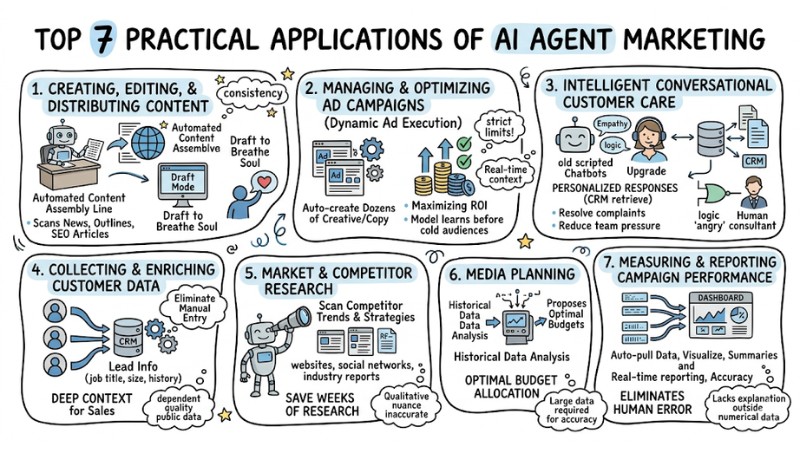
Top 7 Practical Applications of AI Agent Marketing
Visual Comparison: Marketing Scenarios With and Without AI Agent Marketing
To see the difference clearly, consider the scenario of a brand launching a new product. By applying marketing technology (MarTech) with AI Agents, the results change completely.
| Category | Without AI Agent (Manual) | With AI Agent Marketing |
|---|---|---|
| Planning | Takes 1-2 weeks of meetings and researching competitor insights. | Completed in 1-2 days thanks to Agent synthesizing global data. |
| Content Production | Content, Designer, Editor work sequentially. | Multi-agent systems coordinate to create mass variants immediately. |
| Optimizing Ad Budget | Manual optimization once a day. Waiting for report approval. | Real-time optimization based on actual user interaction. |
| Campaign Analysis | Takes 3 days at month-end to gather numbers from Facebook, Google, Web. | Dashboard updates in real-time. Agent automatically provides amendment recommendations. |
3 Preparation Steps to Integrate AI Agents into Your Marketing Team
Step 1: Define Goals and Processes to Automate
Don't try to replace the entire Marketing department with AI immediately. Applying autonomous AI to the marketing team needs to be Goal-oriented.
Start by mapping out current workflows, finding the bottlenecks that consume the most time but require the least creativity (e.g., weekly reports, lead collection).
Warning: Start small and choose a task with clear rules to test the AI Agent before scaling up to avoid the risk of widespread process disruption.
Step 2: Prepare a Clean Data Foundation (Data Collaboration)
AI Agents are only as smart as the volume of data you feed into them. Data collaboration between departments is extremely important; therefore, ensure your CRM data and ad history are cleaned, consistent, and specifically, that the data is accurate and licensed to avoid legal risks.
Step 3: Maintain the Human-in-the-loop Directional Role
A common mistake is users leaving everything entirely to AI while the most optimal model is Human-in-the-loop (HITL).
Human oversight is not intended to slow down the AI, but to ensure they do not deviate from the brand's core values. In the new era, humans are no longer typists but become "directors" – those who approve results and direct the overall strategy.
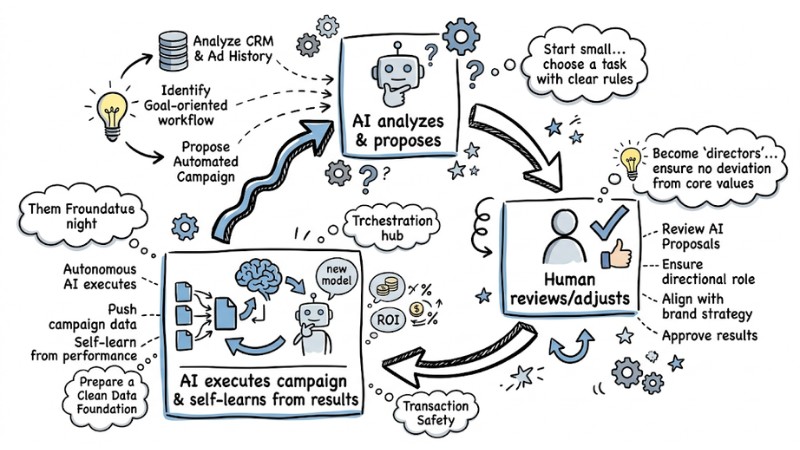
Maintaining the guiding role of humans (Human-in-the-loop)
FAQ about AI Agent Marketing
Can SMEs without a coding team use AI Agents?
Absolutely. Currently, there are many No-code/Low-code platforms providing pre-packaged AI Agents. You only need to drag and drop and connect with existing applications via Application Programming Interfaces (API) without needing to know how to write code.
Will the company's customer data be leaked when using AI Agents?
The issue of Data Security depends on how you set it up. Prioritize AI platform providers that allow private data encryption and commit not to use your data to train their general language models.
How to prevent AI from automatically posting misleading or sensitive content?
This is a matter of AI governance and ethics. The most practical solution is to always set up a final approval mechanism. AI is only allowed to prepare everything; the decision to click "Publish" must be made by a human.
Will AI Agents steal Marketers' jobs?
No. AI Agents only replace repetitive "tasks," not strategic "roles." Marketers who know how to use AI Agents will replace Marketers who work manually.
How is AI Agent Marketing different from traditional Generative AI?
Generative AI creates content based on specific prompts, while an AI Agent self-initiates actions, breaks down big goals into small steps, and self-executes, much like a self-motivated employee completing work.
How do Multi-agent Systems in AI Agent Marketing operate?
In this system, multiple specialized AI Agents (e.g., planning, content writing, design) communicate and coordinate with each other, dividing tasks and sharing information to complete complex processes, just like a team working together.
What are the main benefits of using AI Agents in Marketing?
Core benefits include process automation, personalized customer experience at scale, and real-time campaign performance optimization, helping to increase efficiency and reduce manual workload.
How can AI Agents help with creating, editing, and distributing content?
AI Agents can research trends, automatically create different versions of content (posts, emails), edit according to brand voice, and schedule distribution across appropriate channels, helping speed up content production.
How to prepare for integrating AI Agents into the Marketing team?
You need to clearly define goals and processes that need automation, prepare a clean and accurate data foundation, and always maintain the directional and supervisory role of humans (Human-in-the-loop).
How to ensure data security when using AI Agent Marketing?
It is necessary to use licensed data and comply with security regulations. Technologies like data clean rooms help ensure privacy and regulatory compliance when AI Agents process sensitive data.
Read more:
- What is an AI Sales Agent? Comparing AI Sales Agents vs. Chatbots
- Multi-Agent Systems for Business: A Breakthrough in AI Operations
- AI Agent Customer Support: Optimizing Customer Care and Sustainable Growth
The emergence of AI Agent Marketing marks the end of the era of diligent manual work and paves the way for the ability to autonomously plan, coordinate, and optimize in real-time, helping brands multiply their market reaction speed many times over. At this point, Marketers will lead autonomous teams, completely freeing up labor to focus on what AI cannot do: Empathy and breakthrough creativity.