AI Agent Customer Support: Optimizing Customer Care and Sustainable Growth

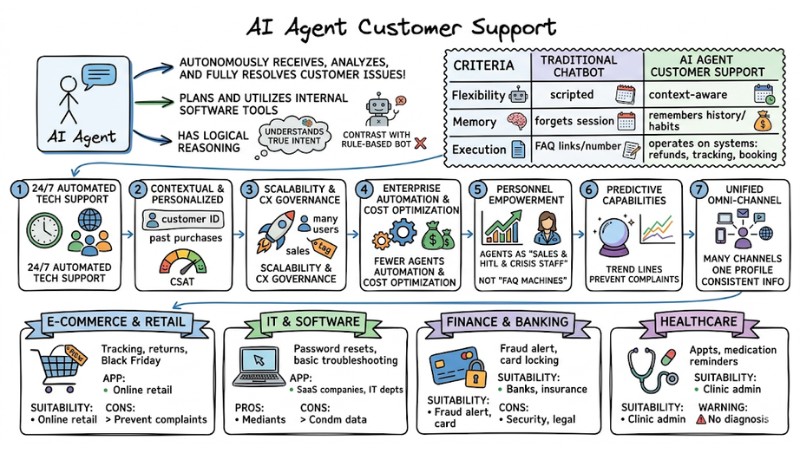
Customers are becoming increasingly impatient, while customer support teams constantly face ticket overload and escalating operational costs. AI agent customer support is the definitive answer to this problem. Unlike rigid, scripted chatbots, the new generation of autonomous AI possesses the ability to think, remember, and automatically handle complex requests from start to finish. This article will provide a roadmap from evaluation and selection to the deployment of AI Agent technology, helping businesses optimize costs and elevate the customer experience.
Key Takeaways
- Definition of AI Agent Customer Support: Understand autonomous AI systems capable of thinking, remembering, and executing actions to fully resolve customer issues, far surpassing the limits of old scripted chatbots.
- Intelligent Operational Mechanism: Master how AI Agents use NLP/LLM to analyze context and connect to internal APIs (CRM, ERP) to automate business operations, enabling rapid ticket processing.
- Breakthrough Benefits: Leverage AI to provide 24/7 support, deep personalization, optimized operational costs, and free up staff for tasks requiring empathy.
- Industry-Specific Practical Applications: Know how to apply AI Agents appropriately for sectors like e-commerce, IT, finance/banking, and healthcare for maximum efficiency.
- Selection and Deployment Criteria: Use a set of software evaluation criteria (API integration, security, no-code) and a 4-step deployment roadmap (from data standardization to Pilot) to ensure success.
- Risk Management and the Future: Grasp the "Human-in-the-loop" model to combine AI power with human insight, ensuring safety and transparency in Customer Care.
- FAQ: Understand strategic questions regarding ROI, personnel replacement potential, and practical deployment roadmaps for both small and medium enterprises.
What is AI Agent Customer Support?
Definition
AI agent customer support (or Agentic AI for support) is an artificial intelligence system capable of autonomously receiving, analyzing, and fully resolving customer issues by planning and utilizing internal software tools.
Imagine an AI Agent as a true support specialist. Instead of just memorizing and spitting out robotic, boilerplate answers, it possesses logical reasoning to understand a user's true intent. Autonomous customer service bots independently evaluate situations, search for relevant data, and directly perform the final action to close the process.
Comparing AI Agent Customer Support and Traditional Chatbots
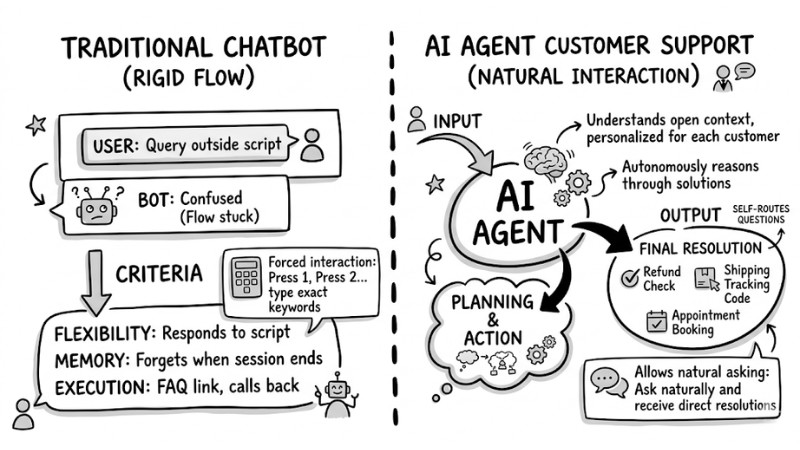
Rule-based chatbots often create significant barriers for customers. They force users to follow fixed flows, press keys, select menus, or type exact keywords. In contrast, AI Agents remove these barriers entirely, allowing customers to ask naturally and receive direct resolutions.
| Criteria | Traditional Chatbot | AI Agent Customer Support |
|---|---|---|
| Flexibility | Only responds according to pre-set scripts (Flows); easily gets stuck with off-script queries. | Understands open context, self-routes questions, and reasons through solutions flexibly. |
| Memory | Forgets all information as soon as the browser is closed or the session ends. | Remembers past interaction history and recognizes habits to personalize for each customer. |
| Execution | Primarily provides information, routes to FAQ links, or asks for a phone number. | Automatically operates on systems: returns, refunds, tracking shipping codes, booking appointments. |
Expert Insight: A customer's biggest frustration is an endless chatbot loop. Investing in conversational AI agents is how businesses buy back time and build customer loyalty.
Comparing AI Agent Customer Support and Traditional Chatbots
How Intelligent Virtual Support Agents Work
Semantic Analysis via NLP and Large Language Models (LLMs)
Upon receiving a message, the system uses Natural Language Processing (NLP) and Large Language Models (LLMs) to extract Intent. Specifically:
- Reading and understanding natural language, acronyms, slang, and typos.
- Evaluating severity and prioritizing events based on keyword clusters.
- Applying Real-time emotion/sentiment detection to identify if a customer is angry or calm, adjusting the tone to soothe or apologize appropriately.
System Interaction
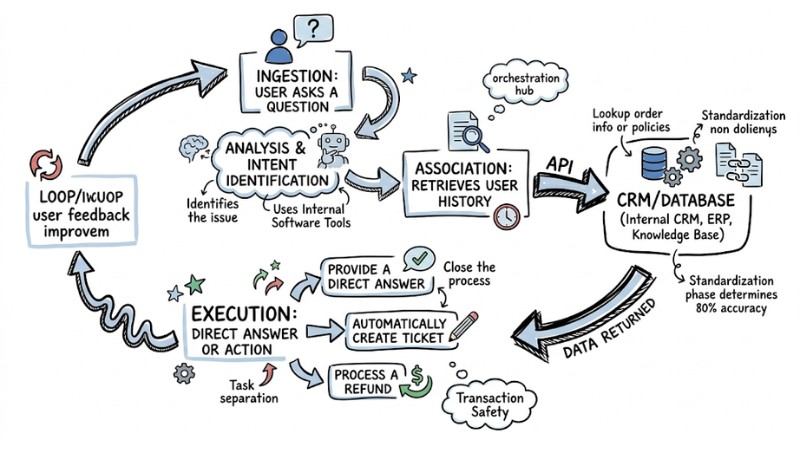
AI Agent does not stand alone as a mere chat tool. It operates as an orchestration hub through the following process:
- Ingestion: The user asks a question.
- Analysis & Association: AI identifies the issue and automatically retrieves user history.
- Lookup: Connects via API to internal CRM, ERP, or Knowledge Base to get order info or policies.
- Execution: Provides a direct answer or automatically creates a ticket/processes a refund in the software.
Expert Note: AI is only as smart as your internal data is clear and high-quality. The root cause of Hallucination (AI making things up) is fragmented or outdated enterprise data. Therefore, the documentation standardization phase determines 80% of the system's accuracy.
The AI Agent acts as a coordination center
Top 7 Benefits of AI Agents for Businesses and Customers
1. Providing 24/7 Automated Technical Support
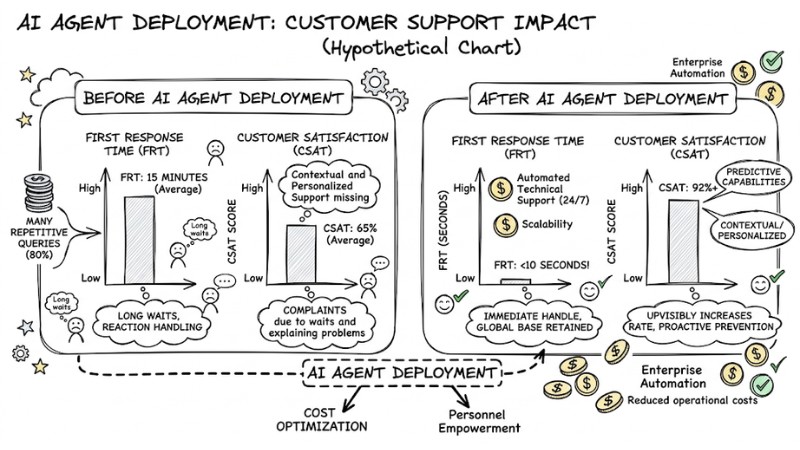
Businesses are not limited by office hours, weekends, or time zones. AI Agent immediately handles basic technical incidents at any time. This retains a global customer base and eliminates complaints due to long waits on social media.
2. Contextual and Personalized Support
The system immediately recognizes who the customer is, what they previously bought, and what issue they are facing before they even open their mouth. This understanding helps shorten the time spent explaining problems and visibly increases the Customer Satisfaction (CSAT) rate.
3. Scalability and Experience Governance
During Flash Sale campaigns or major technical outages, message volume can spike. AI Agent will automatically scale capacity to receive tens of thousands of concurrent visits, ensuring the Customer Experience (CX) Management system does not collapse.
4. Enterprise Automation and Cost Optimization
AI can easily handle up to 80% of repetitive queries. Strengthening Enterprise Automation helps businesses save a significant payroll budget on expanding Level 1 call center teams, thereby helping to reduce operational costs sustainably in the long term.
5. Personnel Empowerment and Upskilling
You should absolutely not fire staff when applying AI; instead, apply the Human-in-the-loop (HITL) model to transfer complex cases to human takeover. Instead of being FAQ-answering machines, businesses can upskill their customer care personnel, transforming them into sales and crisis handling staff.
6. Predictive Capabilities and Problem Solving
The system analyzes customer behavior history to predict incidents right before they have a chance to complain, helping the customer support department shift from a reactive state (handling when problems arise) to proactively detecting and preventing risks early.
7. Unified Omni-channel Integration and Support
Customers can message via Facebook, send complaints by email, or ask questions on the website, but all are centralized and managed in a single profile. Thanks to omni-channel support integration, businesses ensure information is always consistent across every touchpoint with the customer.
The benefits of AI Agents for businesses and customers
Applications of Autonomous AI Agents in Customer Care
Below are typical applications analyzed deeply through 4 key industrial sectors:
1. E-commerce and Retail
- Application: Automatic tracking code lookups, handling return policies, updating delivery status, and suggesting alternative products.
- Pros: Leverages automated task execution to clear thousands of cancellation/exchange requests during festive seasons (Black Friday).
- Cons: May provide incorrect advice on size or color if the system's product description and image database are not uniformly standardized.
- Suitability: A survival feature for every online retail model, from boutique chains to major e-commerce platforms.
2. Information Technology and Software
- Application: Automated password resets, granting/revoking internal access, and troubleshooting basic software/hardware errors.
- Pros: Immediately resolves user incidents, reducing Level L1 ticket volume for IT engineering teams.
- Cons: Completely ineffective against deep system errors requiring physical source code intervention.
- Suitability: Perfect choice for companies selling SaaS or internal IT departments of large corporations.
3. Finance and Banking
- Application: Detecting and alerting credit card fraud, automated emergency card locking, and explaining complex service fee schedules.
- Pros: Strictly complies with Service Level Agreements (SLA) with response times measured in milliseconds.
- Cons: Must face strict legal regulations regarding privacy and data security, requiring expensive independent network infrastructure investment.
- Suitability: Suitable for banks, investment funds, and insurance companies with large security compliance budgets.
4. Healthcare
- Application: Supporting patients with automated appointment booking, medication reminders, and preliminary symptom collection before meeting a doctor.
- Pros: Quickly triages patients, reducing pressure at the hospital reception desk.
- Cons: Serious medical risk if the AI hallucinates and provides incorrect diagnosis or medication advice.
- Suitability: Very good for clinic administrative operations. Absolutely do not use to diagnose in place of medical doctors.
AI Agent Software Evaluation Criteria for Enterprises
When investing in platforms within the Generative AI Ecosystem, businesses should use the following practical criteria to vet providers:
- Open Integration Capability: Does the software have built-in APIs or webhooks for a smooth 2-way data connection with existing Salesforce, HubSpot, or Zendesk?
- Security and Privacy: Should choose infrastructure with SOC2, ISO 27001 certificates, and the contract must have terms committing that the provider is not allowed to use your customer data to train their public AI models.
- Automation Depth: Need to determine if the AI is only capable of text responses (Text-only) or can trigger business processes.
- Flexible Interface: Can the Customer Care and Business teams self-design and drag-and-drop operational scenarios without waiting for the IT department to write code?
- Analytics System: You need to understand if the report dashboard can measure the rate of customers requesting a real person and point out gaps in the AI training documentation set.
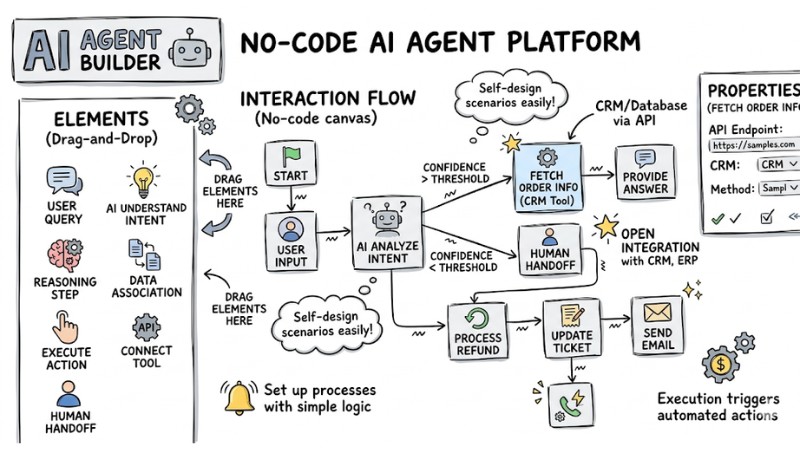
A drag-and-drop, no-code interface creates an interactive flow and establishes the workflow of an AI Agent platform
4 Steps to Deploy AI Agents into Current Customer Service Systems
Step 1: Standardize the Knowledge System
You aggregate all scattered data from: Internal documents, FAQs, warranty policies, and old ticket history. Then you convert raw data into a structured format so the AI can understand and retrieve it accurately. The clearer the enterprise data system, the sharper the AI response.
Step 2: Autonomous Permissioning and Process Setup
You should set up clear permission rules in the enterprise-level automation configuration. Next, you need to specify: which tasks the AI is allowed to complete on its own, and which tasks related to finance must be transferred for human approval.
Step 3: Training Personnel for Handoff Reception
In this step, you need to instruct the call center team on how to work alongside AI. They need to learn how to read the situation summary provided by the AI when receiving a handoff command. This ensures context is preserved, and customers are not frustrated by having to repeat the problem from the beginning.
Step 4: Pilot Testing and Measurement
You should not deploy AI Agent for the entire system on the first day but rather run a Pilot by routing about 10% of customer traffic to the AI for processing (A/B Testing). After that, you evaluate accuracy, collect feedback, and refine the model before expanding to 100%. The Digital Transformation process needs certainty to avoid media crisis risks.
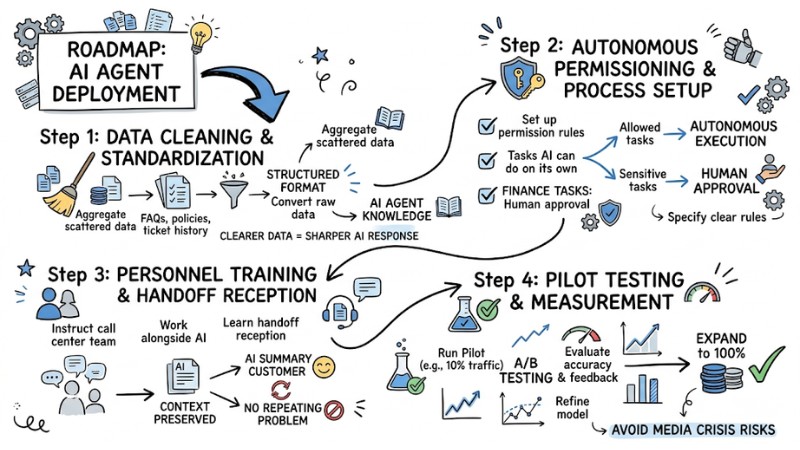
4 steps to deploy AI Agents into your Customer Service system
The Future of AI-Powered Service Automation
The field of customer service is shifting powerfully from a reactive state of resolving complaints to a proactive direction of personalizing the experience. In the next stage of digital transformation, AI Agent will act as the first and comprehensive digital filter layer.
However, humans will not be replaced by AI. Customer Care specialists will transform into "relationship building experts," taking on professional tasks that require deep empathy and complex strategic negotiation.
FAQ
Should and can SME businesses use AI Agents?
Absolutely yes. Currently on the market, there is a lot of AI software supporting customer care for small businesses, provided as a monthly SaaS service. SMEs can fully apply AI to expand service capacity and optimize operational costs without investing in additional server infrastructure or hiring a large amount of new personnel.
Does Artificial Intelligence completely replace customer care staff?
No. AI is superior in processing big data but completely lacks empathy in angry or sensitive situations. Businesses are required to maintain the Human-in-the-loop (HITL) model, where AI clears repetitive workloads, leaving space for humans to connect emotionally and build loyalty.
How long does it take to successfully deploy an AI Agent in reality?
The roadmap depends on the data status and integration complexity. With packaged software (SaaS), it takes 2-4 weeks to clean data and launch. With a deeply customized Customer Experience (CX) Management system connecting many legacy ERP flows, preparation time can last from 2-4 months.
How to measure ROI when investing in AI Agent Customer Support?
Measure ROI when investing in AI Agent Customer Support directly through the decrease in two vital metrics: Average Cost per Contact and First Response Time (FRT). At the same time, observe the increase in the First Contact Resolution (FCR) rate and the ticket resolution productivity of the current personnel team.
What is AI agent customer support?
AI agent customer support refers to intelligent systems capable of automatically performing customer support tasks. They use AI to understand, respond to, and resolve issues, acting as a professional virtual customer service representative.
How is Agentic AI for support different from traditional chatbots?
Agentic AI for support has the ability to remember previous interactions, reason, and act on its own to solve complex problems. Traditional chatbots only respond according to pre-set scripts and process each question independently.
How can AI agents remember previous interactions?
AI agents use technologies like Large Language Models (LLMs) and "memory" mechanisms to store and retrieve information from previous conversations, helping to personalize the experience and better understand context.
Do AI agents automatically solve all customer issues?
Not completely. AI agents can automatically resolve the majority of simple and complex problems. However, special or sensitive cases still require the intervention of human support staff (human-in-the-loop).
What are the main benefits of using AI agents in customer support?
AI agents bring benefits such as 24/7 support, personalized experiences, increased operational efficiency, reduced costs, and freeing employees from repetitive tasks.
Should AI agents be used for small businesses?
Yes. AI agents can provide professional, 24/7 support and enhance customer satisfaction even with a limited budget.
How to deploy AI agents into the current customer support system?
The deployment process usually includes: data collection and preparation, configuring automation capabilities, training staff, and performing pilot testing before comprehensive deployment.
Can AI agents handle complex technical issues?
Yes, depending on training capabilities and system integration. AI agents can diagnose, provide troubleshooting guidance, and even perform certain repair actions.
Read more:
- Boost remote team performance with AI Agents: A step‑by‑step guide
- AI HR Agent: Definition, benefits and 7 practical applications
- What is an AI Ops Agent? How to optimize IT operations and reduce downtime
The presence of AI agent customer support is no longer a "nice-to-have" feature; it has become a mandatory technological standard to maintain a competitive edge. Delaying the application of autonomous systems means wasting the operational budget and indirectly pushing customers toward competitors. Start today by reviewing the current CRM data flow and contacting reputable providers to register for a practical demo experience.
Tags