AI Agents vs Chatbots: Key differences and how to choose the right tool

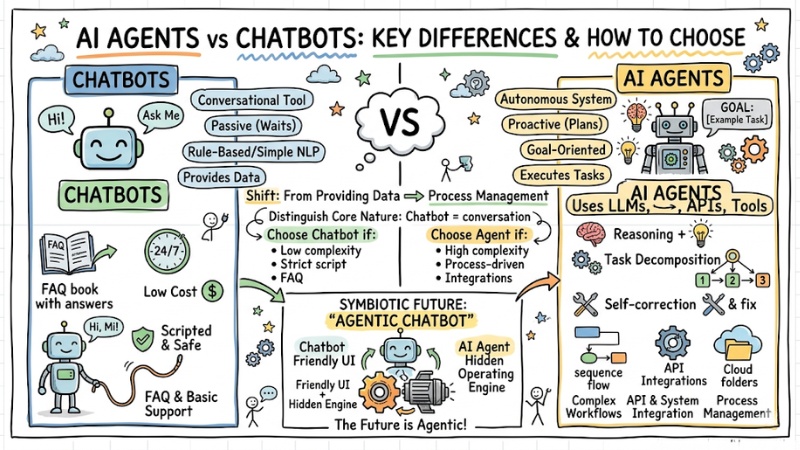
In the booming AI era, businesses face not only the question of "whether to use AI or not" but also the need to choose the right tool between Chatbots and AI Agents. This article helps you clearly understand the core differences between the two models, when to use a Chatbot, when to invest in an AI Agent, and how to combine them to optimize both operations and customer experience.
Key Points
- Distinguishing the core nature: Understand that a Chatbot is a conversational tool that provides information, while an AI Agent is an autonomous system focused on goals and task execution.
- Core technical capabilities: Grasp the power of an AI Agent through its reasoning, task decomposition, and self-correction abilities.
- When to use a Chatbot: The optimal choice for FAQ tasks, 24/7 support, strict script control, and operational cost optimization.
- When to use an AI Agent: Invest in complex workflows that require system/API integration for "process management" rather than just data response.
- Investment strategy: Shift from "providing data" to "process management" by standardizing SOPs before deploying an AI Agent.
- Symbiotic future: Aim to build an "Agentic Chatbot" – where the Chatbot is the friendly UI and the AI Agent is the operating engine hidden underneath.
- FAQ resolution: Get practical advice on cost management, the upgrade path from Chatbot to Agent, and managing the risk of "hallucinations" in real-world operations.
Basic Definitions of Chatbots and AI Agents
To clearly understand the difference between Chatbots and AI Agents, you first need to grasp the definition of each concept, thereby seeing the specific role of each tool in business operations:
- Chatbot (Conversational System): An application focused on language interaction, using available data to answer user questions based on scripts or contexts.
- AI Agent: An autonomous system focused on goal outcomes. It does not just chat but also has the ability to plan, use tools, and execute operations to complete tasks.
Quick Comparison Table of Core Differences Between Chatbots and AI Agents
| Feature | Chatbot | AI Agent |
|---|---|---|
| Primary Goal | Provides information. | Completes tasks / Gets work done. |
| Scope | Usually limited to context within a short conversation session. | Interacts with external systems and APIs. |
| Reasoning | Based on pre-defined scripts (If-Then) or next-word prediction. | Capable of reasoning; breaks down complex requests into smaller executable steps. |
| Typical Examples | Answering customer FAQ questions. | Automated scheduling, sending emails, updating CRM systems. |
Autonomy and Logical Thinking Capabilities of AI Agents
AI Agents go far beyond traditional chatbots thanks to three core technical capabilities:
- Reasoning (Chain of thought reasoning): An AI Agent does not respond immediately; it analyzes the request, breaking the problem down into logical steps to find the optimal solution.
- Task Decomposition: With a "Plan a trip" request, the Agent will automatically: 1. Find flights -> 2. Compare prices -> 3. Book tickets -> 4. Send confirmation. Meanwhile, a Chatbot can only provide a suggested list of flights.
- Self-correction: If an execution step fails (e.g., an expired booking link), the Agent will identify the error, self-evaluate, and retry or find an alternative solution without human intervention.
Thought flow example (Pseudo-code):
Task: "Book a dinner table for 2 people at 7 PM tonight."
1. Check_availability(Restaurant_API)
2. If available: Confirm_booking()
3. Else: Search_alternative_nearby() -> Propose_to_user()
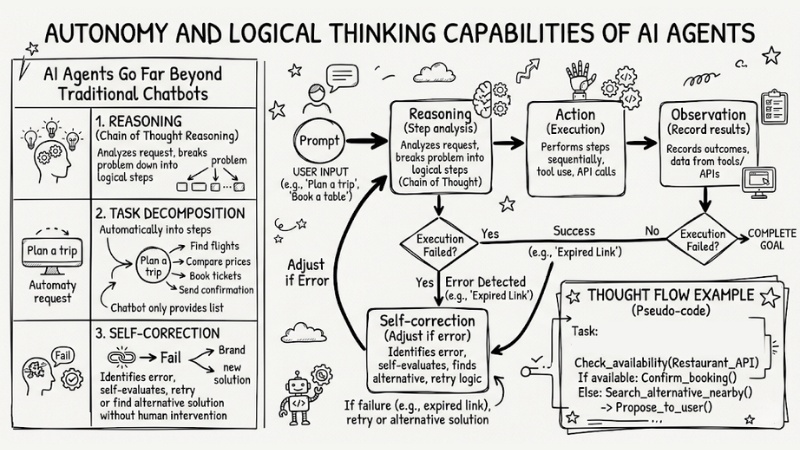
Autonomy and logical thinking capabilities of AI Agents
When Should Businesses Choose a Chatbot?
Chatbots are particularly suitable when you need a stable, easily controllable, and brand-safe interaction channel. Specifically:
- FAQ Automation: Quickly answer repetitive questions about policies, processes, and product/service user manuals.
- 24/7 Customer Support: Maintain continuous connection with customers without needing to staff an on-call team.
- Script Control: Ensure response content always stays within the brand's “safe zone,” limiting the risk of “hallucinations” when using generative AI.
- Low Cost: Easy to deploy, easy to operate, and highly scalable with a reasonable budget.
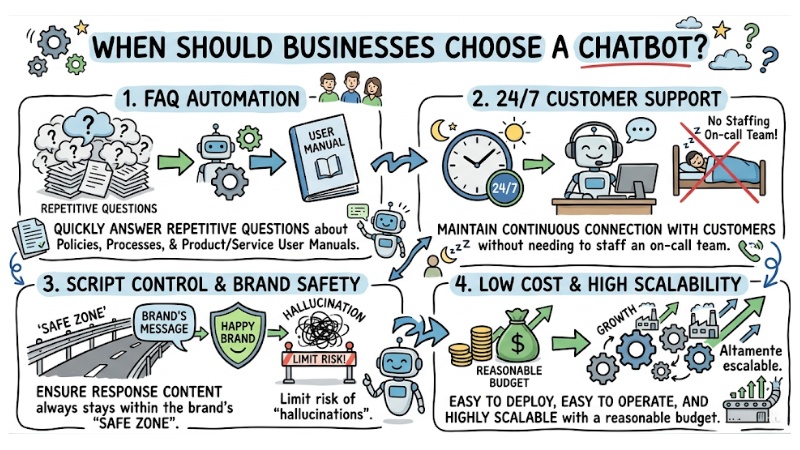
Cases where businesses should choose a Chatbot
When Should You Prioritize Investing in an AI Agent?
An AI Agent is an "extended arm" for complex business workflows. Consider it when you need to shift from "providing data" to "process management":
Practical Advice:
- Standardize Operating Procedures (SOPs): An AI Agent only works well when your workflow is clear. If the process is messy, the Agent will simply automate that mess.
- Evaluate Costs: Unlike chatbots, Agents consume more resources through API calls (LLM tokens) and system integration costs.
- Start Small: Choose a specific workflow (e.g., processing refund requests) to validate before scaling up.
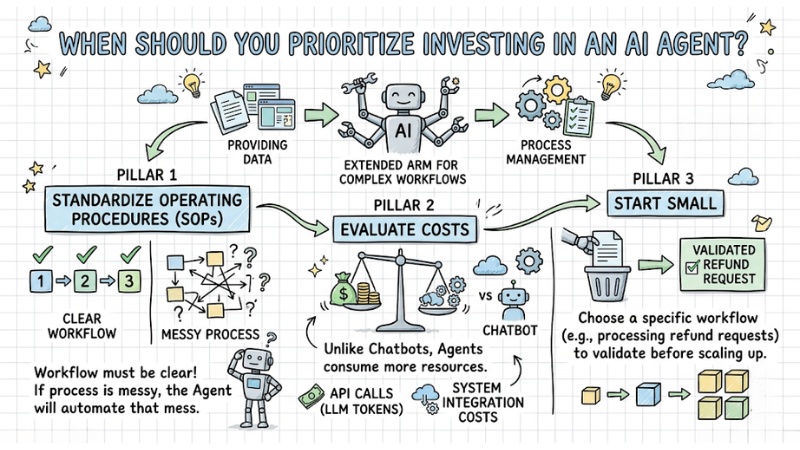
Cases where businesses should prioritize investing in an AI Agent
Investment Comparison:
| Criteria | Chatbot | AI Agent |
|---|---|---|
| Resources | Low. | High (API, system integration). |
| ROI | Operating cost savings. | Performance optimization, downtime reduction. |
| Difficulty | Easy. | Medium - Hard. |
The Future of AI: The Intersection Between Agents and Chatbots
The future of AI is not mutual exclusivity but symbiosis. We are moving towards the "Agentic Chatbot" era – where the Chatbot acts as the friendly user interface (UI), while the AI Agent is the operating engine hidden underneath.
Users will no longer distinguish between "asking" and "doing". Every conversation will automatically trigger real-world actions, transforming the customer experience from passive to fully active.
Frequently Asked Questions When Comparing AI Agents vs Chatbots
Is the operating cost of an AI Agent too expensive?
The initial development cost is higher, but the benefits in terms of time and the ability to process bulk automated tasks often deliver a superior ROI (Return on Investment) compared to hiring manual labor.
Do I need to replace my current Chatbot with an AI Agent?
Not necessarily. You can upgrade your current Chatbot by integrating smaller Agents to handle specific tasks instead of replacing the entire system.
How is an AI agent different from a chatbot?
An AI agent is a system that automatically makes decisions and executes complex tasks, capable of learning and adapting. A chatbot primarily simulates conversations, supporting information within a narrow scope.
How autonomous is an AI agent?
An AI agent can autonomously make decisions, execute sequential action steps, and self-correct when encountering errors, without the need for continuous human intervention.
When to use a chatbot, and when to use an AI agent?
A chatbot is suitable for customer service, FAQs, and simple tasks. An AI agent is ideal for automating complex workflows, analyzing data, and multitasking.
Can an AI agent perform multiple tasks at the same time?
Yes, an AI agent has the ability to break down a large goal into smaller steps, execute related tasks, and coordinate them to complete complex work.
Should I worry about AI agents making hallucination errors?
Yes, AI agents can still make errors. However, they have self-correction mechanisms and learn from feedback, helping minimize risks compared to previous AI systems.
How to get started with an AI agent?
You should start by clearly defining the business workflow that needs automation, standardizing the execution steps (SOPs), and then selecting the appropriate AI agent platform or provider.
See more:
- What is Human-in-the-Loop? The Role of Humans in the AI Era
- Self-hosted AI Agent: Build Your Own Maximum-Security AI Assistant
- What is Multi-tenancy? Multi-tenant Architecture in SaaS
Choosing between a Chatbot vs an AI Agent is not about which technology is more powerful, but about which technology correctly solves your business problem. A Chatbot is the communication gateway, while an AI Agent is the operating engine. Start by auditing your current workflow: If you only need to provide information, choose a Chatbot; if you need to change the state of work, it is time you need an AI Agent.