Measuring AI Agent ROI: A roadmap from implementation to real-world value

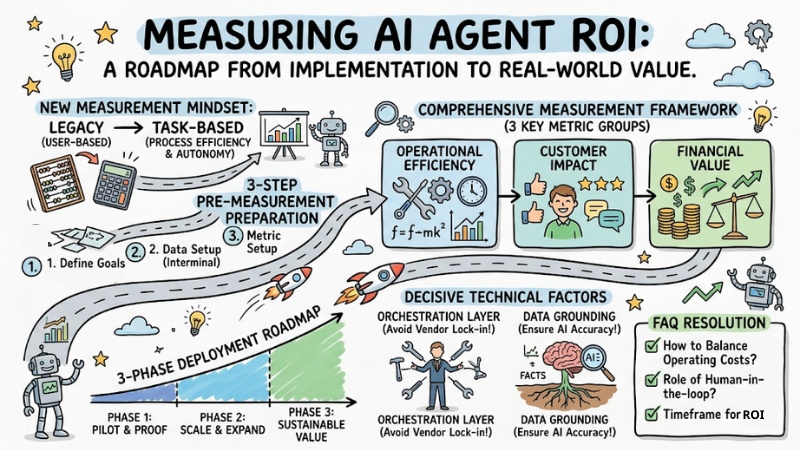
Many AI Agent projects fail, not because of poor technology, but because businesses apply old-school measurement mindsets to a completely new autonomous system. In this article, I will propose a practical AI Agent ROI evaluation framework, helping leaders clearly see the true value of AI, optimize operating costs, and build a roadmap to scale AI sustainably while controlling risks.
Key Points
- New measurement mindset: Shift from legacy measurement (User-based) to a mindset based on process efficiency (Task-based) and the autonomy of AI Agents.
- Pre-measurement preparation: Master a 3-step roadmap to accurately quantify the value contributed by AI.
- Comprehensive measurement framework: Use three key metric groups: Operational efficiency, customer impact, and financial value.
- Phased ROI strategy: Apply a 3-phase deployment roadmap to ensure the business sees value step-by-step and gradually optimizes over time.
- Decisive technical factors: Optimize through an Orchestration Layer (avoiding vendor lock-in) and Data Grounding (ensuring AI accuracy) to improve real-world ROI.
- FAQ resolution: Understand how to balance AI operating costs, the mandatory role of "Human-in-the-loop" in controlling risks, and the expected timeframe to see ROI from AI Agents.
Why are traditional ROI models no longer suitable for measuring AI Agent effectiveness?
Familiar ROI models were originally designed for traditional SaaS software, where revenue and costs are usually tied to the number of users or licenses. Meanwhile, an AI Agent operates on a completely different logic: the value created is directly proportional to its autonomy in decision-making and the execution efficiency of specific tasks.
The core differences:
- Traditional SaaS: ROI is directly proportional to the number of users (User-based).
- AI Agent: ROI is determined by the system's autonomy and the work output.
- Challenges: Old models don't account for token costs, coordination infrastructure (Orchestration Layer), and risks from Large Action Models (LAM).
| Criteria | Traditional SaaS | AI Agent |
|---|---|---|
| Unit of measurement | Number of Licenses/Users. | Completed tasks. |
| Core value | Tool features. | Automated process efficiency. |
| Complexity | Low - Static. | High - Flexible. |
3 crucial preparation steps before measuring ROI
From practical deployment experience, I've noticed the biggest mistake is skipping the baseline data setup phase, making it impossible to quantify the actual value contributed by AI. Specifically as follows:
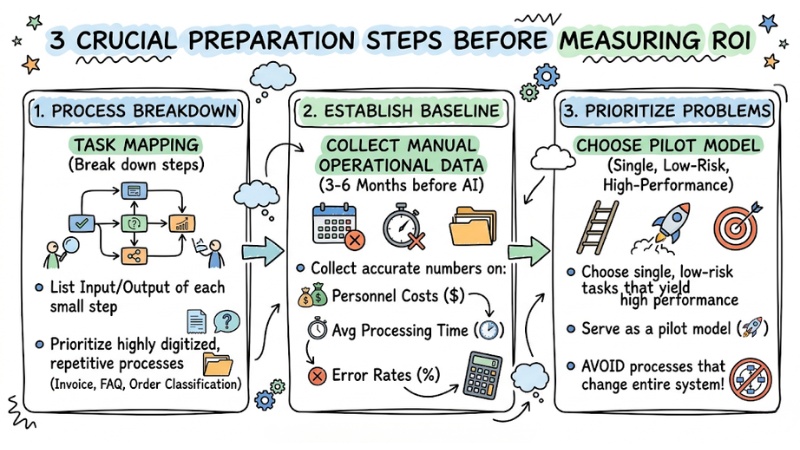
- Process breakdown: Use Task Mapping to list the input/output of each small step. Prioritize highly digitized, repetitive processes such as: Invoice processing, answering customer queries (FAQ), or order classification.
- Establish Baseline: Collect manual operational data for 3-6 months prior to deployment. You need accurate numbers on: personnel costs, average processing time, and error rates.
- Prioritize problems: You shouldn't start with processes that change the entire system. Choose single, low-risk tasks that yield high performance to serve as a pilot model.
3 crucial preparation steps before measuring ROI
Comprehensive ROI measurement framework for AI Agents
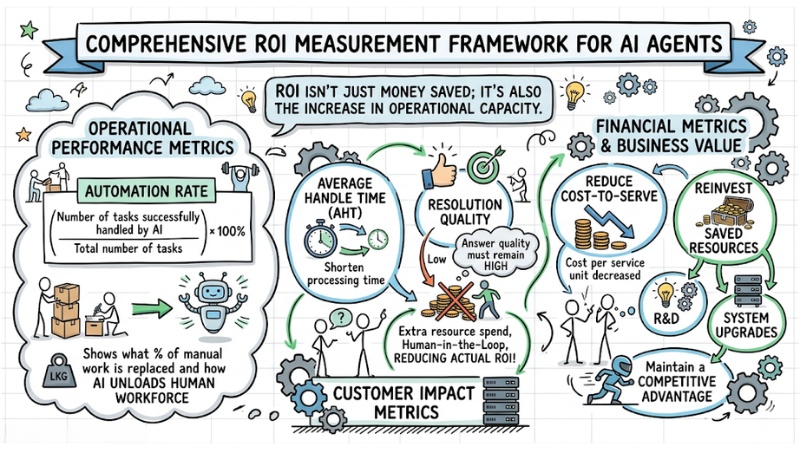
ROI isn't just money saved; it's also the increase in operational capacity.
Operational performance metrics
Focus on the Automation Rate with the formula:
(Number of tasks successfully handled by AI / Total number of tasks) * 100%
This metric shows what percentage of manual work the AI Agent is replacing and how it unloads the human workforce.
Customer impact metrics
Track Average Handle Time (AHT) and Resolution Quality. AI Agents can help shorten processing time, but if the answer quality is low, businesses will have to spend extra resources for human intervention (human-in-the-loop), reducing the actual ROI.
Financial metrics and business value
Focus on reducing the Cost-to-serve (cost per service unit). The saved resources need to be reinvested into R&D or system upgrades to maintain a competitive advantage.
Comprehensive ROI measurement framework for AI Agents
Deployment strategy following a Phased ROI roadmap
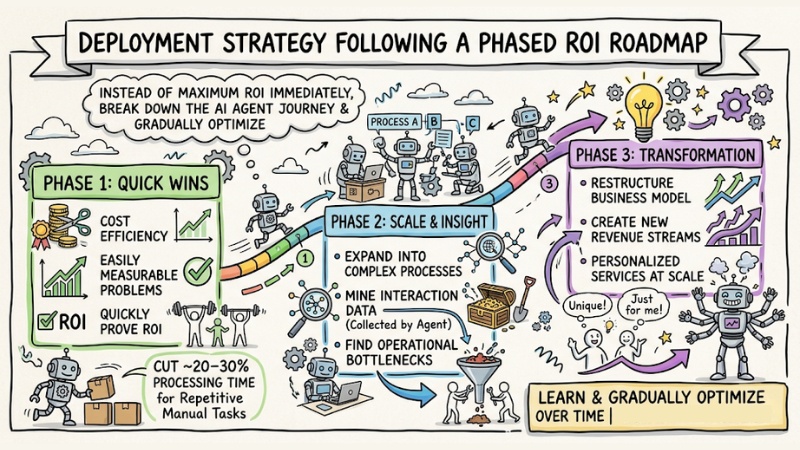
Instead of trying to achieve maximum ROI immediately, you should break the AI Agent journey down into clear phases to learn and gradually optimize over time:
- Phase 1 (Quick wins): Focus on cost efficiency and easily measurable problems. The goal is to quickly prove ROI by cutting about 20–30% of the processing time for repetitive manual tasks.
- Phase 2 (Scale & Insight): Expand into more complex processes. Simultaneously, mine the interaction data collected by the Agent to find operational bottlenecks.
- Phase 3 (Transformation): Restructure the business model. At this point, the AI Agent doesn't just cut costs but also creates new revenue streams or highly personalized services at scale.
Deployment strategy following a Phased ROI roadmap
Technical factors affecting ROI
- Orchestration Layer: You need an intermediary orchestration layer between the AI Agent and legacy systems to avoid vendor lock-in, enabling you to flexibly swap models as technology advances.
- Data Grounding: This is a crucial factor that helps the AI operate accurately based on internal data, minimizing hallucinations and operational errors.
# A simple example of an Orchestration Layer
def task_orchestrator(task):
    if agent_A.can_handle(task):
        return agent_A.execute(task)
    else:
        return human_supervisor.approve(task)
Frequently Asked Questions (FAQ) regarding AI agent ROI
How to balance AI operating costs and the returned efficiency?
You need to set automation thresholds. Only let the AI handle high-confidence tasks and route complex cases to humans to avoid error resolution costs.
Does AI Agent ROI require human supervision?
Yes. The "Human-in-the-loop" model is mandatory to ensure compliance and data safety; it's also the way to mitigate risks of incurring unexpected costs.
How long does it take for businesses to see ROI from AI Agents?
With Quick win projects, you can see clear financial results in the first 3-6 months. Larger strategic values typically appear after 12-20 months of deployment.
What is AI Agent ROI?
AI Agent ROI measures the business benefits gained from deploying artificial intelligence agents (AI agents). It helps evaluate investment efficiency through metrics like increased performance, reduced costs, and net new value creation.
Why is measuring ROI for AI Agents difficult?
Traditional ROI models often focus on static software, making them hard to apply to AI Agents capable of autonomy and learning. The lack of a clear baseline and measuring potential outcomes are also major challenges.
How do you prepare to measure ROI for an AI Agent?
Three important steps:
- Breakdown and clearly understand every task in the process.
- Establish initial performance metrics (baseline) for at least 3-6 months.
- Prioritize problems with clear measurability to start.
What operational benefits do AI Agents provide?
AI Agents help automate repetitive tasks, minimize errors, and speed up process handling. This frees employees from time-consuming work, allowing them to focus on higher-value tasks.
How is the Automation Rate calculated?
The Automation Rate is calculated by dividing the number of tasks successfully handled by the AI Agent by the total number of tasks that need processing. This is an important metric for evaluating the AI's automation efficiency.
How do AI Agents improve customer experience?
AI Agents can shorten request processing time, providing instant and consistent responses, thereby boosting customer satisfaction and reducing the average handle time (AHT).
How do AI Agents create financial value?
By automating processes and minimizing the operating cost per service unit (cost-to-serve), AI Agents save significant costs. The saved resources can be reinvested into R&D or other strategic initiatives.
See more:
- Self-hosted vs SaaS AI Agents: Which option is right for your business?
- Multi-agent vs Single-agent: How to choose the optimal AI architecture
- AI Agents vs Chatbots: Key differences and how to choose the right tool
When measured correctly, AI Agent ROI not only reflects the money a business saves, but also shows that AI is expanding operational capacity, improving customer experience, and creating room for new business models. Instead of chasing short-term numbers, treat AI Agent ROI as a journey: start with quick wins, build your data foundation and standard processes, and then step-by-step turn AI into a core capability within your business's long-term growth strategy.
Tags