Self-hosted vs SaaS AI Agents: Which option is right for your business?

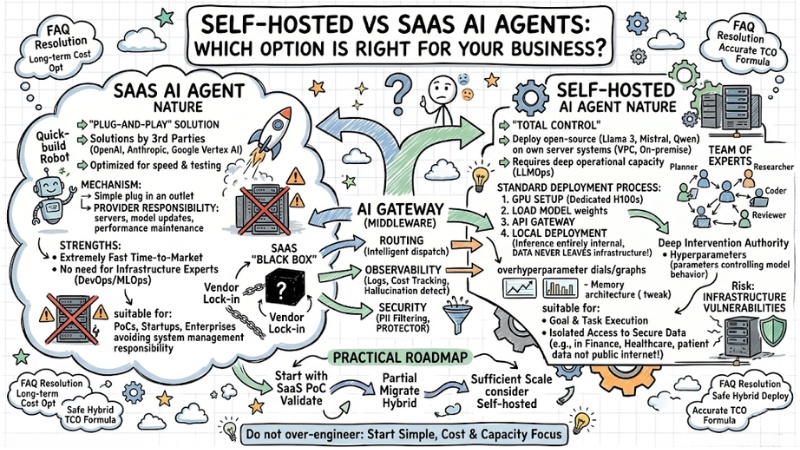
Choosing between a SaaS AI Agent and a Self-hosted AI Agent isn't just a cost problem; it's a strategic decision about data control and your enterprise's operational capacity. This article will help you clearly break down the technical boundaries to make the most optimal choice for your AI infrastructure.
Key Points
- The nature of SaaS vs. Self-hosted: Understand that SaaS is a "plug-and-play" solution optimized for speed and testing; Self-hosted is the path of total control, requiring deep operational capacity (LLMOps).
- Decision criteria: Evaluate based on 3 vital pillars: Available technical resources, Data Sovereignty requirements, and the Total Cost of Ownership (TCO) problem at scale.
- In-depth technical analysis: Identify the differences between the SaaS "black box" and the ability to deeply intervene in Hyperparameters/memory architecture in a Self-hosted environment.
- Middleware solution: Leverage the middleware layer (AI Gateway) to route requests intelligently, combining the strengths of both models (Routing, Observability, PII filtering).
- Practical roadmap: Start with SaaS to validate your idea (PoC), then measure and consider partially migrating to Self-hosted or Hybrid when the system reaches sufficient scale.
- Risk management: Clearly understand the accompanying risks such as infrastructure security vulnerabilities in Self-hosted and vendor lock-in in SaaS.
- FAQ resolution: Grasp long-term cost optimization strategies, how to safely deploy Hybrid models, and the accurate TCO calculation formula for enterprise AI systems.
The nature of SaaS AI Agents: Maximum convenience
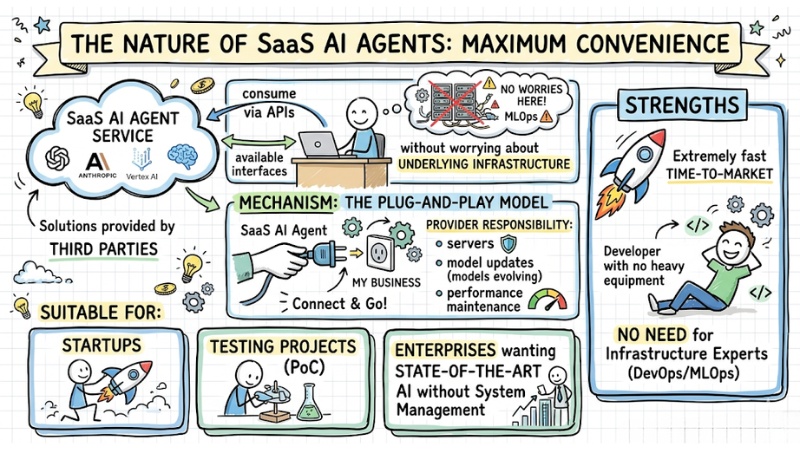
SaaS AI Agents are solutions provided by third parties (like OpenAI, Anthropic, Google Vertex AI). You consume the service via APIs or available interfaces without worrying about the underlying infrastructure.
- Mechanism: The "plug-and-play" model. The provider takes full responsibility for the servers, model updates, and performance maintenance.
- Strengths: Extremely fast time-to-market, no need for a team of infrastructure experts (DevOps/MLOps).
- Suitable for: Startups, testing projects (PoC), or enterprises that want to leverage state-of-the-art AI without shouldering the responsibility of system management.
The nature of SaaS AI Agents: Maximum convenience
The nature of Self-hosted AI Agents: Total control
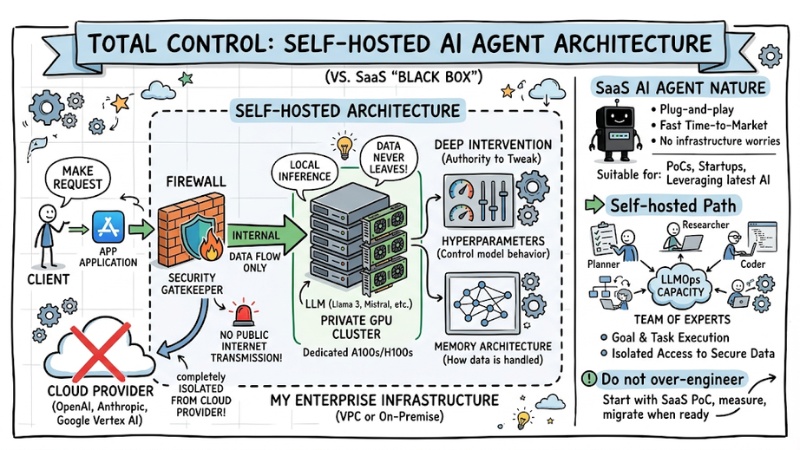
Self-hosted AI Agents involve deploying open-source models (e.g., Llama 3, Mistral, Qwen) directly on your own server systems (VPC or On-premise).
Standard deployment process:
- GPU Setup: Provision server clusters with dedicated GPUs (A100/H100) to serve inference.
- Load Model: Load the model's weights from a repository (like Hugging Face) into GPU memory.
- API Gateway: Build a layer to handle incoming requests from applications, ensuring stability under high traffic.
- Local Deployment: Run inference entirely in an internal environment, meaning your data never leaves your infrastructure.
Technical analysis: Unlike the SaaS "black box," here you have the authority to deeply intervene in Hyperparameters (parameters controlling model behavior) and tweak the memory architecture. This is especially critical in industries like Finance or Healthcare, where sensitive client record data is not allowed to be transmitted over the public Internet. You retain absolute control over how the model handles business logic.
The nature of Self-hosted AI Agents: Total control
Comparing core criteria of SaaS AI Agents vs Self-hosted AI Agents
| Criteria | SaaS AI Agent | Self-hosted AI Agent |
|---|---|---|
| Technical Complexity | Low (Only requires an API Key). | High (Requires an MLOps team). |
| Data Control | Limited (Data is sent to the Cloud). | Absolute (Resides within VPC/On-prem). |
| Operational Costs | Usage-based (Pay-as-you-go). | Fixed costs (Hardware/Power/Staffing). |
| Customizability | Medium. | Very high. |
| Compliance | Dependent on the provider. | Managed/Defined by the enterprise. |
Questionnaire to choose the right model
To choose the right model, you need to answer the following 3 vital questions:
What are your technical resources (LLMOps)?
If you don't have a dedicated AI infrastructure engineering team, the Self-hosted model can easily become a technical burden with all sorts of tasks from maintenance and version updates to handling GPU errors. In case you want to focus your resources on product development rather than infrastructure, SaaS will be a safer and more reasonable choice.
What are the Data Sovereignty requirements?
If legal regulations (like GDPR, HIPAA) or internal policies strictly dictate that data must not leave systems under your control, Self-hosted is practically the mandatory path; even though costs are higher, the trade-off is the ability to maximize the elimination of privacy risks.
What is the Total Cost of Ownership (TCO)?
Calculate using the formula:
- SaaS: API fee x Number of Tokens/requests.
- Self-hosted: Hardware depreciation + Electricity cost + MLOps engineer salary + Maintenance fee. When traffic hits massive thresholds, SaaS costs will often exceed the cost of maintaining self-operated GPU clusters.
Middleware Layer: The balanced solution between the two extremes
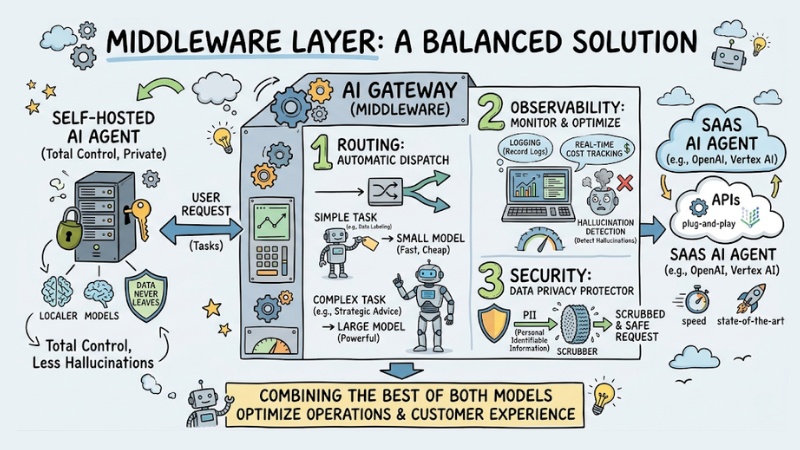
Middleware acts as an intermediary "AI Gateway" layer, helping you combine the benefits of both Self-hosted and SaaS AI Agent models:
- Routing: Middleware automatically routes requests. Simple tasks (e.g., data labeling) are sent to small models (fast/cheap); complex tasks (e.g., strategic consulting) are sent to large models.
- Observability: This tool records all logs, tracks costs in real-time, and detects AI "Hallucination" phenomena early.
- Security: Middleware filters PII (personally identifiable information) data before pushing requests outward, protecting customer data.
Example logic of Middleware (Pseudo-code)
def route_request(input_data):
  if is_sensitive(input_data):
    return run_on_local_model(input_data) # Self-hosted
  else:
    anonymized_data = mask_pii(input_data)
    return call_saas_api(anonymized_data) # SaaS API
Middleware Layer: The balanced solution between the two extremes
Practical advice from experts
Never start by building Self-hosted infrastructure on day one. The optimal roadmap for you is:
- Proof-of-Concept (PoC) with SaaS: Use the most powerful models (GPT-4, Claude 3.5) to validate the feasibility of your idea.
- Measure and optimize: Once the product is stable, inspect the token costs and security risks.
- Migrate gradually: Only when the data volume is large enough or security requirements mandate it, consider shifting some core tasks to Self-hosted or Hybrid (a combination of both).
FAQ when choosing between Self-hosted vs SaaS AI Agents
Is Self-hosted AI really more cost-effective than SaaS in the long run?
Yes, if you achieve a scale large enough that GPU depreciation costs are lower than your total monthly API costs. For small apps, the MLOps personnel operating costs for Self-hosted will be much more expensive than paying SaaS fees.
What is the biggest security risk of Self-hosted?
It is the lack of software security patches and misconfigurations. When you operate it yourself, you are also responsible for attacks against your model hosting infrastructure and training data.
What is a Hybrid model?
The Hybrid model combines both: Using SaaS for non-sensitive features (increasing speed, leveraging the intelligence of the world's largest models) and Self-hosted for core, sensitive data processing tasks that require maximum security. This is the choice of the majority of large enterprises today.
How does a Self-hosted AI Agent differ from a SaaS AI Agent?
A Self-hosted AI Agent allows you to manage the infrastructure, model, and data on your own systems. A SaaS AI Agent is an all-in-one service provided by a third party; you just need to connect and use it without worrying about the infrastructure.
When should you choose a SaaS AI Agent instead of Self-hosted?
You should choose a SaaS AI Agent when you prioritize deployment speed, lack a specialized AI engineering team, and don't have strict requirements for data control or deep model customization.
What long-term cost advantages does a Self-hosted AI Agent provide?
The long-term costs of a Self-hosted AI Agent can be lower if it reaches a large enough scale, since you only pay for infrastructure, electricity, and technical personnel, rather than user subscription fees or SaaS tokens. However, for small apps, MLOps personnel operating costs for Self-hosted will be much more expensive than paying SaaS fees.
How do you deploy a Self-hosted AI Agent safely?
To deploy a Self-hosted AI Agent safely, you need to set up a robust firewall, update systems regularly, strictly control access permissions, and apply advanced data security measures to prevent software vulnerabilities or misconfigurations.
What security risks does a Self-hosted AI Agent have?
Key risks include software vulnerabilities, misconfigurations, unauthorized access due to poor management, and the threat of cyberattacks if the infrastructure isn't adequately protected, leading to sensitive data leaks.
How does the Middleware Layer work in managing AI Agents?
Middleware acts as an intermediary layer, routing requests to appropriate models, gathering data for observability, filtering sensitive information (PII), and can apply security rules before the request is processed by the AI.
When is the Hybrid model suitable for AI Agent deployment?
The Hybrid model is suitable when you want to optimize costs for high-volume data using Self-hosted, while simultaneously utilizing the advanced analytical features or specialized SaaS services for critical data, helping strike a balance between control and efficiency.
How is the TCO (Total Cost of Ownership) of a Self-hosted AI Agent calculated?
The TCO of a Self-hosted AI Agent includes the cost of buying/renting GPUs, power consumption, storage costs, salaries for the operating engineering team (LLMOps), system maintenance costs, and other incurred expenses related to infrastructure.
Which AI Agent model provides the best data control?
Self-hosted AI Agents provide the best data control capabilities, as all processed and stored data resides within the infrastructure managed by the enterprise, ensuring compliance with privacy and security regulations.
See more:
- Multi-agent vs Single-agent: How to choose the optimal AI architecture
- AI Agents vs Chatbots: Key differences and how to choose the right tool
- What is Human-in-the-Loop? The Role of Humans in the AI Era
There is no single Self-hosted or SaaS AI Agent model that is best for every enterprise; there is only the model that fits your current data strategy and human resources. Start with a SaaS AI agent to experiment and learn from real-world data, then gradually shift to self-hosted only when your system scale or compliance requirements begin to become more stringent.