How to Choose the Optimal AI Agent Platform for Your Business in 2026

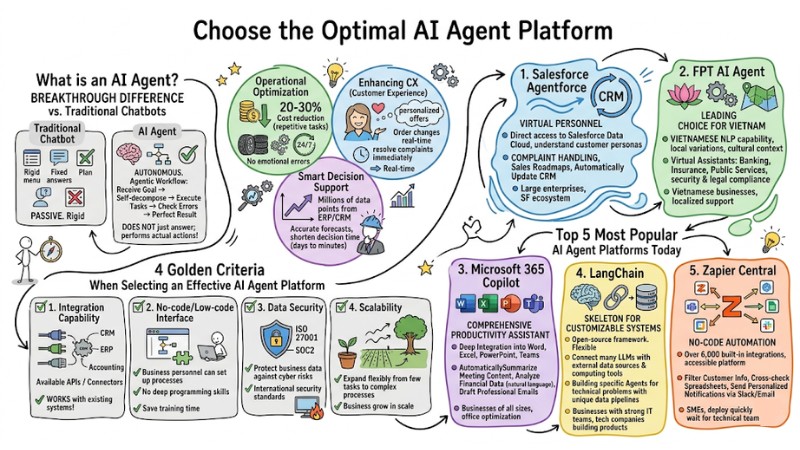
AI Agents are not just support tools but artificial intelligence systems capable of self-planning, task execution, and self-adjustment based on specific goals. While traditional software passively waits for commands, AI Agents proactively solve complex workflows, helping businesses significantly cut operational costs and increase labor productivity. In this article, we will delve deep into how to choose the AI Agent platform that best suits your needs and resources, aiming to help you make the best decision when selecting an AI Agent platform so that every investment in AI truly brings value.
Key Takeaways
- AI Agent Concept: Understand that an AI Agent is an autonomous system that doesn't just communicate but is capable of an "Agentic Workflow" - self-planning, executing on software, and self-adjusting, far surpassing scripted chatbots.
- Strategic Value: Capture core benefits including significant reduction in operational costs, real-time customer experience personalization, and decision support based on ERP/CRM data.
- Platform Selection Criteria: Evaluate providers based on integration capability (API), No-code/Low-code interface, international security standards (ISO 27001/SOC2), and scalability.
- How to Choose the Right AI Agent Platform: Categorize suitable choices for every need: Salesforce (Deep CRM), FPT AI (Localization), Microsoft Copilot (Office Productivity), LangChain (Technical Customization), and Zapier (Fast Automation).
- 3-Step Deployment Roadmap: Follow a minimalist process: Define Use Case (repetitive processes, low risk) -> Perform PoC (Testing) -> Integration and KPI measurement to optimize efficiency.
- FAQ: Understand the "smart assistant" role of the AI Agent (not a complete replacement for humans), flexible cost options, and the importance of security in business operations.
What is an AI Agent? The Breakthrough Difference Compared to Traditional Chatbots
An AI Agent is an autonomous artificial intelligence system that knows how to plan, execute tasks, and self-adjust to achieve a specific goal without human guidance at every step.
Specifically, AI Agents operate under an "Agentic Workflow" mechanism: Receiving a goal, self-decomposing the work, performing each step, checking for errors, and perfecting the result. The difference lies in autonomy; AI Agents do not just answer questions but perform actual actions within software systems.
| Criteria | Traditional Chatbot | AI Agent |
|---|---|---|
| Mechanism | Responds based on available scripts | Reasoning and self-planning |
| Scope | Communication only (Text/Voice) | Execution (System connection, task processing) |
| Autonomy | Low, requires detailed instructions | High, self-completes large goals |
| Error Handling | Stops when intent is not understood | Self-analyzes, tests, and adjusts |
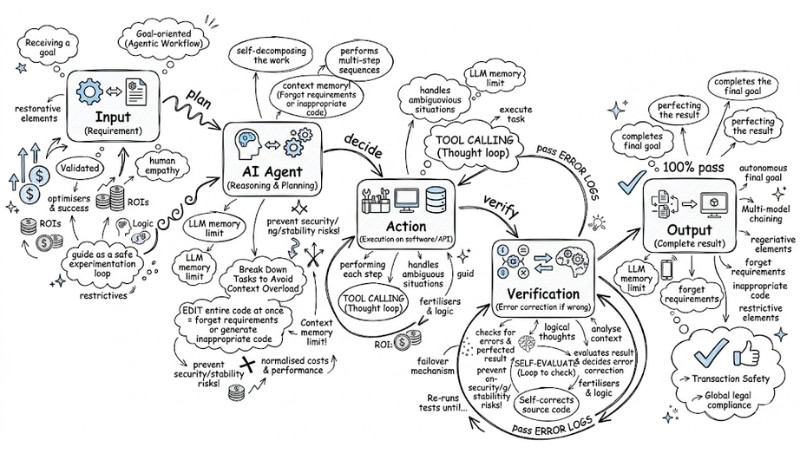
Description of the AI Agent workflow
Why Do Businesses Need to Choose an AI Agent Platform and Deploy Today?
Deploying AI Agents brings three important strategic values that change the face of the business:
- Operational Optimization: According to a report from McKinsey, businesses can reduce operational costs by 20-30% by letting AI handle repetitive tasks. AI is tireless, free of emotional errors, and works stably 24/7.
- Enhancing Customer Experience (CX): Instead of a chatbot that only provides template answers, an AI Agent can access transaction history to personalize offers, resolve complaints, or execute order changes immediately in real-time, providing a superior experience.
- Smart Decision Support: AI Agents analyze millions of data points from ERP (Enterprise Resource Planning) and CRM (Customer Relationship Management) systems to provide accurate forecasts, helping managers shorten decision-making time from days to minutes.
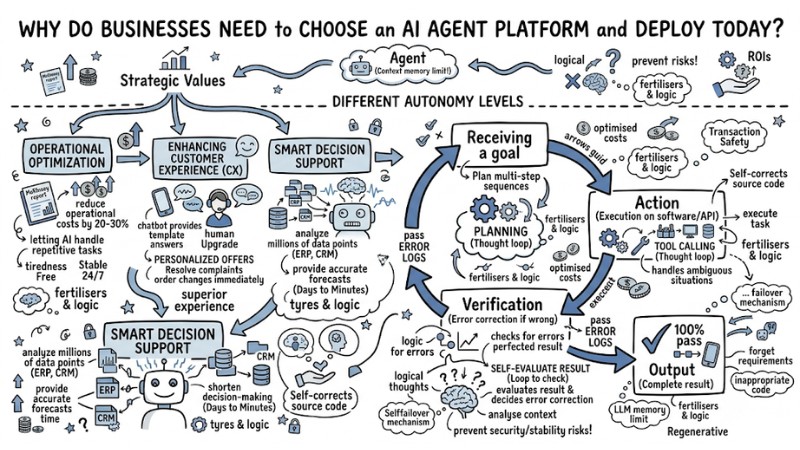
Businesses need to choose an AI Agent platform and deploy it today
4 Golden Criteria When Selecting an Effective AI Agent Platform
To invest effectively, you should evaluate based on 4 core criteria:
- Integration Capability: The platform must have available APIs or connectors to work with existing systems such as CRM, ERP, or accounting software.
- No-code/Low-code Interface: Prioritize platforms that allow business personnel to set up processes without deep programming skills, helping to save training time.
- Data Security: Ensure the provider complies with international security standards such as ISO 27001 or SOC2 to protect business data against cyber security risks.
- Scalability: The platform needs to support flexible configuration to expand from a few small tasks to complex processes as the business grows in scale.
Top 5 Most Popular AI Agent Platforms Today
1. Salesforce Agentforce: The Optimal Solution for the CRM Ecosystem
Salesforce Agentforce is not just a support tool but a true "virtual personnel" within the customer relationship management system.
- Core Strength: Ability to directly access Salesforce's Data Cloud to deeply understand customer personas.
- Application: Fully automates the complaint handling process, suggests personalized sales roadmaps, and automatically updates CRM data without human intervention.
- Best For: Large enterprises already using the Salesforce ecosystem.
2. FPT AI Agent: Leading Choice for the Vietnamese Market
With the advantage of local understanding, FPT AI Agent is the brightest choice for domestic businesses wanting to deploy in-depth AI Agents.
- Core Strength: Excellent Vietnamese Natural Language Processing (NLP) capability, understanding regional variations and Vietnamese business cultural contexts.
- Application: Deploying virtual assistants for banking, insurance, and public services - places requiring absolute linguistic accuracy and security according to local legal regulations.
- Best For: Vietnamese businesses prioritizing localization and direct technical support.
3. Microsoft 365 Copilot: The Comprehensive Productivity Assistant
Microsoft 365 Copilot has transformed familiar office tools into a powerful AI operating system.
- Core Strength: Deep Integration into Word, Excel, PowerPoint, and Teams.
- Application: Automatically summarizes meeting content, analyzes complex financial data in Excel using natural language commands, and drafts professional emails based on actual work context.
- Best For: Businesses of all sizes wanting to optimize the work efficiency of office personnel.
4. LangChain: The "Skeleton" for Customizable Agent Systems
Unlike packaged software, LangChain is an open-source framework specifically for development teams.
- Core Strength: Flexibility. It allows developers to connect many different Large Language Models (LLMs) with external data sources and computing tools.
- Application: Building specific Agents for difficult technical problems that require unique data pipelines.
- Best For: Businesses with strong IT teams or technology companies wanting to build their own AI products.
5. Zapier Central: No-code Automation
Zapier Central is an "instant" but extremely effective solution for connecting thousands of disparate applications.
- Core Strength: Connectivity. With over 6,000 built-in integrations, this is the most accessible platform.
- Application: Setting up "action loops" such as: Automatically filtering customer information from Forms, cross-checking with spreadsheets, and sending personalized notifications via Slack or Email.
- Best For: Small and medium-sized enterprises (SMEs) or departments wanting to deploy quickly without waiting for a technical team.
3-Step Roadmap to Choosing an AI Agent Platform and Minimalist Deployment
To start without being overwhelmed by technology or costs, you can deploy AI Agents according to the minimalist 3-step roadmap below:
- Define Use Case: Choose a repetitive, rule-based, and low-risk process to act as a "bait" for testing (e.g., automatically responding to customer emails or extracting data from invoices).
- Perform PoC (Proof of Concept): Set up a test version in a simulated environment. Monitor performance to evaluate whether the AI correctly completes the target steps.
- Integration and KPI Measurement: Bring into reality and set specific KPI indicators: time saved, number of errors reduced, and monthly reduction in operational costs.
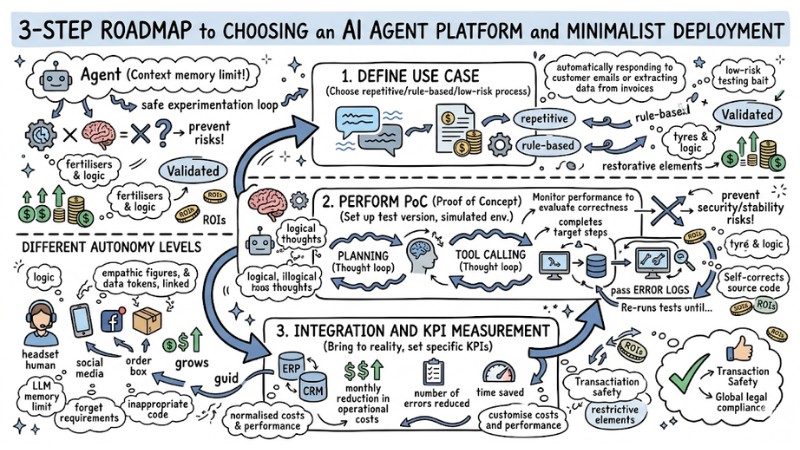
A 3-step roadmap to choosing an AI Agent platform and implementing a minimalist approach
Frequently Asked Questions When Choosing an AI Agent Platform
Will AI Agents completely replace humans?
No. AI Agents act as "smart assistants" performing repetitive tasks, allowing personnel to focus on creative work, strategic thinking, and human relationship management.
Is deploying an AI Agent expensive?
Costs are flexible depending on scale. Current SaaS (Software as a Service) solutions allow businesses to start with low costs and pay according to actual usage needs.
How is data security handled when using AI Agents?
Reputable AI Agent platforms typically comply with international security standards such as ISO 27001, SOC2, and local legal regulations, using encryption and multi-factor authentication to protect data.
How are AI Agents different from traditional chatbots?
Traditional chatbots are primarily Q&A interfaces, whereas AI Agents are capable of executing actions, interacting with systems, and automating complex processes. AI Agents have higher reasoning and autonomy capabilities.
Why should businesses deploy AI Agents?
AI Agents help optimize operations by automating repetitive tasks, significantly reducing operating costs and enhancing customer experience through personalization.
Which AI Agent platform should I choose for my business?
The choice depends on needs: Salesforce Agentforce for CRM, FPT AI Agent for the Vietnamese market, Microsoft 365 Copilot for the office ecosystem, LangChain/AutoGPT for development teams, and Zapier Central for small and medium enterprises.
How to start deploying AI Agents?
Start by defining a specific use case, performing a small-scale Proof of Concept (PoC) test, then planning system integration and tracking KPI indicators to measure effectiveness.
Read more:
- What is MCP Transport? Understanding the Transmission Mechanisms of the Model Context Protocol
- What is MCP? The Breakthrough AI Connection Standard for Enterprises
- What is Agent Swarm? How Agent Swarm Automates Workflows
AI Agents are becoming a nearly mandatory step if a business wants to survive and develop in a competitive digital environment. Instead of letting old processes slow down growth momentum, start with a small PoC project and focus on choosing the right AI Agent platform so that you soon notice a clear difference in performance and operational costs.
Tags